How Agencies Shortlist Creative Concepts with Audience Evidence
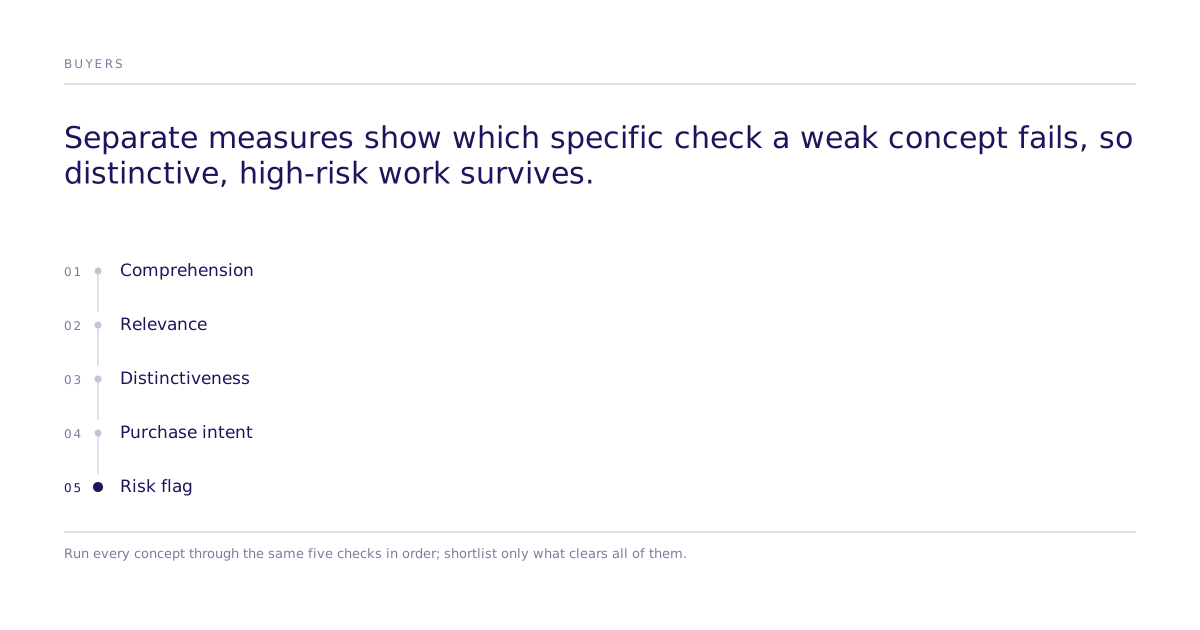
Test every concept against a defined target audience before the shortlist meeting, on separate measures rather than one blended score. The meeting then argues craft and narrative, not which of 12 to 20 concepts deserves a client's attention. The room still decides, but against evidence.
The decision: which three concepts leave the building
A creative team arrives with 12 to 20 concepts. A strategy lead has sixty minutes to cut them to 3. Advocacy decides the outcome: a few people argue hard for their favorites, and the directions that survive are the ones with the loudest defender, not the most evidence.
Two failures follow from that. Unfiltered opinion picks get killed at client review, costing re-briefs and creative hours spent on directions nobody outside the agency wanted. The opposite failure is quieter: a single composite rank drops the distinctive, high-risk concept a creative director would have fought for on craft grounds.
Structured concept testing is established practice for this stage of the work, defined as comparing alternatives against a described target audience rather than asking which one the team likes (Qualtrics, "Concept Testing: Definition, Methodology & Examples").
Four measures and one flag
Creative evaluation is subjective in the parts that matter for craft. The parts that matter for shortlisting are not.
| Measure | Question the test answers | A weak result means |
|---|---|---|
| Comprehension | Can the audience say what the brand means within 3 seconds? | The idea does not survive without the creative team in the room explaining it |
| Relevance | Does it read as made for this audience or for everyone? | Casting, context, or language does not match the buyer in the brief |
| Distinctiveness | Does it break from category convention? | The concept looks like the rest of the category and earns no attention |
| Consideration or purchase intent | Does it move the decision measure the brief is paid to move? | The concept is liked and inert |
| Risk flag | What reads as confusing, alienating, or off-brand? | There is a problem that takes a line of copy to fix now and a reshoot to fix in production |
A worked pre-shortlist sequence
The durations below are inherited planning examples from an agency workflow: a way to budget effort, not a delivery commitment or a claim about study duration.
How often should you define the target audience?
Write the target audience once for each retainer client and reuse it for every concept review. Include age range, geography, role or company size, purchase context, recent category behavior, and the attitudes the brief turns on.
A worked audience definition for a direct-to-consumer skincare client might hold 40 buyer profiles: women 28 to 45 in NYC, LA, SF, Chicago, ATL, and Miami, currently using mid-tier brands, following at least 5 beauty creators, and spending $80 to $250 per month on skincare.
Give every concept the same evidence: 30 min
An unfair comparison is worse than no comparison. Each concept gets a headline of 1 to 2 lines, a visual description or scamp, body copy of 2 to 4 lines where the format needs it, the call to action, and the channel context: print, social, TVC, or OOH.
Finished art is not required: early-stage testing reads the idea, not the production, which is why rough executions are the normal input (Cubery, "A Guide to Early-Stage Creative Testing"). One inherited planning assumption holds that a scamped concept and a finished concept return 95 percent of the same audience response. That figure is a historical benchmark from an agency workflow, not a Subconscious result. Check it against your own work.
How do you compare concepts in batches?
Present concepts in batches of 4 to 6 and ask the same questions of each: what is the brand saying, how does this land, does it feel made for me, how does it differ from typical advertising in this category, would it change what I consider, and what feels wrong. Identical questions are what make the comparison readable.
How do you sort concepts into kill, hold, and shortlist?
Tag each concept once the comparison is in front of you: a bottom 6 to kill on low comprehension, low relevance, or a live risk flag; a middle 5 to hold as sound directions needing craft work; and a top 3 to 5 to shortlist because they perform on the measures tied to the brief. The room then opens with 5 to 8 scored concepts instead of an undifferentiated stack.
Why one composite score kills the wrong concept
The concept that scores low on stated intent while scoring high on attention and distinctiveness is the breakthrough archetype. A single blended rank buries it under safe, bland work that scores acceptably everywhere.
Report the measures separately and let the creative director make the call. Evidence that a concept is polarizing argues for pushing it, not against it, and the discriminating numbers let an account lead defend that choice to a client.
Taking the evidence into the client room
The method slide should describe the work rather than assert rigor. Name the audience definition, the number of directions compared, the measures that separated the survivors, and the uncertainty around them: 18 directions tested against a defined target audience, the 3 that led on comprehension, relevance, and intent, and what distinguished them from the other 15.
Clients tend to accept 3 well-examined directions more readily than 12 unfiltered ones, provided the screening is presented as what it is: pre-shortlist triage that removes weak concepts, not final validation of the winner.
Where causal testing does the work
Subconscious runs randomized experiments that compare a defined set of concepts or actions against a defined target audience and estimate the effect of each one, with confidence intervals where the study design supports them. That maps onto the pre-shortlist problem directly: the concepts are the intervention, the audience definition is the population, and the measures above are the outcomes. Not descriptive. Not predictive. Prescriptive. The method is described on our research page.
The advantage at shortlist stage: the same causal question carries further without being rewritten. Subconscious can test or validate studies with real human participants, so a shortlist heading into a large production budget can be re-checked against real people while the question, the audience definition, and the measures stay fixed. Our engagement model covers how that sequencing works on a retainer.
What this evidence cannot settle
Be plain with the client and your team about the boundary.
- It does not predict award recognition. It compares audience response, not craft judged by a jury.
- It does not measure twenty-four-month brand health. It reads response to a concept now.
- It does not see the news cycle in the week the work runs, so cultural timing stays a human call.
- It does not decide production quality. Music, voice-over, casting direction, and finish remain craft decisions.
- Recurring failure patterns are worth watching but are hypotheses, not rules: category-convention concepts often lose on distinctiveness, clever wordplay often fails when the audience cannot restate the message in 1 sentence, a bold visual can carry weak copy, and casting that contradicts the implied customer damages relevance before production starts. Test each in your own category rather than assuming it.
Run it on one client batch
Pick the largest retainer client, write the audience definition, and run the next batch of concepts through comparison before the internal meeting. Track which concepts the client rejects and why across 2 cycles, then compare that against your record from opinion-led shortlists.
The point is not to remove creative judgment from the shortlist. It is to give that judgment something to argue with. If you want to see the experiment design applied to a live brief, book a working session.