AI Research for Advertising Agencies: Test Creative Before the Client Commits Budget
An agency pitch lands in two weeks. A campaign has to launch next month. The client wants evidence the concept will work before it commits media budget. Traditional pre-launch research may not fit that schedule, some creative decisions ship on instinct alone.
Subconscious gives an agency a way to ask the question that matters: which creative concept, tagline, or message hierarchy produces the stronger simulated stated choice among a modeled target buyer, before the agency recommends one to the client. A simulated participant's choice is not observed buyer behavior.
The research gap in agency workflows
The client briefs the campaign. The creative team develops two to four concepts. Someone proposes testing them with real consumers. The research team, or a partner research agency, scopes recruitment, methodology, timing, and cost, and the quote may exceed what the campaign has set aside. For scale, Drive Research's cost guide, dated November 2025, gives a vendor ballpark of $5,000 to $15,000+ for an online survey of 400 responses. If the proposed study exceeds the campaign's budget or schedule, the creative director's preferred concept ships instead.
That gap can leave creative decisions (taglines, visual concepts, message hierarchies, campaign themes, brand positioning) without any structured read on how the target audience responds. Nobody can tell whether the creative director's judgment was right until the campaign is already in market.
How the decision compares across methods
| Method | Budget implication | Workflow constraint | What it tells the agency |
|---|---|---|---|
| Creative instinct only | No incremental cost | Immediate | An internal opinion, not a measured buyer response |
| Traditional focus groups or surveys | Recruitment and fieldwork require a separate research budget | Fieldwork must fit before creative lock | Directional consumer reaction, if the study fits the campaign plan |
| Controlled simulated choice experiment (Subconscious) | Scoped per study | Scoped per study | An estimated effect on simulated stated choice, comparing concepts across defined buyer segments |
The third row is the option Subconscious adds: a controlled discrete-choice experiment that compares the concept alternatives directly, rather than collecting an open-ended reaction from a recruited group.
What the experiment actually measures
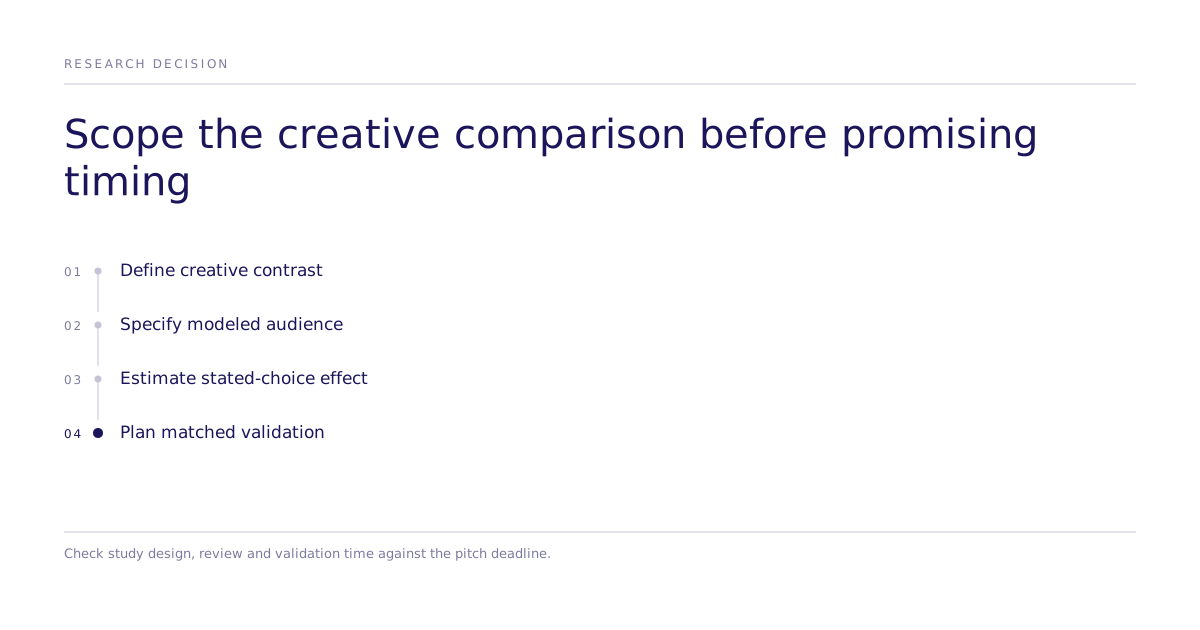
The agency defines the concepts or message alternatives to compare and the audience segments they need to hold up in market. Subconscious runs a controlled experiment across those segments and returns an estimated effect on simulated stated choice for each alternative, not a simulated persona's free-text reaction. The agency can compare which concept the modeled target buyer chooses. The outcome is a simulated stated choice at every step: in the table, in the image and in the client conversation.
The research page and the case studies describe how Subconscious structures these experiments. When the decision calls for it, the same question can be put to real human participants in a matched study. That step is not automatic. Decide whether to run it from the stakes, how well the task fits a simulated audience, and any relevant prior validation. A large production budget or a novel concept argues for it. A small, reversible choice between close variants may not need it.
Where this fits into agency work
Pitch preparation. A pitch team rarely has the research budget or runway for a traditional study. Arriving with a comparison between strategic positioning options, labeled as a simulated stated-choice result rather than in-market data, gives the client more to inspect than creative instinct alone.
Message hierarchy. Which line should lead the campaign? Comparing message alternatives head-to-head against the same defined audience gives an estimated stated-choice answer to that question, rather than commissioning a full study for each candidate line.
Multi-market adaptation. Comparing a concept across modeled market segments identifies differences in simulated stated choice. Matched human or live evidence is needed before claiming market performance or committing to market-specific adaptation.
Creative refinement. Once a broad concept is approved, the same approach can compare narrower execution choices (tone of voice, visual direction, call-to-action wording) against the client's audience.
What this does not replace
The stated-choice comparison described here estimates modeled preference. It does not establish emotional response or observed campaign performance; those claims need a study measuring the relevant endpoint. It does not replace client discovery work, moderated qualitative research with real participants, or observed in-market campaign performance. And a simulated experiment is not itself real-human validation: the audience-segment comparison and a study recruiting real participants are two different steps, and an agency should keep them distinct.
A useful next step
Pick one project already on the agency's calendar where a research decision would otherwise get skipped for budget or timeline reasons. Define the concept alternatives and the client's target segments, then compare them before the recommendation goes to the client rather than after the campaign launches. Book a decision review to scope that comparison and its timeline, or read how Subconscious works for the underlying method.