The Consumer Analyst's Staged Path From Concept Screen to Validation
A consumer analyst rarely gets to choose whether AI enters the concept-testing process. The choice that remains is which stage of that process gets a fast, exploratory read and which stage still needs a controlled experiment before fieldwork budget and stakeholder trust are on the line.
Get that staging wrong in one direction and a weak concept moves into full validation on the strength of a fluent but uncontrolled reaction. Get it wrong in the other direction and a concept never gets a causal test at all, so the team only discovers the mistake after the study is fielded and the recommendation has shipped.
The pressure is real, the job is not disappearing
What began as a novelty add-on has settled into everyday research tasks: drafting surveys, summarizing transcripts, and producing first-pass reads on a concept. That does not remove the need for the role. Federal labor projections back this up: the U.S. Bureau of Labor Statistics expects the market research analyst and marketing specialist workforce to keep expanding between 2024 and 2034.
What's at risk is something short of replacement. When the mechanical parts of the job get faster and cheaper, the analyst has to move closer to the decision itself: better questions, better evidence choices, sharper caveats, and more influence over what gets tested next. The people who only produce output become easy to substitute. The people who can say which output deserves trust do not.
Draw the line between a directional read and a causal test
An open-ended AI-assisted first pass is useful for generating hypotheses, objections, and alternative framings of a concept. It is not a substitute for a controlled experiment, and treating it as one is the mistake that makes this stage dangerous: asking a fast method to pick a winner without exposing the trade-off behind the pick.
The distinction to hold onto is between an exploratory hypothesis and a measured, comparative result. One tells you what might be true. The other tells you, within a stated population and a stated set of alternatives, which option produced the stronger effect and how confident that estimate is.
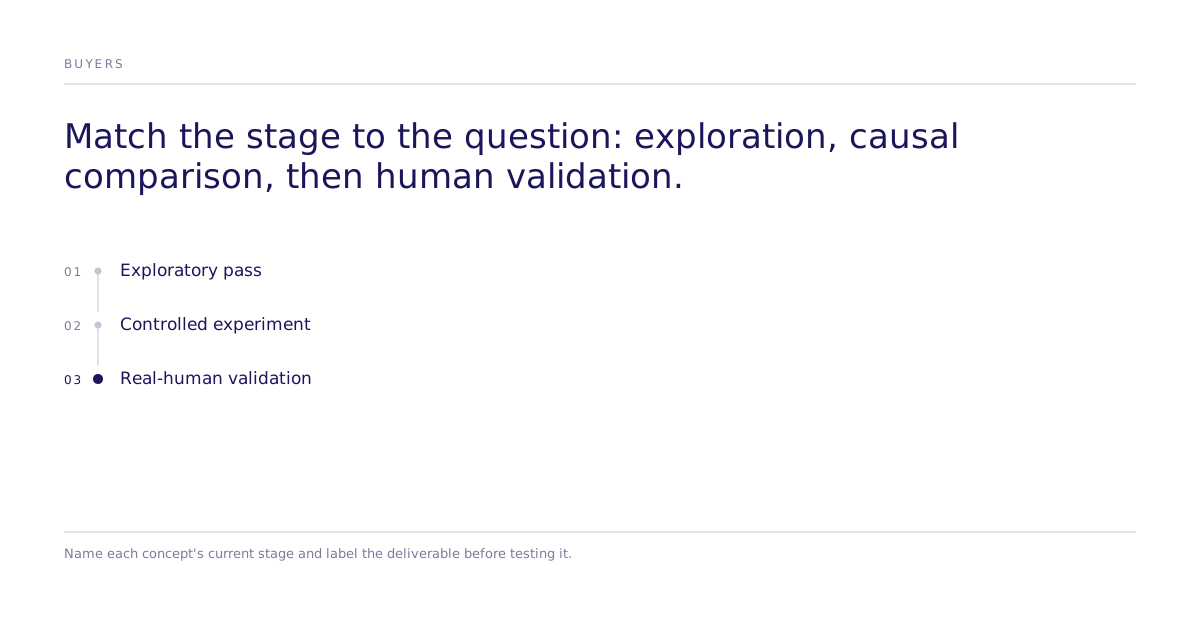
| Stage | What it answers | What it should never be presented as |
|---|---|---|
| Exploratory pass | What objections, framings, or angles exist for this concept | A validated finding |
| Controlled experiment | Which concept alternative produces a measurably stronger effect, for whom, with what confidence | A substitute for sensory, physical, or fielded human testing |
| Real-human validation | Whether the causal result holds with recruited human participants | A different question than the one already tested |
Where does a controlled experiment fit between exploration and fieldwork?
This is the stage where Subconscious is built to sit. Once an analyst has defined the concept alternatives and the population they matter to, Subconscious runs a controlled discrete-choice experiment comparing those alternatives and returns causal effects with confidence intervals, rather than a single fluent reaction to one concept at a time. That gives the analyst a disciplined middle step: still fast enough to run before committing to full fieldwork, but structured enough to produce a comparative, causal result.
When the decision is expensive or public enough to warrant it, the same causal question can move to real-human validation rather than switching to an unrelated method. See /research for how these experiments are structured and /case-studies for how that comparison has played out on specific decisions.
What does a controlled experiment not replace?
A controlled discrete-choice experiment is not a sensory test, a physical prototype evaluation, or a qualitative refinement conversation, and it does not turn into one by adding more questions. It answers a comparative causal question about a defined population; it does not tell you whether a product tastes right, feels right in hand, or survives a regulator's read of a claim. Those still need their own method.
It is also not open-ended persona chat. The output is a measured comparison across defined alternatives, not a simulated conversation with a synthetic customer. Keeping that boundary explicit in a report is what makes the caveat credible instead of decorative.
Build the staging into the deliverable, not just the workflow
The habit worth building is not "use AI," it is "label the stage." State what the exploratory pass was used for, state what the controlled experiment measured and at what confidence, and state what still requires real-human validation before anyone treats the finding as external-facing. An analyst who can explain the boundary of their own confidence reads as more rigorous, not less.
A workable first move: take three concepts a team is already debating, define the population each one has to win with, and run one as a controlled comparison instead of an open-ended exploratory pass. Compare what the causal result adds versus what the exploratory pass already told you. That single comparison does more to build the evidence system than a long list of AI tools ever will.
If a concept decision is close enough to warrant this staging, the next step is to see a working example of how a controlled experiment gets defined before it runs.