How Agencies Can Test a Client-Audience Decision
An agency should use a controlled choice experiment on a modeled audience when a recommendation depends on a defined choice for a defined client audience and fresh customer evidence is unavailable. Name the alternatives before testing. Estimate how the stated choice changes. Report uncertainty. Do not use the result for open-ended discovery or as a guarantee of market performance.
This distinction protects the client relationship. An assumption presented as evidence can lose a pitch, misdirect a paid engagement, or conflict with the client's own customer data. A simulated result presented as direct customer validation creates the same credibility risk.
Match the Evidence to the Client Question
| Client question | Best evidence | Boundary |
|---|---|---|
| What problems, language, or unmet needs should we explore? | Open-ended conversations or observation | Generates hypotheses. It does not estimate the effect of choosing one action over another. |
| What do the client's customers report or do in context? | Fresh recruited research with real participants | Provides direct human evidence. Its budget depends on the method, sample, recruitment, incentives, and analysis ([User Intuition](https://www.userintuition.ai/posts/market-research-cost/)). |
| Which defined message, position, or concept changes a target outcome? | A controlled choice experiment comparing named alternatives | Estimates a causal difference in stated choice for the specified audience and decision. It does not prove the same effect will occur in market. |
How Do You Turn a Brief Into a Testable Choice?
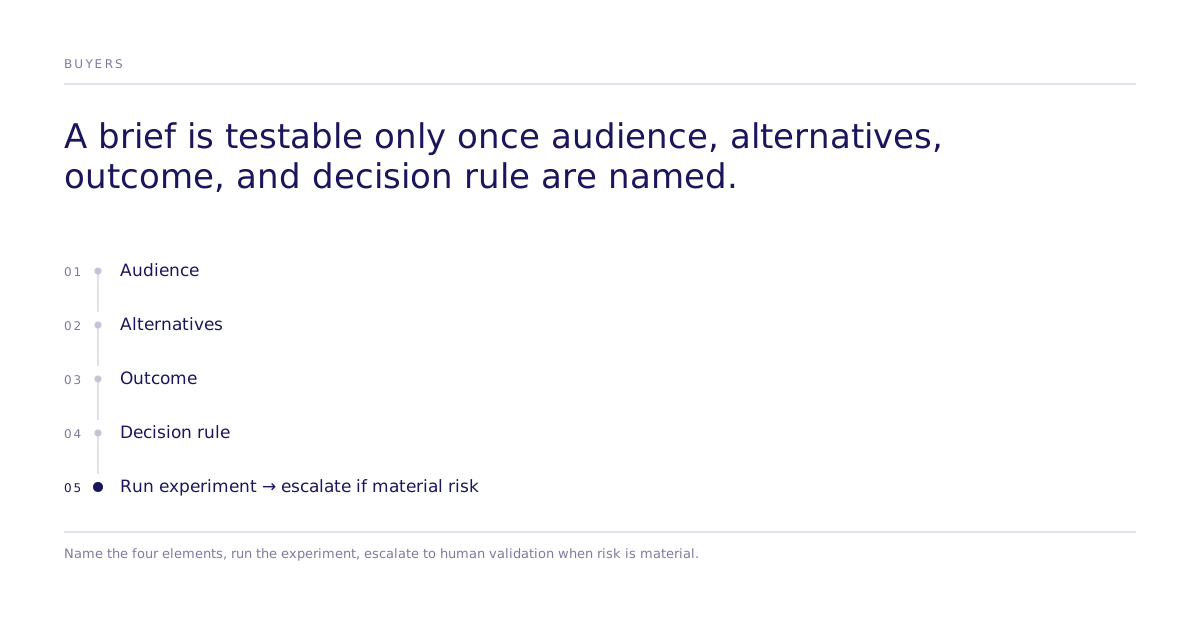
A defensible experiment begins with the decision, not a request for general audience feedback. The agency and client should agree on four elements:
- Audience: the specific buyer or market segment the recommendation concerns.
- Alternatives: the messages, positions, concepts, or actions under consideration.
- Outcome: the choice, preference, trust, or intended behavior that would change the recommendation.
- Decision rule: the evidence that would support, reject, or narrow the proposed direction.
This design makes the causal question visible and exposes weak briefs. If the team cannot name the alternatives or the outcome, the work is still in discovery.
Subconscious research uses causal experimentation and discrete-choice-style modeling to compare defined actions for a defined audience. The study estimates the difference between alternatives. When the design supports it, the result can include quantified uncertainty such as a confidence interval.
Define the client audience, alternatives and outcome before running a simulated choice study. Inspect population grounding and matched validation; use recruited participants or market evidence when the recommendation requires evidence of actual customer behavior.
What Belongs on the Slide?
The experiment earns a place in the pitch or strategy deck when the client must choose among concrete options. Useful questions:
- Which position is more likely to move the stated choice for this segment?
- Which message changes stated trust relative to the agreed alternative?
- Which concept should advance to direct customer validation?
- Does the proposed direction behave differently across defined audience segments?
The result should state what changed, what was compared, which audience was modeled, how uncertain the estimate is, and that the finding is simulated. A causal estimate supports a recommendation. It does not guarantee adoption, conversion, revenue, or any other market outcome.
When Should You Escalate the Evidence?
Current client research should anchor the recommendation when it matches the audience, decision, and market context. The controlled experiment can then test a gap or a new alternative without overriding stronger direct evidence.
A team can put the same causal question to real people in a matched human study by preserving the audience definition, alternatives, and outcome where the study design permits. State the validation question explicitly. Scope the human study, and confirm its participant source, per engagement.
Use recruited human research before action when the recommendation carries material financial, regulatory, reputational, or customer risk, and keep direct observation for questions of lived context and unmet needs that a defined comparison cannot capture.
Reject a Result That Cannot Survive These Checks
Do not present the result as client evidence if:
- the client has not accepted the audience definition;
- the alternatives do not represent the real decision;
- the outcome is a vague proxy for the behavior that matters;
- the estimate lacks enough uncertainty information for the decision;
- current customer evidence contradicts the finding and the conflict has not been investigated; or
- the deck describes a simulated result as observed customer behavior.
These are not disclosure details. They determine whether the experiment answers the client's question at all.
Start With the Decision, Not the Method
Write one sentence that names the client audience, the actions being compared, and the outcome that would change the recommendation. Then bring that sentence to a working session. The quality of the decision statement sets the ceiling on the evidence that follows. For background on the method, see how Subconscious works.