How Agencies Decide Which RFPs to Pursue, Decline, or Partner
Agencies decide by testing a draft pitch angle against modeled profiles of the prospect's buying roles, then sorting the result on two signals, angle strength and comparative standing, into pursue, rewrite, partner, or decline. A borderline RFP lands in the inbox: pursuable, not obviously winnable. The question before anyone opens a slide template: does this one earn a full pitch team, get declined, or go to a partner? Answering that late, after the deck is half built, wastes the same margin either way.
Pitching everything is a real cost
Unbilled pitch work uses staff time before an agency knows whether it will win. Duval Partnership's 2021 discussion of an Australian agency-pitch survey separates the survey's 48% average win rate from the author's experience-based 25–33% estimate. Neither is a current universal benchmark for this agency or this RFP. Use the agency's own pitch hours, costs and outcomes to judge how much effort a borderline opportunity earns.
Sort the brief before anyone opens a slide deck
Not every RFP deserves the same scrutiny. Four categories cover most of a pipeline:
- Clear win. An existing client expanding scope, or a warm relationship with an obvious fit. Proceed without extra review.
- Worth the fight. Strong category fit, a real budget, and no entrenched incumbent standing in the way. This is where sharpening the angle before the deck locks pays off most.
- Genuinely uncertain. Mixed signals on fit, an opaque buying process, or an incumbent that may or may not be dislodgeable. This group benefits from testing before committing.
- Pass. Wrong category, wrong size, no visible budget, or a brief that reads like the decision is already made. Decline quickly and move on.
Why test the angle before finishing the deck?
For the uncertain middle group, the goal is to find out whether a draft positioning angle survives contact with the prospect's decision-makers before spending real production budget on it. Subconscious can run a randomized comparison of draft angles against modeled profiles of the roles who will weigh in on the award: the primary decision-maker, the people who will use the work day to day, and whoever signs off on spend. These are modeled profiles built from the brief and public role information, not the prospect's actual decision-makers. The test needs two or more alternative angles, a fixed pitch context and an elicited outcome such as stated preference, with uncertainty attached where the study design supports it. The objections and gaps those roles raise are diagnostic responses to read next to the comparison. They are not the comparison itself.
Build the audience from what the brief and public role information show. A useful version of that lineup, drawn from a typical mid-market brief, might include two or three people who own the final decision, one or two who will work with the output directly, one person evaluating technical or legal fit, and one or two who control the budget. Treat that lineup as a starting template; every brief signals its own buying group.
Write the angle down before testing it: the reframe of the problem, the recommended approach, and roughly what the engagement looks like. Keep it to a page. Testing early finds the weak spot before it is buried in fifteen slides of production value.
How do you read the test results?
Two signals decide what happens next: whether the angle answers the prospect's real problem, and whether the agency compares favorably against the alternatives the prospect is considering. Combined, they point to one of four actions.
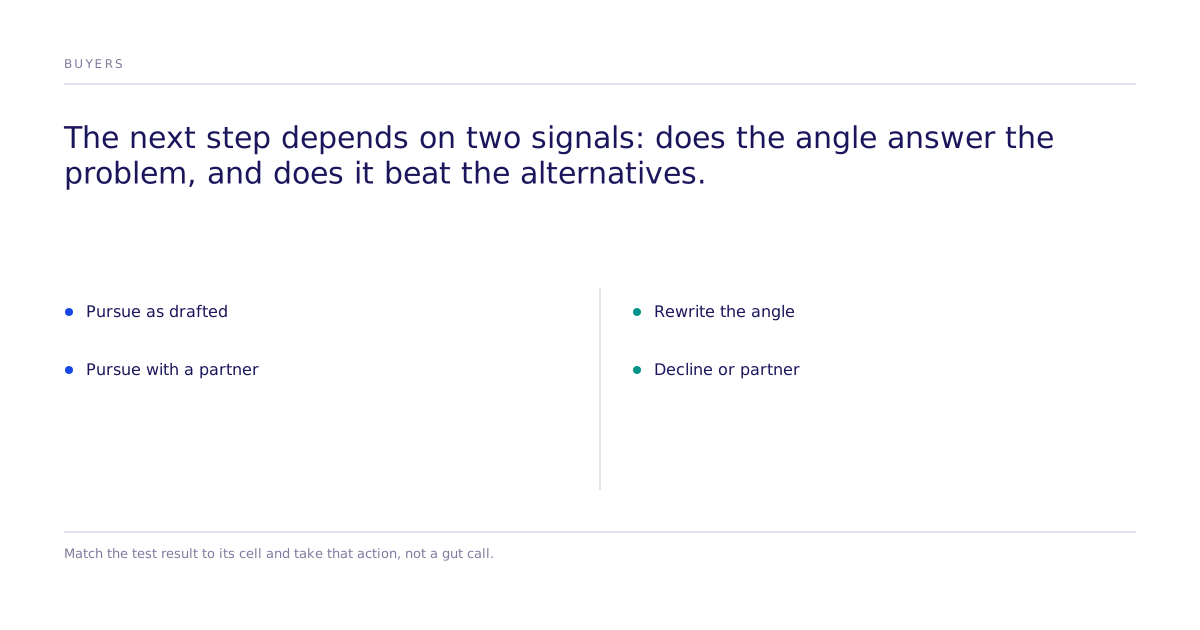
| Angle strength | Comparative standing | Next action |
|---|---|---|
| Strong | Strong | Pursue as drafted, tightening the weakest objection |
| Strong | Weak | Pursue, but close the gap with a partner |
| Weak | Strong | Rewrite the angle; the fit is right, the framing is not |
| Weak | Weak | Decline or partner |
A capability gap here is worth a second look before it becomes an automatic decline. If the missing piece is a real hole in the agency's offering, that argues for a partner or a pass. If it is a capability the agency has but buried in the pitch, the fix is a rewrite, not a walkaway.
What a structured test catches that an internal review misses
Internal pitch reviews still matter for tactics, craft, and rehearsing the room, but they carry three built-in blind spots. The internal team wants the agency to win, which makes it reluctant to voice the harshest objection. The team has already seen earlier drafts of the angle and cannot read it cold the way a prospect will. And the team has no structured way to compare the pitch against what competing agencies are likely to offer. A modeled test of the prospect's buying group has its own limits, including sensitivity to how the brief is framed, but it adds a different kind of signal than a closed-door review can produce.
For a higher-stakes RFP, a team that wants more confidence before the pitch is finalized can put the same question to a recruited group of real people in a matched human study. Scope that study, and confirm who the participants would be, before you rely on it. Recruited people who match the buying roles are still not the prospect's actual account participants (how we work).
What this does not do
This is a test of a draft angle, not an automated recommendation engine. In the proposed study, the deliverable (for example a comparison of the draft angles with its uncertainty) and the human responsibilities are scoped per engagement. Someone on the new-business team reads the result and makes the call. There is no published case result or benchmark yet showing how this workflow performs against actual pitch outcomes. And the test cannot see everything that decides an award: existing relationship strength, internal politics at the prospect, or agency-of-record history.
Where to start
Pick the next uncertain RFP in the pipeline. Draft the one-page angle, test it against the buying group before the deck is built, and treat the result as one input alongside the team's own read of the account. To scope a real brief, book a decision review and bring the draft angles, the buying roles you expect and what you already know about the account. You can also review Subconscious's published study results first.