How to Test a Pricing Tier Structure Before You Launch
A pre-launch founder must choose a pricing tier structure before committing engineering and sales motion to it, usually without enough buyer conversations to triangulate the choice. A structure that buries the sticky feature in the wrong tier or confuses buyers with too many tiers suppresses conversion and expansion for months. Re-packaging a pricing page after launch can be harder than getting it right the first time, because existing customers may resist a change to a price they have already accepted.
Separate the decisions before testing any of them
A pricing page bundles decisions that call for different evidence:
- Tier count. Two tiers, three tiers, or four tiers.
- Feature allocation. Which features sit in which tier.
- Packaging language. What each tier is called and how its value is described.
- Price points. The actual dollar or euro amounts.
| Decision | Appropriate evidence |
|---|---|
| Tier count, feature allocation, packaging | A comparison of candidate structures against a defined buyer segment |
| Price points | Include price as an attribute in a joint choice design, or use a suitable dedicated pricing study |
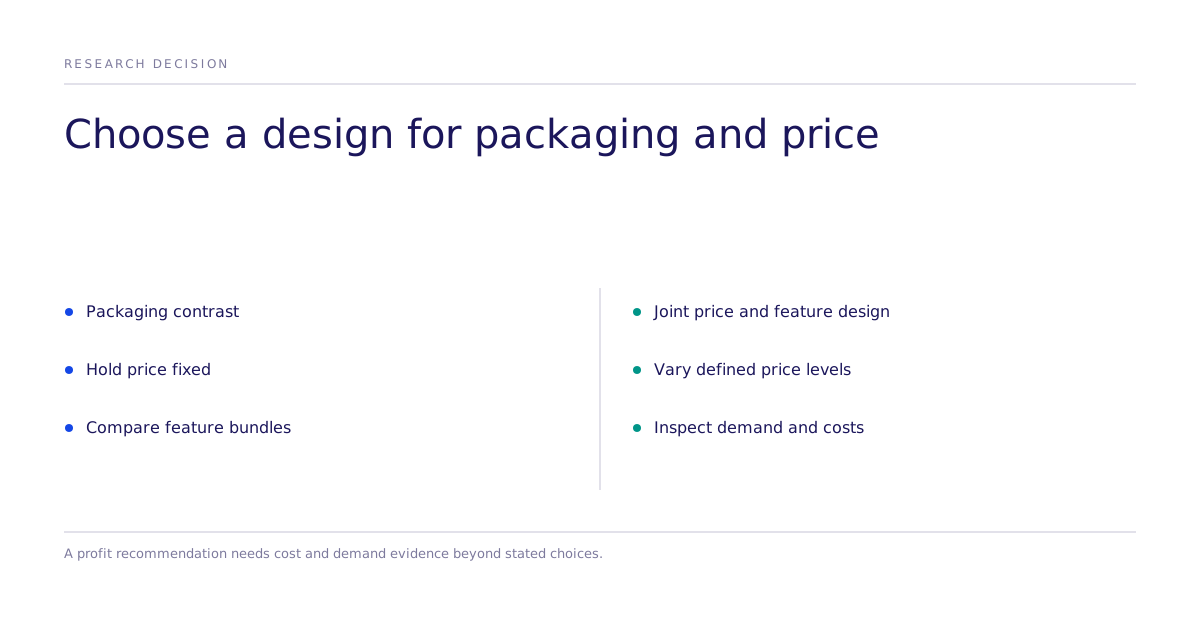
Tier count, feature allocation, and packaging are relative-preference questions: which candidate structure a defined buyer segment prefers. Price can be held constant to isolate a packaging contrast, or randomized with features in a joint design. Choose the task according to the decision and estimate uncertainty; combining price and structure does not by itself invalidate a conjoint study.
Test structure and feature allocation against a defined segment
Define the buyer segment first. Pricing research is sensitive to who answers it: the same structure can win with one segment and lose with another. Be explicit about job title and seniority, company size and stage, geography, current tooling and budget context, and buying authority. A vague segment returns consensus answers that do not predict anything.
Draft candidate structures with the same feature surface. Hold the total feature surface constant across candidates so the comparison tests structure, not scope:
| Structure | Packaging approach |
|---|---|
| Classic tiered | Starter / Pro / Team, features stack inclusively as price increases |
| Usage-based with seats | Each seat is priced individually, and every tier caps how much usage it includes |
| Per-feature module | A base plan plus paid add-ons |
| Self-serve plus sales-led | Buyers can self-serve through two published tiers, then a third tier requires talking to sales and lists no price |
Compare the structures against the segment. Subconscious can compare defined pricing structures with a modeled audience, showing the candidate structures side by side with their feature lists and price points, to see which the defined segment prefers. Look for a structure that wins clearly across the segment, or a split where one sub-segment prefers a different structure than another. A split is itself useful: it can mean the launch needs two pricing pages, or a decision about which segment to prioritize first.
Probe the winning structure. Test the feature allocation inside the leading structure directly: what happens if a feature is removed from a tier, moved up a tier, or added to the tier below it. This surfaces upgrade triggers and deal-breakers an internal pricing discussion tends to miss.
When warranted, the same question can be put to real participants in a matched human study, scoped per decision.
What does this pricing comparison not decide?
Two questions sit outside it. The first is a profit-optimal price. A structure comparison can show which candidate structure, with its price points, a segment prefers, but a stated preference is not a profit target. Each price method estimates something different:
- A choice-based conjoint that randomizes price with features estimates price sensitivity and willingness to pay for the attributes tested. Sawtooth describes it as the way to vary features and prices together, and it warns that careless respondents can inflate willingness to pay.
- The Van Westendorp Price Sensitivity Meter is a simpler survey method that asks buyers which prices feel too low or too high. It gives a range buyers find acceptable. Sawtooth considers choice-based conjoint the preferred technique for measuring price sensitivity, and treats Van Westendorp as a simpler option for some cases.
Neither method supplies a profit-optimal number by itself. Combine the preference evidence with your costs, the competitive alternatives and any observed demand before you set a profit target.
The second is enterprise contract-stage negotiation. Once a deal reaches enterprise B2B territory, procurement workflows, multi-year discount schedules, and negotiation specific to that account take over, none of which a structure-and-packaging comparison can simulate. For enterprise-tier pricing, use the comparison to settle structure and packaging, then handle deal mechanics with the actual buyer.
What should happen before the pricing page ships?
Testing tier count, feature allocation, and packaging against a defined buyer segment before the page goes live, and choosing a price method for the dollar amounts, gives a founder a structure they can defend on launch day rather than one shipped on guesswork. See the current case studies for how teams have used repeated comparisons to shape pricing, messaging, and positioning ahead of a launch. To scope your own pricing decision, book a decision review and bring the candidate structures, the buyer segment and your cost and demand data.