How to Test a Product Name Before You Commit to It
A founder naming a product before launch, fundraising, or a rebrand has three common options: pick from gut, ask a handful of friends who already like the founder, or hire a naming agency. Each can leave the question that matters open: what a buyer who has never met the founder assumes about the product the first time they read the name.
Why the name decision is expensive to get wrong
A product name appears on every URL, every contract, every pitch deck, and every customer's first impression for the life of the company. If the name misleads on category, is hard to recall, or undercuts trust in a sensitive category like finance or health, that friction repeats on every future interaction. By the time collateral, a domain, and brand equity are sunk into the name, reversing it is expensive.
Why the usual methods don't answer the buyer question
Three fallback methods dominate naming decisions, and each has a structural blind spot:
- Gut check. The founder has spent months attached to the project, which contaminates their read on how a stranger encounters the name cold.
- Friends and family. A small group that already likes the founder and wants the launch to succeed cannot hold the frame of a buyer who has never heard of the company.
- A naming agency engagement. The paid alternative. Scope and price vary, and some engagements include customer research. Ask what evidence an engagement includes. A full process may suit a team with the budget and runway for it, and may be out of reach for a one-to-three-person founding team deciding this week.
A gut check, a friends-and-family poll, and an agency package that omits buyer testing do not test what a real buyer population assumes about the product, or whether that assumption holds up under a controlled comparison against the alternatives.
What a structured comparison answers, and what it doesn't
The naming decision splits into two kinds of question, and only one of them is a research problem with a defensible answer.
| Question type | Example | Who answers it |
|---|---|---|
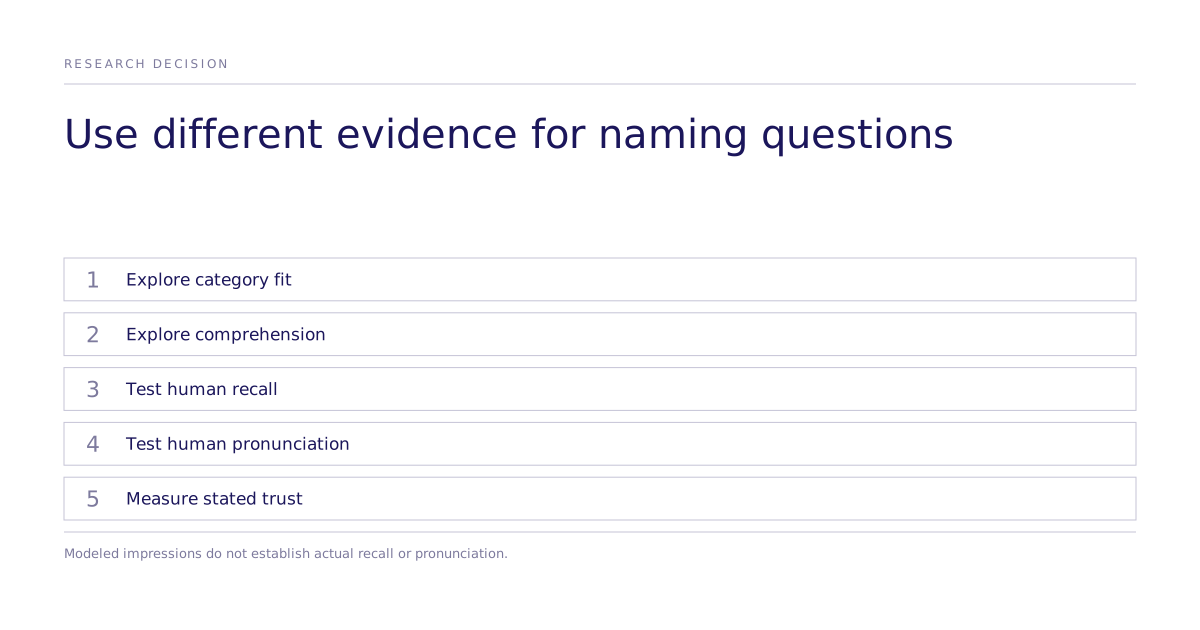
| Association and comprehension | Does the name signal the right category? What impression does it leave about the product? | An exploratory structured comparison against the target buyer population |
| Pronunciation and recall | Can people say it on the first try? Do they remember it a day later? | A human test with timed exposure, a pronunciation task and delayed recall |
| Legal and mechanical availability | Is the trademark clear? Is the domain available? Does the name read correctly in another market's language? | A trademark search, a domain registrar, native-speaker review |
Subconscious runs controlled experiments on a simulation of the market. For a naming decision, treat the output as exploratory: simulated associations and stated impressions of category fit and trust among a defined buyer population, rather than unstructured opinions from a small, biased group. Pronunciation and next-day recall are human behaviors. Test them on the shortlist with a human protocol: a timed exposure to each name, a pronunciation task, and a recall check after a delay.
The buyer questions worth asking, regardless of method
Whatever route a founder uses, five questions distinguish a name that holds up from one that doesn't:
- Reading the name cold, what product category does a buyer assume it belongs to?
- Is it easy to say out loud, without hesitation?
- Would a buyer remember it a day later?
- Does it stand apart from the closest competitor's name, or does it get confused with one?
- What does the name imply about the product before anyone reads a word of copy?
A name that wins on all five is rare; most founders optimize for the three that matter most for their category. Trust and category fit usually dominate for money, health, or sensitive data.
How do you build a candidate set for name testing?
A comparison only produces a useful answer if the candidate set spans genuinely different naming strategies, not variations on one preferred idea:
| Naming approach | How it might apply to a market research tool |
|---|---|
| Descriptive | ResearchHub, MarketLens, InsightFlow |
| Evocative | Compass, Lighthouse, Echo |
| Invented | Vexro, Kindo, Lumera |
| Myth or founder reference | Hermes, Mercator, Argus |
Populate each structure with a handful of candidates, then remove anything that collides with a major brand or is hard to spell or say out loud.
What does this naming method not replace?
A naming comparison does not substitute for checks that sit outside comprehension and recall:
- Trademark clearance. No comparison, human or synthetic, can tell a founder whether a trademark application will be rejected. That requires a trademark search or an IP attorney.
- Domain availability. Whether a domain sits parked, was grabbed by a squatter, or belongs to a running business elsewhere in the market is a registrar-level check, not a research question.
- Cultural and acoustic fit for non-English markets. A name that reads cleanly in English can trigger unintended associations elsewhere; that calls for a native-speaker review, not an English-language comparison.
A pre-launch name test does not guarantee market reception after launch, and it does not replace founder judgment on the qualitative texture a name carries beyond the dimensions tested.
Where does human validation fit in the process?
For a founder who wants both a fast comparison and a human check, the practical path is to run the controlled comparison first, then test the shortlist with real people before committing. A matched human study can put the same question to real participants: which name shifts buyer comprehension and stated trust, and by how much. Scope that study, and confirm its participant source, per decision.
A choice-based conjoint, which Sawtooth Software describes as a survey in which respondents choose among product concepts, is one design for comparing alternatives against a baseline. A survey choice task, including one run with real humans, still elicits stated preference. It is not an observed purchase, and it does not measure human next-day recall. Keep those outcomes separate in any report.
A practical sequence for the decision
- Build a candidate set spanning different naming strategies rather than variations on one idea.
- Compare the shortlist against a defined buyer population on category assumption, distinctiveness and implied promise. Questions 2 and 3 above, saying the name aloud and remembering it a day later, need real people.
- Take the top few names into a second, deeper pass that asks specifically about trust and category assumptions.
- Run trademark and domain checks on the finalists in parallel. Do not wait until after the name is chosen.
- If launching outside English-speaking markets, get a native-speaker read before committing.
No Subconscious case study covers a naming decision specifically. The relevant proof is the experiment design and validation process behind the platform, not a borrowed result from an unrelated use case.
Next step
Read how Subconscious structures causal choice experiments on the research page, see applied comparisons in the case studies, and review the workflow for standing up a study. To test a specific naming decision, book a decision review and bring the candidate names, the buyer population and the trademark and domain checks you have run.