Setting the Validation Line for Synthetic Panels
An insights leader who lets every stakeholder invent synthetic-research rules loses control of the team's evidence standard. The fix is not banning early synthetic reads. It is drawing a governance line in advance: which questions can move on a simulated read, and which must wait for a real-human check before a pricing, launch, or positioning decision spends budget or reputation on evidence that was never validated.
The pressure is real, and it points to a decision problem
Research teams face daily pressure to move faster: a stakeholder wants an answer before the researcher has finished reading the data, or a manager asks whether the first pass can run on AI. Industry analysis of synthetic data in marketing studies documents this shift toward AI-assisted exploration, alongside continued demand for research judgment.
The risk for an insights leader is not that every research task changes. It is narrower: letting a synthetic panel become either a toy nobody trusts or an ungoverned replacement for the validation a decision needs.
What the leader's job becomes
The old advantage in insights leadership was partly access: knowing how to field a study, clean the responses, and package a finding. Faster tooling weakens that advantage. More people can now draft a survey, summarize a transcript, or ask a synthetic audience for a first reaction.
That does not make the leader's judgment less valuable. It makes it more testable. Once answers are cheap to generate, the scarce skill shifts to judging which one merits trust and which one needs a real-human check before it reaches an external claim.
Draw the line before a decision needs it
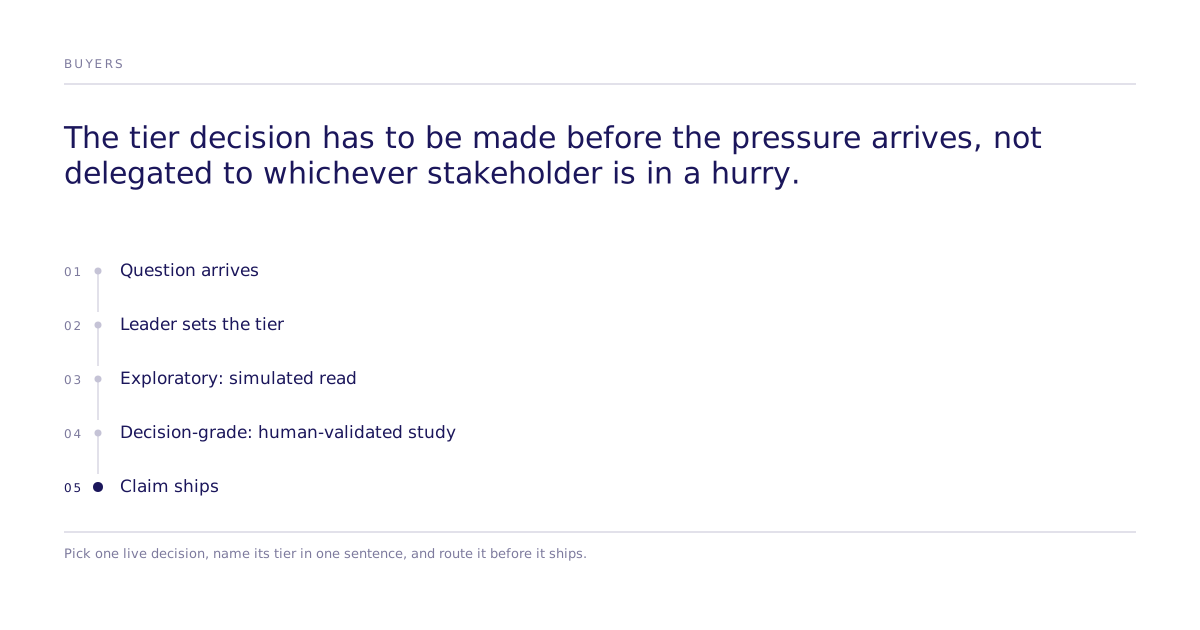
A governance line has to exist before the pressure arrives. A workable version has two tiers:
| Tier | What it's for | What clears it |
|---|---|---|
| Early / exploratory | Hypothesis generation, directional comparisons, narrowing options before a costly study | A simulated read against a defined audience and stimulus |
| Decision-grade | A pricing call, a launch decision, or any claim that will leave the building | The same causal question, tested or validated with real human participants |
Subconscious runs randomized experiments on a simulation of the market and can test or validate the same study with real human participants, so the leader decides which tier a question belongs to, not whichever stakeholder is in a hurry.
What stays the leader's call?
Three things still require human review regardless of which tier a question sits in:
- Whether the decision is expensive or public enough to require human validation before it ships.
- Whether the audience definition, prompt neutrality, and source grounding behind a simulated read are sound.
- Whether the causal question stayed the same when a study moved from a simulated read to a human check.
Moving to real human participants does not turn a causal action test into a usability session, a clinical trial, or automatic proof of market performance. It answers the same question with a different population.
What does Subconscious not replace?
Subconscious does not make that call, and it does not replace human review of audience definition, prompt neutrality, or source grounding. Those checks happen before and after every study, not instead of it.
Put one decision through the line this week
Pick one live research decision. Write down, in one sentence, which tier it belongs to and why. If it is exploratory, run the simulated read and label it as directional. If it is decision-grade, define what the human-validated study needs to confirm before the team commits to a claim.
Repeat that once for every open project for a month. The output is not a faster team. It is a documented line between what a synthetic read can support and what a decision requires. See how we work for the underlying method and case studies for examples of studies carried through to validation, or start at research.