Should You Trust a Simulated Read on an Ad-Hoc Consumer Question?
You have a backlog of ad-hoc requests, no budget for more fieldwork, and a stakeholder who wants an answer by Friday. The question is not whether a fast simulated read is possible. It is whether you can trust it enough to act on it, or you present it as settled fact and get burned when the market disagrees.
A confident directional answer, delivered under time pressure, gets treated as ground truth. If the method was never checked against real respondents for that exact question, a wrong launch, claim, or budget decision follows it back to the analyst who signed off.
What is a simulated consumer study?
A simulated consumer study runs a defined research question (a concept test, a messaging comparison, a positioning question) as a controlled experiment against a modeled population, instead of fielding human respondents for every version you want to test. You still define the target segment, the stimulus, and the comparison; only the response source changes, so you can test more variations before committing recruitment budget to the ones worth validating with real people.
It is not a shortcut around the causal question you are trying to answer. It changes the fielding step, not the analysis.
What the validation evidence actually supports
Every vendor in this space will show you a correlation number. Treat it as a claim about that vendor's setup, on that question, not a general property of "AI research" that transfers to yours. A benchmark on brand-tracker questions in one country does not tell you how a method performs on a niche B2B segment or a regulated product claim.
The academic grounding for conditioning a model on individual-level background to reproduce human response patterns comes from Argyle and colleagues, writing in the journal Political Analysis in 2023 (Cambridge University Press). Conditioning a model on a real respondent's detailed background produced opinion distributions that tracked benchmark national survey data. That result belongs to the method generally, established by its authors, not to any particular platform's accuracy claim.
To know whether a simulated read matches real behavior for your question, run the same causal question through a simulated study and a small real-human validation study, and compare. Subconscious can run controlled studies against a person-level audience graph covering 800 million real people, then test or validate the same study with real human participants, without changing the causal question. That audience graph describes the population the experiment can address, not a recruitable panel of respondents.
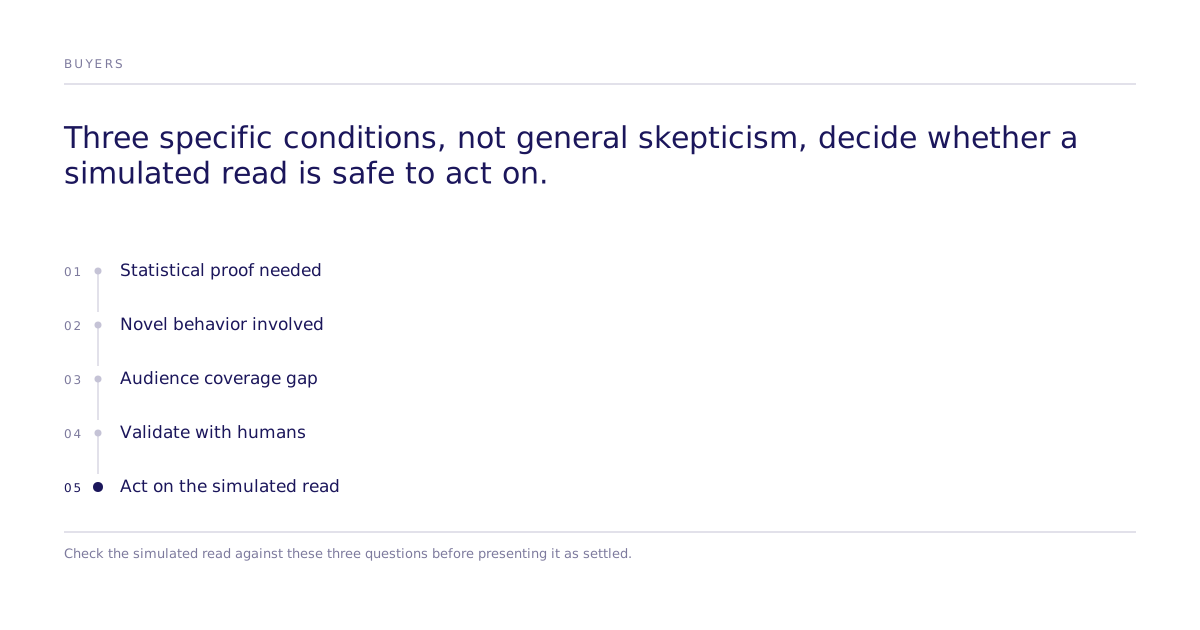
Be honest with stakeholders about where a simulated read stops being useful:
- No statistical validation. A simulated study is not built to output a population figure with a confidence interval. Proving to an auditor or regulator that exactly 34 percent hold a view still requires traditional recruited research.
- Unreliable for genuinely novel behavior. A modeled population is built on historical behavioral patterns. Launch into a category with no real-world analog, and a simulated read will lag the actual shift.
- Cultural and language coverage gaps. Public-web training data skews English-language and Western. An audience underrepresented in that data gets a more generalized, less specific read.
- No physical-world proof. A simulated respondent does not pull out a credit card, hit a shipping delay, or churn after a bad support call. Real-world behavioral data remains the standard for longitudinal tracking of real customer cohorts.
Where does a simulated-first pass fit in your existing workload?
Your trackers and ad-hoc human panels can stay as they are; a simulated read earns its place alongside them, not instead of them. Fold it in as an early, low-risk pass, and reserve human recruitment budget for decisions that carry real cost if you get them wrong:
| Research task | Traditional-only approach | Simulated-first pass |
|---|---|---|
| Concept screening | Multi-week agency recruitment and fielding for every concept | Narrow a large concept set down to the top few before committing fielding budget |
| Questionnaire pretesting | Launch a live pilot with real respondents and risk budget on a broken question | Run draft questions through a simulated pass to catch logical flaws and leading language first |
| Ad-hoc stakeholder requests | Deny the request, or answer from gut feel, because there is no budget or time | Run a directional simulated study, then decide with the stakeholder whether the stakes justify human validation |
| Segment exploration | Recruit a niche, low-incidence audience over several weeks | Explore segment hypotheses against the audience graph before deciding what is worth recruiting for |
Treat the timing and effort figures as illustrative planning examples, not a current Subconscious delivery guarantee.
A step-by-step framework for your first study
- Define the target segment. Specify age range, geography, core challenges, and behavioral traits as precisely as you can.
- Frame the causal question. State the decision the stakeholder actually needs to make, and the specific comparison (concept A vs. B, message X vs. Y) that would resolve it.
- Design the research instrument. Write the questions, prompts, or stimuli you want tested, including any visual concepts, ad creative, or product mocks.
- Run the simulated study. Submit the instrument against the modeled audience, and review the resulting distributions and qualitative reasoning together.
- Analyze for reasons, not just rankings. Look at why a concept won or lost: the language, tradeoffs, and objections, before you report a result upward.
- Validate high-stakes findings with real people. If the study informs a high-cost, final decision, use what you learned to design a smaller, targeted real-human validation study against the same causal question.
Staying credible with your stakeholders
The failure mode to avoid is presenting a simulated read as a stand-in for human feedback. The credible framing is narrower: a simulated pass lets you explore a wider space of questions and catch weak concepts and broken instruments early. It narrows what you need to validate, and tells you where to spend the budget you have.
Case studies walk through this same causal-question-first process, and a live walkthrough can run it against your own comparison.
Frequently asked questions
What is a simulated consumer study?
A controlled experiment that tests a defined causal question (a concept, a message, a positioning claim) against a modeled population instead of, or before, a fully recruited human panel.
How do I know if a simulated read is accurate enough to act on?
You do not know in the abstract. Accuracy is specific to the vendor, the question, and the population. Run the same causal question through a real-human validation study once and compare, rather than trust a general correlation figure from someone else's benchmark.
Can a simulated study replace my existing tracker studies?
No. Its best use is as a complement to trackers: a quick early pass to screen hypotheses, pretest a questionnaire, and dig into an unexpected tracker-wave shift, before you commit budget to a full human fieldwork study.
Does a simulated study require processing real people's personal data?
A modeled population does not require recruiting or storing individual respondent data, since there is no respondent to recruit. Confirm the data-handling practices of whatever platform you use before relying on this for a compliance decision.