When You Have No Co-Founder to Catch a Bad Call
A solo founder makes the pricing call, the positioning call, and the feature call alone. There is no co-founder to push back before it ships, no funded board to ask the hard question in a Tuesday meeting. The gut check a team would normally run informally never happens, so the first real test of the decision is the market itself.
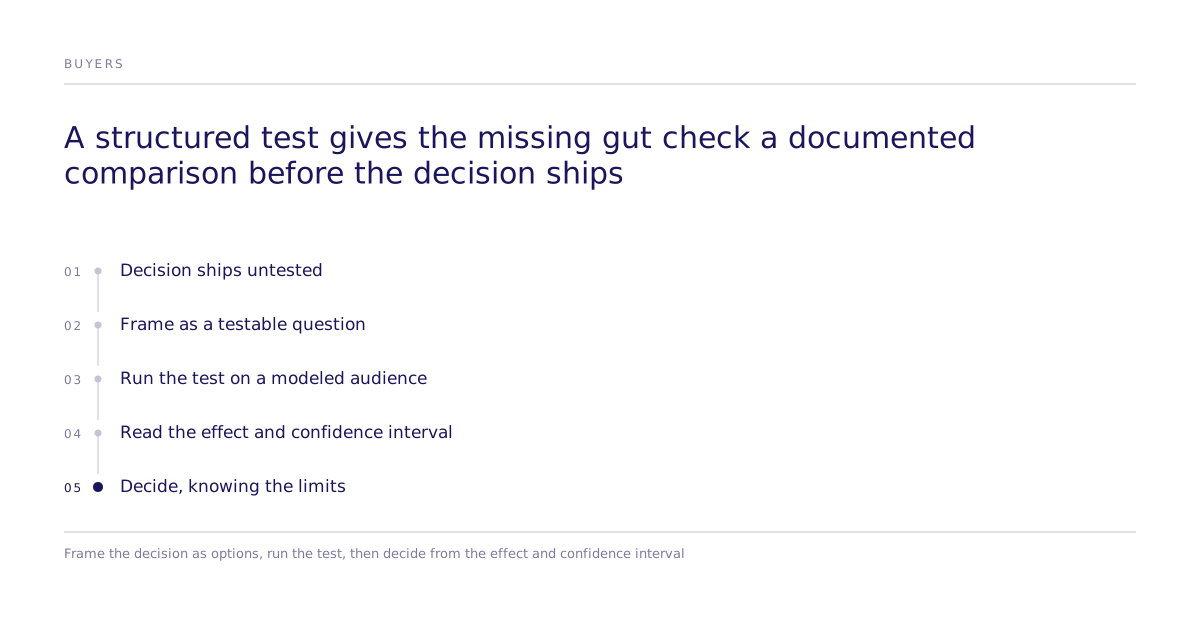
What it costs to skip the check
Hiring an advisor is one way to check a decision, but the cost depends on the scope and provider. Being a solo founder does not itself establish worse survival odds. Greenberg and Mollick's study, summarized by NYU Stern in 2018, found longer survival for solo-founded for-profit ventures in its Kickstarter-based sample of 2009 to 2015 projects; nonprofit ventures showed the reverse. That observational result does not show that a second opinion or a simulated test causes a venture to survive. The reason to test a pricing or positioning decision is the uncertainty in that decision.
| Gut call, alone | Structured test | |
|---|---|---|
| Who catches a bad assumption | No one, until customers do | A modeled audience, examined before launch |
| What you get back | One confident opinion | An estimated effect, with uncertainty |
| Cost of being wrong | Full exposure: the decision already shipped | Lower: the option is examined before commitment, within the test's limits |
What is the alternative to a co-founder's gut check?
The alternative to guessing is not a roundtable of simulated expert opinions. It is a controlled comparison of the options on the table. Subconscious builds a market simulator for business decisions using controlled causal experiments and choice modeling. Define the decision (which price, which message, which feature framing), run it as a discrete-choice-style experiment against a modeled audience, and get back an estimated effect with quantified uncertainty instead of a single confident take.
A co-founder's gut check is still a guess, informed but untested. A structured test replaces the guess with an estimate of how the modeled audience responds to each option. That estimate is a hypothesis about real buyers, not a measurement of them.
Putting a real decision through the test
Take a hypothetical case: a solo SaaS founder is deciding whether to raise price or hold, after a competitor cuts theirs. The test estimates how modeled buyers choose between the price levels. Signups and revenue are a different outcome, and they need observed data from the founder's own product. The same structure applies to a positioning pivot or a new feature bet: state the decision as a set of options, run the test, read the effect size and its confidence interval, then decide.
Can you add human participants?
When a call is big enough to warrant it, a founder can separately commission a recruited human study that uses the same price levels, message variants or feature framings. Agree recruitment, allocation and analysis ownership before fielding. A human study has its own cost and its own limits; it is a scoped project, not a setting on the simulated test.
What does a structured test not replace?
A structured test is not a stand-in for real mentor relationships or investor diligence. The founder still has to frame the decision and interpret what the estimated effect means for the business. The test estimates how a modeled audience would respond to a specific option. It does not say what the founder should do with the company.
Where to start
Framing a pricing, positioning, or feature decision as a testable question is the first step. See how Subconscious tests a decision or look at applied examples. To run a specific call through a test, book time to scope it, or read the method evidence and its limits.