Where AI Belongs in the Research Process: A Buyer's Decision Guide
A research or insights leader who folds AI-assisted methods into an existing practice faces one decision repeatedly: which stage of the process gets an AI-assisted read, and which stage still needs a fielded study with real respondents. Get that wrong and a directional exploration gets presented as validated evidence. That mistake costs the researcher's credibility: the next study they present gets read with more suspicion, not less.
Why This Decision Is Getting Harder
AI has moved from a novelty layer into daily research workflows: drafting surveys, summarizing transcripts, generating first-pass reactions to a concept. That does not eliminate the need for a researcher; it removes the advantage that used to come from access alone: knowing how to field a study, clean the data, and produce a chart. When more people can generate a plausible-sounding answer, the valuable skill becomes knowing which answer deserves trust, and why.
Compare the quote and deliverables for the actual brief. Human fielding can measure stated choices, interviews or observed behavior depending on the design; it does not automatically measure transactions. Drive Research's November 2025 cost guide gives that vendor's own budget ranges for traditional methods such as surveys and focus groups, and it does not compare them with simulation. Vendor cost guide.
The Method Boundary That Matters
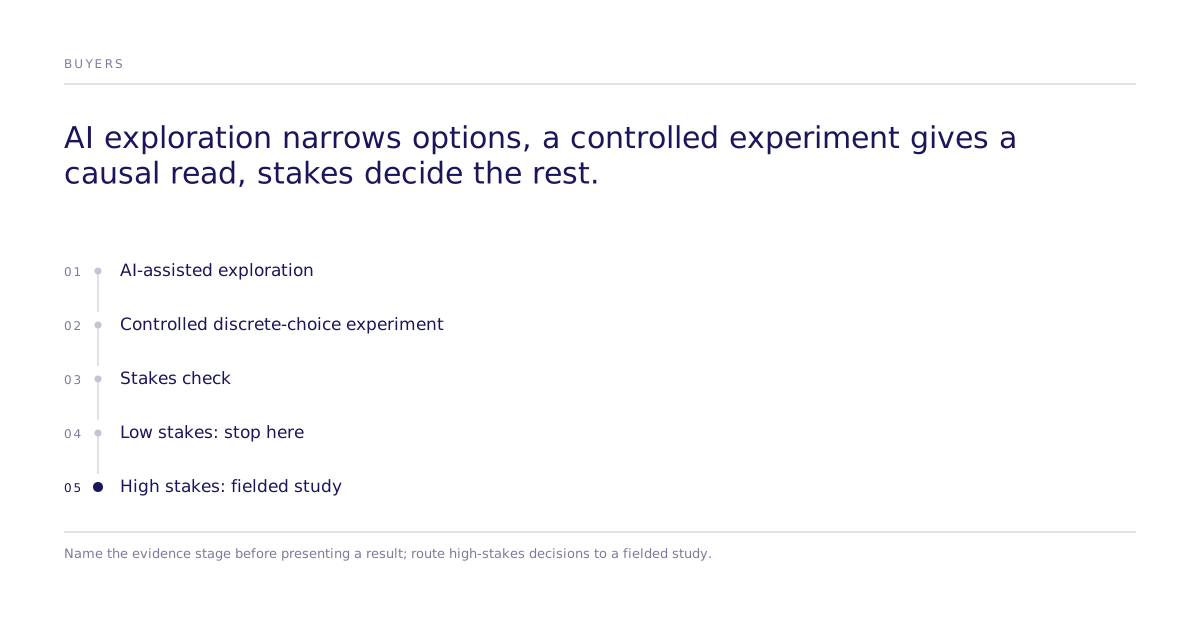
Three categories of method sit on this continuum. A research team benefits from naming which one it is using before presenting a result.
| Method | What it tests | What it can support | What it cannot support |
|---|---|---|---|
| AI-assisted exploration (hypothesis generation, transcript summarization, early concept reactions) | Generates hypotheses, objections, and alternative framings | Narrowing a wide option set before further testing | A claim that a specific concept, price, or message will move real behavior |
| Controlled discrete-choice experiment on a simulated market | Compares defined alternatives for a defined population and estimates differences in modeled choices, with uncertainty conditional on the study | A structured comparison of effects on the specified simulated response | A substitute for fielded validation when the decision is expensive, public, or regulated |
| Fielded study with real human respondents | Elicits stated choices or records observed behavior, depending on the task | Validation of a causal read before a high-stakes commitment | An unconditional guarantee that stated responses predict market outcomes |
Subconscious sits in the middle row: the controlled, causal step between open-ended AI exploration and a fielded human study. The replication leaderboard reports parameter-rank validation results and their limits.
What Causes the Mislabeling Problem?
The failure is rarely a bad tool. It is a missing label. A team under deadline pressure runs an AI-assisted exploration, gets a fluent answer, and drops it into a deck without stating what stage of evidence it represents. The fix is making the evidence stage part of the deliverable: what was tested, at what stage, and what still needs checking before an expensive commitment rides on it.
A Practical Evaluation Framework
Before running any test, a research lead can walk through four questions:
- What decision does this test inform, and what does the business do differently depending on the result?
- How expensive or public is the decision if it turns out wrong? Low-stakes, reversible decisions can stop at the controlled experiment, or at an AI-assisted exploratory read when the choice is cheap to undo. High-stakes, public, or regulated decisions need a controlled experiment, and often a fielded human study.
- What alternatives is the team actually comparing? A vague "get reactions to this idea" question produces a vague answer. A defined set of alternatives, audience, and outcome produce a testable one.
- What would change the answer? If nothing found in testing could shift the recommendation, the test was not designed to inform the decision.
Where Does Real-Human Validation Fit?
A team can separately scope a recruited-human study using comparable alternatives, population criteria and outcomes. Specify the recruitment and analysis owners before fielding. That study checks the defined choice result rather than assuming that a supplier offers automatic human validation.
Keep modeled population coverage separate from recruitable human participants. Document the actual sampling frame, coverage exclusions and validation evidence for the buyer segment; a large population claim by itself would not establish representative responses.
Limitations and Failure Conditions
A controlled experiment is not a substitute for the researcher's own judgment, the stakeholder framing around a decision, or fielded human validation when the decision is expensive or public. A recruited human study checks a causal claim; it does not turn that claim into an observed usability session, a clinical trial, or automatic proof of market performance. Keep audience-scale claims, simulated experiment results, and recruited human study results labeled separately in any deliverable that leaves the research team.
Treating an exploratory, low-cost read as if it carried the confidence of a validated study is what damages credibility when the underlying decision turns out wrong.
Where Should a Research Team Start?
Pick one active project with a real, live decision behind it. Use an AI-assisted or synthetic exploratory pass only for the discovery stage: narrowing hypotheses, not confirming an answer. Move anything supporting an expensive or public decision into a controlled, causal experiment and, where the stakes justify it, a separately scoped recruited human study. Book a working session to walk through where a specific decision falls on that continuum, or see how the platform structures a study end to end.