Which Draft Should a Founder Actually Publish?
A founder who posts in public every week is not really choosing between
"post" and "don't post." The decision happens earlier: which hook, which
angle, which framing of the same idea goes out. Get that choice
wrong often enough and the damage isn't one flat post. It's a target
audience that quietly stops reading, a candidate who only ever saw the
weakest version of the pitch, or a buyer who formed an opinion from a post
that never should have shipped.
Why does guessing get more expensive with volume?
A single bad post is a rounding error. A pattern of bad posts is a
reputation problem: slow to notice and slower to reverse. The founder
rarely learns which post caused the miss. By the time a deal stalls or a
candidate goes quiet, the post that misjudged them is long gone from the
feed.
What "testing a post" should actually mean
Reading a draft one more time before publishing doesn't tell a founder how
a CFO, a product lead, or a head of marketing will read it. Asking a single
AI assistant for an opinion returns one point of view dressed up as
feedback. Neither approach separates the audience a founder is trying to
reach from whoever happens to be watching.
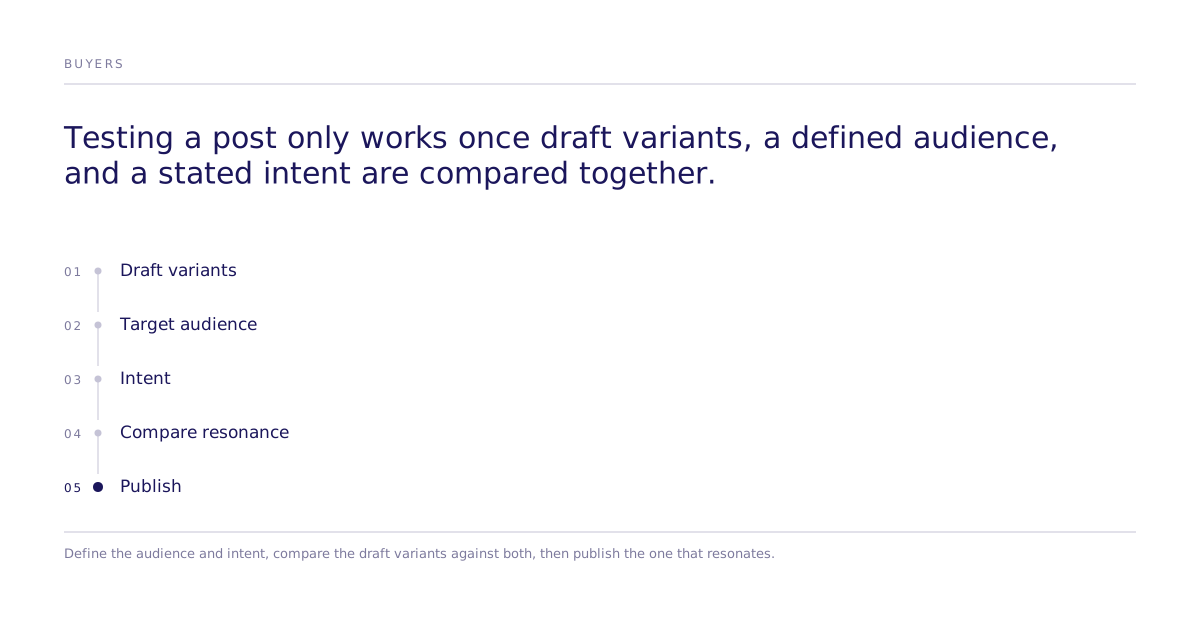
A useful test of a message variant needs three inputs, not a vibe check:
| Input | What it answers |
|---|---|
| The draft variants | Which specific wording, hook, or framing is being compared |
| The target audience | Who the post actually needs to land with, not "professionals," a defined buyer or reader segment |
| The intent | Whether the post is meant to build trust, tell a customer story, take a position, or recruit |
Without a defined audience, a test of "does this post work" returns a
generic score that flatters everything and clarifies nothing. The narrower
the audience definition, the more the comparison means something.
Testing the message, not the metric
Subconscious tests messaging and claims variants against a defined target
audience through causal experiments before a team commits to publishing,
pricing, or positioning a message, the same class of decision as choosing
which post to ship, framed around confidence and uncertainty rather than a
promise about likes or impressions.
A founder's actual question is rarely "how many people will see this." It's
"which of these messages lands with the people I need to reach." Only the
second question is answerable before a post goes out, and only as a modeled
comparison between the drafts. Raw engagement (likes, impressions, how a
specific platform's ranking system routes a post) depends on network size,
timing, and platform mechanics that a message test does not predict.
An illustrative comparison, not a promised outcome
Take a founder deciding between a numbers-led hook, a contrarian claim, and
a customer story, all making the same underlying point. A team might draft
several variants, define the specific reader they're writing for (an
early-stage operator wrestling with the transition the founder's product
addresses, say), tag the intent, and compare relevance and resonance across
that audience before choosing. The value is in forcing the comparison and
the audience definition before publishing, not in a number promising how
well any one post will perform.
The July 2026 causal-fidelity working paper, not peer reviewed, evaluates parameter-rank agreement on choice studies. It does not validate LinkedIn post performance, reach or booking lift. Those outcomes require observations or an experiment on the publication surface.
Where does this approach stop being useful?
The comparison answers one question: which message resonates better with a
defined, modeled audience. It does not tell a founder how many people will
see a post, how a platform's ranking algorithm will treat it, or whether a
post will go viral. Scope message testing for public content to that
comparison, not to a forecast of reach or engagement volume.
When a launch post or recruiting campaign carries higher stakes, a founder
can scope a recruited human study separately, using the same variants. Agree
recruitment and analysis ownership first. That is a deliberate step up in
effort, not a requirement for every weekly post.
The next post
A founder who defines the audience and compares the real candidates before
publishing replaces instinct with a documented choice, especially on posts
aimed at a specific buyer, investor, or hire rather than a general audience.
Picking the winner is the easy part once that comparison exists.
Read more on how Subconscious tests actions before a team commits to
them, see the method evidence and its limits, or
talk to the team about a specific message decision.