9 UserInterviews Alternatives for Restructuring Your 2026 Research Stack
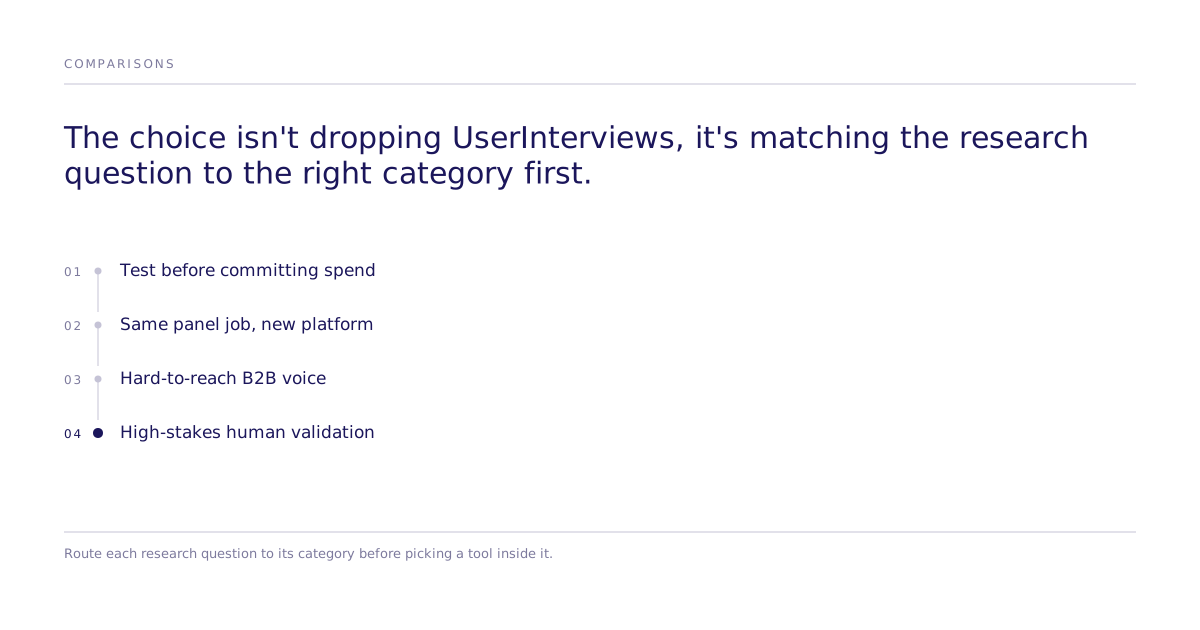
User Interviews provides participant recruitment and research operations. A team reviewing its research stack should start with the studies it needs to run. The real question isn't whether to drop it, but which category to add alongside it or substitute for it: a synthetic-first tool for iterative testing, a different recruited-human panel for the same job UserInterviews already does, or a hybrid stack that reserves recruited humans for high-stakes or hard-to-reach segments.
Get this wrong in either direction and it costs you. Treat a plausible synthetic opinion as validated evidence for a launch, price, or positioning call, and you ship on an untested assumption. Keep paying recruited-panel rates for decisions that don't actually require an individual qualitative voice, and you waste research budget.
Vendor descriptions below come from each vendor's own site, checked October 2, 2026. They describe what each vendor says it offers. They do not rank the vendors, and none of them is an independent evaluation.
Why Teams Look Beyond UserInterviews
- Speed. Obtain a recruitment feasibility estimate for the actual audience. A quick synthetic response does not establish that the audience or outcome is valid.
- Cost per participant. Compare per-session or per-participant fees against the study design and your iteration cadence.
- Coverage on niche segments. User Interviews reports a consumer panel in 34 countries and 74,000 director-plus decision-makers (User Interviews recruit page). Check availability for your own B2B segment, such as CFOs, security leads or procurement, before choosing.
- Iteration cost. Five concept variants may be tested within one appropriately allocated study. Recruitment depends on the design, segment cells and sample requirement, rather than one separate run per variant.
- International coverage. Compare country-level availability for your own segment across vendors, because panel sizes and reach differ by country.
The 9 Alternatives, With Sources
1. Subconscious, for comparing actions in a market simulation
Subconscious provides controlled comparisons on a market simulation. Define the alternatives, modeled buyer population and response before estimating differences. Keep the public validation limits visible and separately scope any recruited-human check. The platform is not a recruitable panel merely because a population is modeled.
Best for: teams deciding a launch, price, or message before they commit spend to it, not teams that need an individual's unscripted qualitative voice.
2. Respondent, a recruited participant panel
The closest like-for-like alternative to UserInterviews: a recruited, real-human panel on a different platform. Respondent describes a panel of more than 4.3 million participants in more than 150 countries, including professionals verified by role, industry and seniority and credentialed subject-matter experts.
Best for: teams that want recruited real humans, on a different panel.
3. Synthetic Users, AI participants for qualitative-style research
Synthetic Users generates interview responses from AI participants for a defined audience and returns a thematic report. It describes itself as a discovery co-pilot, not a replacement for real research.
Best for: product teams exploring a problem before a recruited study.
4. Prolific, participant recruitment for research and AI evaluation
Prolific describes a platform for collecting data from verified participants, used by researchers and by AI developers evaluating models.
Best for: teams running survey-style research with recruited participants.
5. dscout, diary and in-context research
dscout describes studies that combine product tours, deep dives and reflections across mobile and web, with a pool of verified participants. That is a different shape of study than UserInterviews' interview format, and often complementary to it rather than a substitute.
Best for: longitudinal, in-context research.
6. UserTesting, video-led testing with its own participant network
UserTesting describes video-based user testing and a network of more than 7 million authenticated participants across 34 countries, including some specialized B2B audiences.
Best for: teams that want video, a recruited panel, and a platform in one contract.
7. Evidenza, synthetic B2B decision-maker personas
Evidenza describes AI-generated customer personas, including B2B buyers it calls hard to reach. Its site names Peter Weinberg, formerly founder of the LinkedIn B2B Institute, among its co-founders.
Best for: B2B teams exploring enterprise decision-maker audiences before a recruited study.
8. Maze, prototype and usability testing
Maze describes prototype and usability testing and a participant panel of more than 6 million people, with the option to connect your own community.
Best for: PMs running prototype tests with real humans.
9. Lyssna, preference, first-click and five-second tests
Lyssna describes preference tests, first-click tests, five-second tests and surveys, with a panel of more than 690,000 verified participants.
Best for: teams that want design or copy checks with actual people.
Which Research Need Points to Which Tool
| Research need | Alternative to evaluate |
|---|---|
| Qualitative-style exploration with AI participants | Synthetic Users |
| Structured simulated comparisons, with matched human validation separately scoped | Subconscious |
| You still need a recruited human panel | Respondent |
| Survey-style research with recruited participants | Prolific |
| Longitudinal or diary research | dscout |
| Video-led usability with a built-in panel | UserTesting |
| Synthetic B2B decision-maker personas | Evidenza |
| Live prototype validation with actual users | Maze |
| Preference or first-click checks with people, not synthetics | Lyssna |
What Stack Pattern Is Showing Up in 2026?
A proposed hybrid stack uses simulation for questionnaire development or option screening and recruited people for the human evidence required by the decision. Compare the actual studies, recruitment dependencies and total cost before changing contracts. This is a design option, not a documented market-wide adoption trend or a guaranteed reduction in panel volume.
What Is Subconscious Not Positioned For In This Stack?
This comparison does not position Subconscious for 1:1 qualitative interviews, moderated video sessions, or longitudinal diary studies. It is not a replacement for a recruited-panel platform in discovery-stage research, where hearing a real person's unscripted language is the point. A separately specified human study can test comparable alternatives. Recruitment, the observed outcome and analysis ownership remain explicit requirements.
Making the Call for Your 2026 Budget
If most of your research spend is going toward individual qualitative voice, such as discovery interviews, diary studies, and moderated usability sessions, a recruited panel like Respondent, dscout, UserTesting, Lyssna, or Maze stays the right tool. If a meaningful share of that spend is going toward deciding which pricing, message, or product action to ship, that's a different question, and it's worth testing it as one. Book a decision review before you decide where the next research dollar goes.