5 Alternatives to User Interviews When Recruiting Stalls
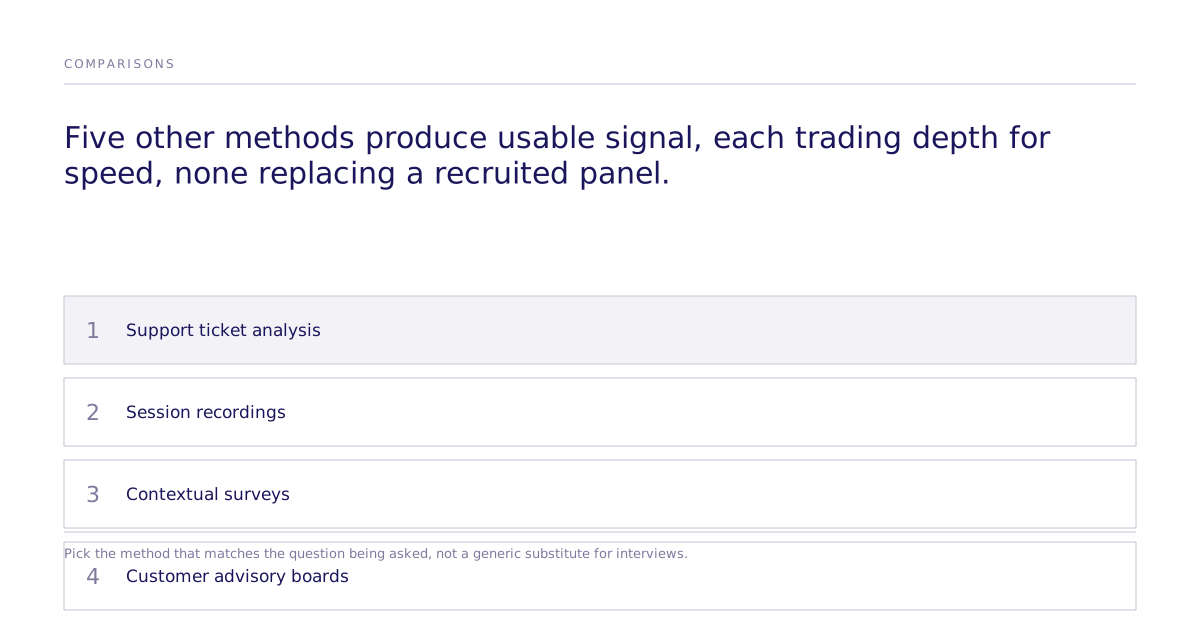
When you can't recruit enough of the right people for a full interview session, five other research methods still produce usable signal: support-ticket analysis, session recordings, contextual surveys, customer advisory boards, and simulated causal experiments. None of them replace a recruited interview panel on a high-stakes call: each trades some depth for speed, and the right choice depends on the question you're actually answering.
The Bottleneck: Why B2B Interview Recruiting Fails
Any product team running ongoing research eventually runs into one recurring obstacle: locating people who fit the profile and can actually make time to talk.
- External recruitment is expensive at small scale. A study needing 12 participants still requires sourcing, screening, and scheduling each one individually.
- Narrow segments are hard to fill. A target audience like "VPs of Engineering, B2B SaaS, 50-200 employee headcount" starts as a small global pool even before you factor in who's willing to make time.
- Your most valuable customers have the least availability. Whoever you'd most want on the call tends to be the person least likely to have an open calendar slot for a research session.
The method just has to match what recruiting can actually deliver in the time available.
Five Ways to Get Signal Without a Recruited Panel
1. What Do Support Tickets and Feature Requests Reveal?
Existing support conversations, ticket logs, and feature requests are unsolicited and contextual: customers describe problems in their own words, without a moderator in the room. It works well for surfacing pain points and ranking which bugs or feature requests matter most. It's weak on anything a customer hasn't already complained about, including new concepts or messages you haven't shipped yet.
2. What Are Session Recordings and Behavioral Analysis?
Tools like Hotjar and PostHog capture how people actually move through a product, where they click, where they hesitate, where they leave. This is best for identifying UX issues, understanding navigation patterns, and confirming whether users find and use a specific feature. It shows what happened, not why, and it can only observe features that already exist.
3. What Are Contextual Surveys?
Firing a brief survey at a precise moment in the product flow gauges satisfaction at key touchpoints and reveals why a feature does or doesn't get adopted. They're simple to trigger and easy to segment, but they depend on customers self-reporting in the moment, which limits how much reasoning a respondent will write down.
4. Customer Advisory Boards and Communities
A standing group of customers who provide continuous feedback turns one recruitment effort into a consistently reachable panel. This is well suited to ongoing feedback loops, beta testing, and relationship-building that also generates research data over time. Naming the failure mode here is what lets you plan around it. The tradeoff is that an advisory board self-selects toward engaged customers, not your full target market.
5. Simulated Causal Experiments
Rather than a single conversational persona, a simulated experiment compares defined actions, such as two messages, two concepts, or two prices, across a modeled population and reports which one moves the outcome and by how much. Subconscious runs this kind of controlled, causal comparison, and validates its simulated results against real human behavioral studies. Our best configuration reaches 87% of the measured human ceiling on one study: 0.832 rank correlation against the published human result, where two independent samples of real humans reach 0.959. Across all 43 studies that pass design filters the mean is 0.73. See the causal fidelity paper. A number without its limits is marketing. It is a validation result, not a guarantee for a new market. This method is best for concept validation, message testing, and comparing how different customer segments respond to the same stimulus, particularly for segmented B2B audiences that are hard to recruit at all. It is directional and hypothesis-generating, not a substitute for a recruited interview panel when a decision carries high financial or reputational risk.
Which Method Answers Which Question
| Method | Best for | What it can't tell you |
|---|---|---|
| Support ticket analysis | Prioritizing known pain points and bugs | Reactions to concepts customers haven't seen yet |
| Session recordings | Confirming navigation and feature usage | Why a user behaved that way |
| Contextual surveys | Measuring satisfaction at a touchpoint | Deep reasoning behind an answer |
| Customer advisory boards | Continuous feedback and beta testing | Views outside an engaged, self-selected group |
| Simulated causal experiments | Comparing message, concept, or price alternatives before a study | A stand-alone answer for a high-stakes, high-risk decision |
What Simulated Experiments Can't Tell You
Publishing the limit is what makes the method usable for a real decision. A simulated population is a modeled comparison group, not a recruitable interview panel: it cannot substitute for talking to your actual customers when the decision is expensive to get wrong. Treat it as a directional signal alongside support tickets, session recordings, contextual surveys, and advisory boards. When a decision genuinely needs recruited human interviews, such as entering a new market, a pricing change with contractual implications, or a claim that will appear in a regulated filing, recruit the interviews, even if it takes longer.
Where to Go From Here
Match the method to the question: use observation-based methods (tickets, recordings, surveys, advisory boards) to understand what's already happening, and use a simulated, causally-designed experiment to compare alternatives before you commit to a live study. See how the comparison holds up against published case studies, review how the causal experiments are built, or book time to scope a specific decision.