6 Alternatives to Focus Groups for a Concept, Message, or Pricing Decision
Focus groups carry well-documented problems: groupthink, moderator bias, small samples, and long timelines. If the concept, message, or price you're testing can't wait weeks for a room of eight strangers to agree with each other, you have options.
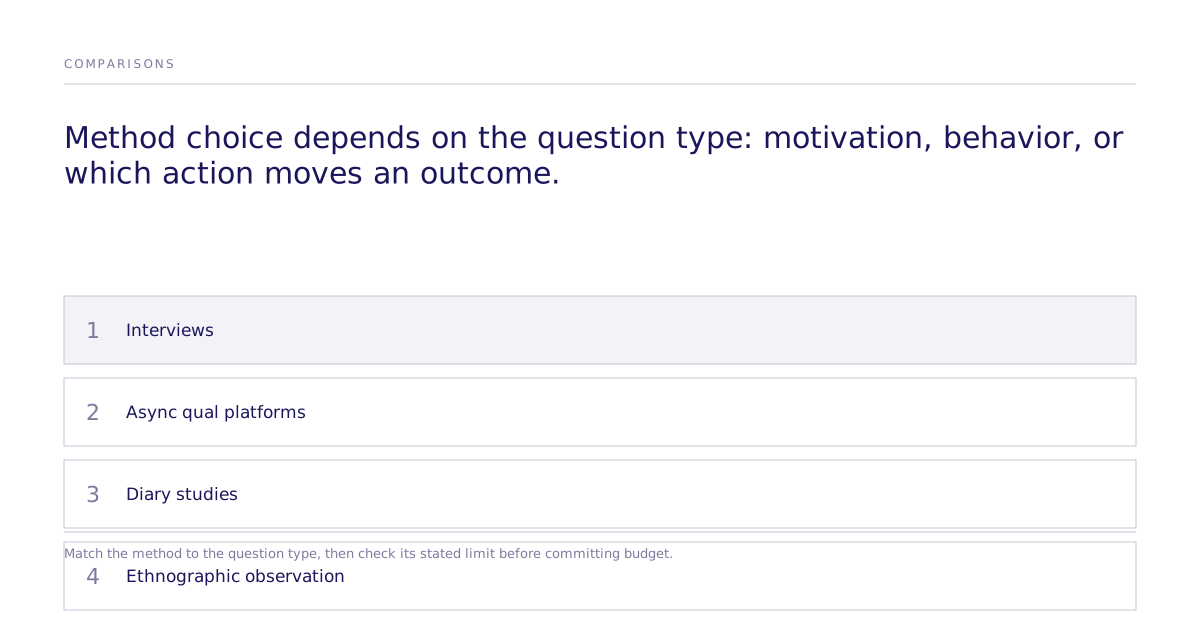
The right method depends on the decision in front of you: are you trying to understand a motivation, observe a behavior, or estimate which of several actions moves an outcome? Below are six methods, described honestly, including where each one runs out of depth.
1. Individual interviews
One-on-one conversations with target customers, usually 30 to 60 minutes, following a semi-structured guide, giving each person an individual view instead of a group-influenced one.
Interviews are strongest for exploring the "why" behind a decision: motivation, hesitation, and the mental model a buyer is using. A number without its limits is marketing. They're weakest on breadth: a typical study runs 8 to 20 interviews, and recruitment and analysis both take real calendar time.
2. Asynchronous qualitative platforms
Participants answer questions, complete tasks, or record video responses on their own schedule, often over several days, instead of in a live session. Removing the group and the clock changes what people say: fewer social-pressure answers, more considered ones.
This format fits concept testing, message testing, and lightweight longitudinal work, especially with a geographically spread audience. Publishing a method's limits is what lets a buyer check it against their own question. The trade-off is spontaneity: there's no moderator probing a half-answer in real time, so the quality of what you learn depends heavily on how well the questions were written going in.
What are diary studies?
Participants log their experiences, behaviors, or decisions over days or weeks, typically through a mobile app or written journal. Because behavior is captured in the moment rather than recalled afterward, diary studies avoid a lot of the recall bias that shows up in a single retrospective interview or survey.
Diary studies are well suited to habits, routines, and customer-journey mapping. Nielsen Norman Group's overview of the method covers why in-context logging surfaces patterns a one-time conversation misses. The misses belong on the record next to the hits. The cost is participant burden: dropout rises with study length, and the data is unstructured and slow to analyze.
"As a broad guideline, we recommend about $40 per hour of the total time commitment you expect for a study with a general sample of US-based participants."
Nielsen Norman Group, Diary Studies: Understanding Long-Term User Behavior and Experiences (source)
What is ethnographic observation?
A researcher observes people in their natural environment instead of asking them to describe their own behavior, removing most self-report bias.
It's the right call for understanding physical environments, workflows, or behaviors people can't easily narrate, common in health, retail, and industrial-design research. Naming where a method runs out is what makes the comparison usable. It's also the most expensive and least scalable option here, requires trained observers, and the findings take real interpretive work to become a product decision.
5. Simulated behavioral experiments
Instead of asking people to describe a preference, a controlled experiment on a simulated population tests two or more alternatives (messages, prices, concepts) head to head and estimates which one is more likely to move a defined outcome. This is a causal-experiment method, not a moderated conversation: the output is a comparison of actions, not a transcript.
Subconscious.ai runs this kind of experiment. Its best configuration reaches 87% of the measured human ceiling on one study: 0.832 rank correlation against the published human result, where two independent samples of real humans reach 0.959. Across all 43 studies that pass design filters the mean is 0.73 (the causal fidelity paper). It is a validation result, not a guarantee for any single new question. When a decision is regulatory, high-stakes, or emotionally complex, the same causal question can be re-run with recruited human participants: the simulated result sets the direction to test, and the human study confirms it. It can't be treated as an interview with one named, recruitable person the way a qualitative panel can.
What are micro-surveys?
Very short surveys, one to five questions, deployed in-app, post-purchase, or as a website intercept. Unlike every method above, this one is quantitative: it captures a number in the moment instead of a story recalled later.
Micro-surveys are the right tool for tracking satisfaction, monitoring NPS, or validating one specific hypothesis at scale. They give you "what," not "why": question design carries almost all the weight since there's no room to probe, and overuse trains customers to ignore the prompt.
How the six compare
| Method | Typical timeline (planning example) | Best for | Where it runs out |
|---|---|---|---|
| Individual interviews | 3–6 weeks | Understanding motivation and decision logic | Small N, slow recruitment |
| Async qualitative platforms | 1–3 weeks | Concept and message testing at a distance | Less real-time probing depth |
| Diary studies | 2–8 weeks | Watching what people actually do across weeks | Participants quit partway, and the notes are messy to code |
| Ethnographic observation | 4–12 weeks | Behavior in its real environment | Expensive, not scalable |
| Simulated behavioral experiments | Hours to a day | Comparing actions before committing budget | Estimate, not a guarantee; pair with human validation for high-stakes calls |
| Micro-surveys | Real-time, ongoing | Quantitative tracking at scale | No depth on "why" |
These timelines are historical planning ranges, not current quotes for any specific method or vendor.
Sequencing the decision
Match the method to the question, not the other way around. A motivation question needs interviews or an async qualitative platform. A behavior-over-time question needs a diary study or observation. A "which of these options performs better" question is what a simulated experiment is built to answer quickly, before a slower or more expensive method gets scoped.
Most research programs that get this right don't pick one method: they sequence them. Run a simulated experiment to narrow a wide field of concepts, messages, or prices down to the strongest candidates. Then take the finalists to individual interviews or a recruited study to confirm the result with real people before it ships. That sequence protects the research budget for the step that actually needs recruited humans, instead of spending it on options you were always going to cut.
If the decision in front of you is which message, price, or concept to run with next, see how a causal experiment is set up or book time to walk through a specific decision.