6 Aaru Alternatives for Synthetic Research and Causal Testing
Aaru’s current product-innovation page describes audience-specific simulation for adoption, switching and willingness-to-pay questions. That overlaps with product and pricing decisions rather than restricting Aaru to broad population modeling. Compare the actual brief, design and evidence before selecting a supplier. Aaru product innovation, checked October 2, 2026.
The question is which category of tool matches the decision, not which tool is biggest: a lightweight directional read, a research team's existing methodology carried over, an enterprise population simulation, or a causal experiment that returns a quantified, defensible effect. Committing to a heavy enterprise engagement for a question a lighter tool could answer wastes budget. Trusting an informal directional read for a pricing or launch decision with real financial exposure wastes the decision.
What actually distinguishes these tools
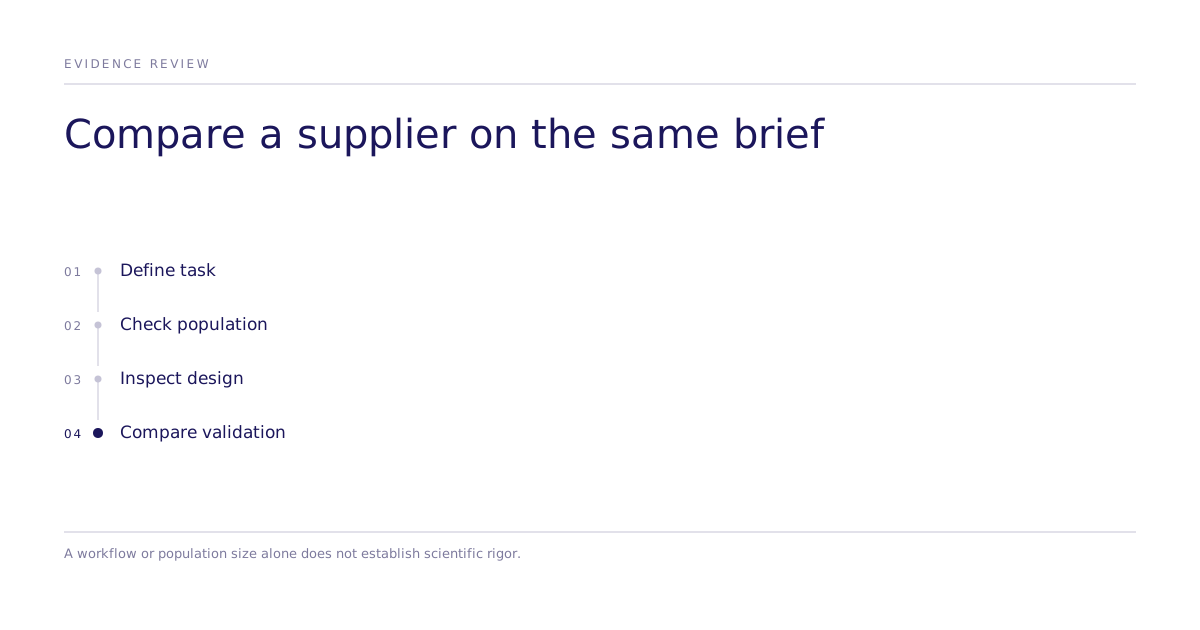
Four questions help compare the tools.
Decision and method. A tool for simulated interviews answers a different question than a platform that compares product, pricing, messaging, or GTM actions against each other.
Level of analysis. Some platforms model an entire population. Most commercial questions concern a defined buyer segment and a finite set of actions.
Self-serve or specialist-run. Some products are operated by a vendor's research team; others are self-serve. A regulated or population-scale program may need specialists; a routine pricing or messaging test may not need to start with an implementation project.
Procurement posture. GDPR, data residency, and SOC 2 status matter once a purchase moves past a pilot. Verify each requirement against a vendor's current, published evidence rather than inferring compliance from category or headquarters.
The six alternatives
1. Subconscious
Subconscious provides controlled comparisons on a market simulation. Define the alternatives, buyer segment and recorded choice; report uncertainty only as supported by the configured study. Independently check human validity for the decision. A separately scoped human study needs recruitment and analysis ownership; no population-scale coverage claim establishes that path automatically.
This comparison does not position Subconscious as a substitute for full population-scale simulation, an automated price optimizer, or a generic persona-chat product. Use uncertainty language only when the configured study supports it.
2. Highlight
Highlight describes in-home product testing run end to end, with a community of more than 60,000 pre-vetted testers. That can address sensory and usage questions a text-only hypothetical choice cannot measure. Check the actual participant criteria, product exposure and outcome for the proposed study.
3. Synthetic Users
Synthetic Users generates interview responses from AI participants for a defined audience and returns a thematic report. It describes itself as a discovery co-pilot, not a replacement for real research. It may fit teams that need a narrow interview workflow rather than population-level modeling or causal comparison.
4. SYMAR
SYMAR describes synthetic surveys, interviews, focus groups and creative evaluation, with a self-serve sign-up and a demo request. Assess the assignment protocol and matched validation for the proposed task rather than inferring scientific rigor from the workflow’s delivery format.
5. Simile
Simile describes simulations of how customers, employees or populations respond to change. Its site reports weekly validation against real humans across more than 7,000 evaluations and a 2024 result in which AI agents reproduced participant responses at 85% of human self-retest accuracy. These are vendor-reported figures. Compare Simile's method and evidence against the same population, alternatives and outcome as your brief. A vendor-reported result is not an independent replication or proof of validity for a new task.
6. Qualtrics
Qualtrics documents synthetic panels trained on survey responses, based on the U.S. general population and available in English. Confirm eligibility and audience coverage for the proposed study. Existing Qualtrics customers may value keeping surveys, feedback, and synthetic work inside one environment rather than adding a separate vendor.
At-a-glance comparison
| Tool | Best fit | Level of analysis | Operating model |
|---|---|---|---|
| Subconscious | Causal comparison between product, pricing, or GTM actions before committing capital | Defined modeled buyer segment; coverage documented for the study | Configured simulated study; human validation separately scoped |
| Highlight | Human in-home consumer product testing | Qualified human participants | Verify product logistics and fieldwork scope |
| Synthetic Users | Interviews with AI participants | Persona-level | Self-serve workflow, with demo option |
| SYMAR | Synthetic surveys, interviews, groups and creative evaluation | Defined synthetic respondents | Verify project and self-service options |
| Simile | Simulation of human decisions | Population and task defined for the study | Verify access, method and matched evidence |
| Qualtrics | Synthetic panels inside an existing experience-management deployment | Segment-level | Fits existing Qualtrics customers |
| Aaru | Product adoption, switching and willingness-to-pay simulation | Buyer audience and question | Verify delivery scope and validation |
A practical selection test
Ask three questions before evaluating a specific vendor:
- Does the decision need an answer this week or this quarter?
- Is the required evidence persona-level, segment-level, or population-level?
- Who will operate the work: a specialist research team, or the functional team making the decision?
Run the same bounded question through the finalists and compare the supported method, the level of analysis, and who has to operate it. Pick the fit, not the vendor with the broadest category claim.
For a decision that needs a quantified comparison rather than a directional read, read the method evidence and its limits and bring the brief to a decision review. A recruited human check is a separately scoped step with its own owner.