Agency Study, Synthetic Panel, or Causal Experiment: Choosing a Research Approach
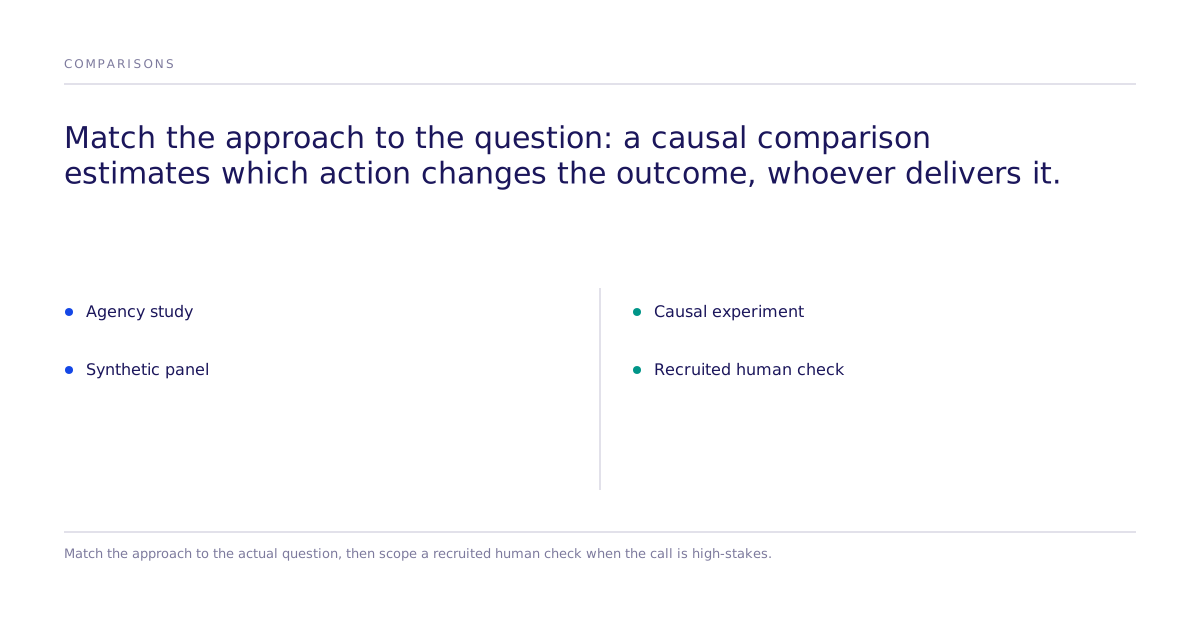
An insights or marketing leader choosing a research approach usually starts from two known models: commission a full-service research agency, or run an AI persona panel for a directional read. Both can be useful. Neither guarantees a design that compares the specific actions under consideration, so inspect the actual design for the question the team cares about: which action changes the outcome.
Committing a large agency engagement to a question that only needed a controlled test of one action can waste budget and time. Treating a directional synthetic-panel read as adequate evidence for a high-stakes brand or pricing call risks a decision the read was never designed to support.
What Is the Agency Research Model?
A global research agency runs the traditional playbook: bespoke quantitative and qualitative work fielded against real respondents, plus brand-tracking programs, segmentation, advertising-effectiveness benchmarks, and a consulting layer. Kantar, for example, describes BrandZ as a brand-equity study drawing on 4.6 million consumers, 22,392 brands, 545 categories and 54 markets (Kantar BrandZ, checked October 2, 2026).
Turnaround depends on the commissioned design, not on the type of provider. Kantar advertises PriceEvaluate pricing guidance in as little as 48 hours (Kantar PriceEvaluate). Ask each provider for scope and timing for your question.
What Is the Synthetic-Panel Model?
A newer category of tools generates AI personas from public and customer-provided data, then runs structured conversations or simulated focus-group panels against them. The output is conversational and directional: summaries, quotes, and a read on how a modeled audience might react to a concept, message, or pitch.
That model can be useful for low-stakes questions: pre-testing a campaign angle, stress-testing stakeholder messaging, or prepping for an internal pitch. The output is a plausible read against a modeled population, not a fresh, statistically fielded sample.
What the Delivery Model Does Not Tell You
Agency delivery and a synthetic response source do not determine whether a study is experimental. Agencies can offer controlled choice and message tests: Kantar PriceEvaluate, for example, uses conjoint analysis for pricing decisions. A synthetic tool may support exploratory conversations, structured studies or randomized tasks. For either approach, inspect the actual population, assignment, alternatives, endpoint and validation. An unrandomized discussion cannot isolate an action effect, while a randomized stated-choice result still needs validation before being treated as realized purchase behavior.
What Is a Controlled Causal Experiment?
Subconscious builds a market simulator for business decisions using controlled causal experiments and choice modeling. It runs controlled experiments on a market simulation to estimate how defined product, pricing, packaging, or messaging alternatives change a modeled choice. Read the method evidence and its limits.
When a decision depends on validation beyond simulation, a team can scope a recruited human study separately, using the same alternatives. Agree recruitment, allocation and analysis ownership first. That step matters most when a wrong call carries enough downside to justify checking the simulated result against human evidence before committing.
Comparing the Three Models
| Approach | Respondent basis | What it answers | Fits best when |
|---|---|---|---|
| Full-service agency study | Real respondents fielded per study, plus proprietary benchmark frameworks | Depends on the commissioned design: interviews, surveys, conjoint or controlled message tests | The decision is category-defining and warrants board-level scrutiny |
| Synthetic persona panel | AI-generated personas modeled from public and provided data | A directional read on reaction to one concept, message, or pitch | The team has low-stakes questions and needs a directional signal |
| Controlled causal experiment | Simulated population; a recruited human study is scoped separately | Which specific action changes a defined, modeled outcome, compared with the alternatives | The decision requires comparing defined actions, not just gauging reaction to one |
Where a Causal Experiment Doesn't Replace the Other Two
A causal experiment on a simulated population doesn't replace the panel networks or proprietary brand-equity frameworks an agency maintains. This page makes no claim that a simulated experiment is faster, cheaper or better than any specific vendor. A recruited human study complements it rather than being replaced by it: the simulated and human results should answer the same question.
Choose the response source and study design separately. A controlled comparison can be delivered by an agency, a panel platform or a simulation provider. The result only answers the outcome it measured in the population it tested. To scope a specific decision, book a decision review.