AI-Moderated Interviews or Causal Experiments: Which Fits Your Decision
An insights or marketing lead facing a product, pricing, or messaging decision usually has to pick between two very different tools: an AI-moderated interview platform that talks to real people, or a causal experiment platform that tests actions on a simulated market. Picking the wrong one wastes a recruitment cycle, or trades away the depth a real conversation gives you. The right choice depends on the question you're actually asking.
What decision is actually on the table
Before comparing tools, name the decision. Two questions get confused constantly:
- "What do people think, and why?" This needs open-ended human narrative: contradictions, tone, unscripted objections, the reasoning behind a preference.
- "Which specific action moves the outcome?" This needs a controlled comparison: show one group action A, another group action B, and measure the difference in a decision-relevant outcome like preference, adoption, or willingness to switch.
Choosing an interview tool when the real question is which lever to pull leaves a team with rich quotes and no quantified answer about what to do next. Choosing a causal-experiment tool when the question needs emotional nuance or open-ended discovery loses exactly the depth that format is built for. The cost isn't just the study itself; it's shipping the next decision on the wrong kind of evidence.
Two different answers to "what will people do"
AI-moderated interview platforms recruit real participants and use an AI moderator to run one-on-one conversations, then synthesize themes and quotes across the transcripts. Teams reach for this category when they want that same depth but can't put a live moderator on every session (listenlabs.ai).
Causal experiment platforms run randomized experiments on a simulation of the market instead of asking one group of real people what they think. They compare how a simulated population responds to alternative actions, such as different prices, messages, or product concepts, and estimate which action is more likely to change the outcome that matters, with uncertainty reported where the study design supports it.
Neither approach is a strict upgrade on the other. They answer different questions.
Comparing the two approaches
| AI-moderated interviews | Causal experiments on a simulated market | |
|---|---|---|
| Respondent | Real people | Simulated population |
| What it produces | Themes, quotes, and open-ended narrative | A comparison of actions and an estimate of which one moves the outcome |
| Strongest for | Discovery, emotional nuance, unscripted objections | Testing a specific action before committing budget or roadmap |
| Recruitment required | Yes, participants must be sourced and screened | No participant recruitment, but the simulated population still needs a definition and a validation record |
| Weakest for | Comparing many actions quickly across segments | Open-ended discovery of things the team didn't think to ask |
Use the table to decide which job needs doing, not to pick a category winner.
How to route the decision
- Is the question "why" or "which"? If the team needs to understand reasoning and language, start with real conversations. If the team needs to know which specific action performs better, start with a controlled comparison.
- How many alternatives are being compared? A handful of messages, prices, or concepts across several segments favors a method built for running many controlled comparisons quickly.
- What's the cost of being wrong? High-stakes, capital-committing decisions usually deserve both: a fast causal read to narrow the field, then real-human depth or validation on the finalists.
This is where a causal behavioral platform like Subconscious fits: it runs randomized experiments on a simulated population to estimate which action is likely to change a decision-specific stated choice before a team commits budget, roadmap capacity, or brand equity to it. The published fidelity evidence is on the replication leaderboard, and How it works explains the design. That is a different job than synthesizing interview transcripts.
Where does each method run out of road?
A method's limits belong on the record next to its strengths, so a buyer can weigh both before choosing. AI-moderated interviews are bound by recruitment. Every study needs real participants sourced, screened, and incentivized, and the depth that makes the format valuable also limits how many alternatives a team can practically test.
Causal experiment platforms have two limits of their own. First, a simulated population is not a substitute for the open-ended narrative, contradictions, and unscripted objections a live conversation surfaces. A simulated study estimates which action moves the outcome, not what a person means when they say something. Second, the estimate holds within the simulation. Whether it carries over to your actual customers depends on how the population was built and whether a human study on your decision agrees. For example, a simulated price test for enterprise buyers can rank three tiers confidently while real procurement teams react to contract terms the simulation never modeled.
How do you move from a fast read to a validated one?
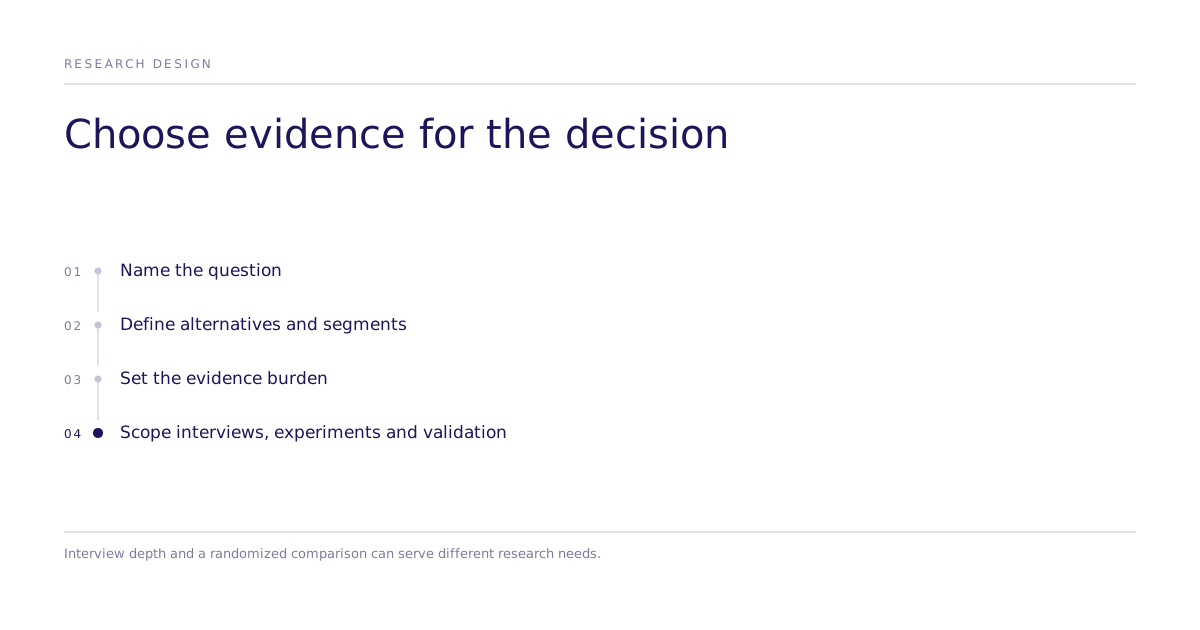
For decisions where the answer needs confirmation from real people, the practical path is to take the finalists from the simulated experiment into a human study that asks the same causal question, adapted to a real respondent sample. A real-world choice claim needs that matched human or live check. AI-moderated interviews can supply the human side for the "why", and a randomized survey or bounded live test supplies the "how much". Who recruits and fields that check, and with which instrument, is scoped in a decision review. That sequence, not a single tool, is usually the right answer for a high-stakes decision.
Adjacent questions
Can you use both in the same project? Yes. A common pattern runs a fast simulated comparison to narrow a wide set of alternatives, then follows with real-human interviews or validation on the finalists, using each method for the job it's built for.
Does a causal experiment replace qualitative research? No. It answers which action is likely to move a specific outcome. It doesn't replace the open-ended discovery and emotional nuance a real conversation surfaces.
What proof should a causal-experiment vendor be able to show? Ask what the simulated population is built from, what it covers, and what it was validated against, on a task and segment like yours. Ask for the design, the metric, the sample and the uncertainty, and ask whether the vendor's own results are peer reviewed. Subconscious's published fidelity evidence is a July 2026 working paper, not peer reviewed, that reports 0.73 mean Spearman rank correlation on estimated choice parameters across the 43 studies that passed its design filters (0.55 across roughly 300 replications) (causal fidelity paper). That is rank agreement on choice parameters. It is not an accuracy rate for your decision. Case studies show customer examples, and to scope a matched human check for your decision, book a decision review.