AI Personas vs. Buyer Personas: When to Use Each
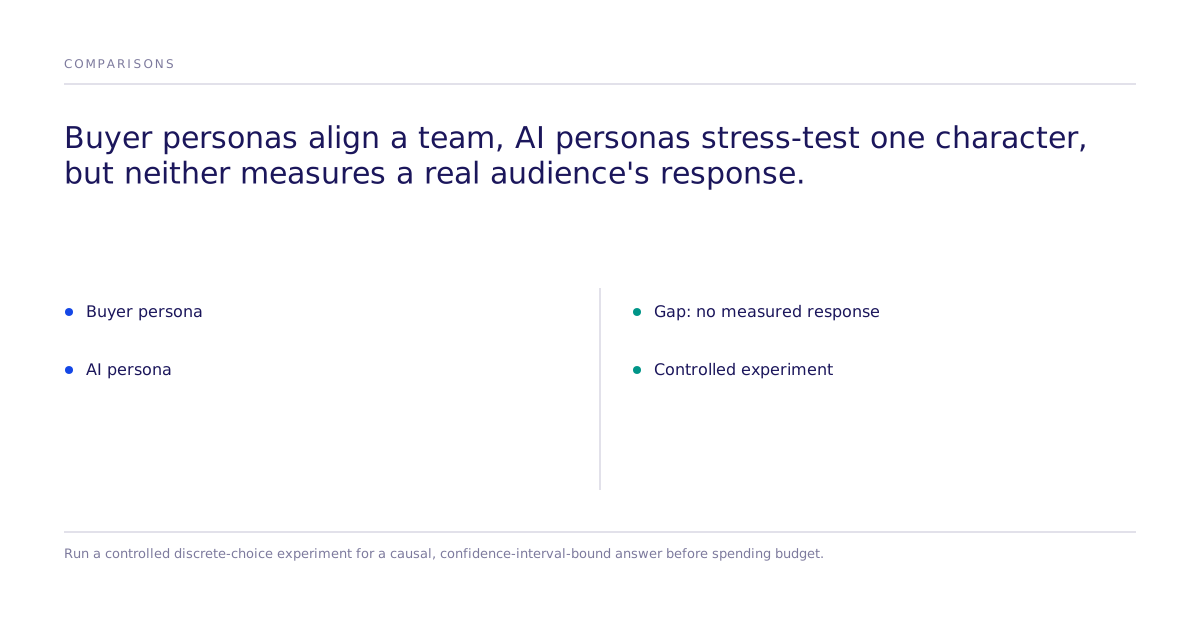
Buyer personas and AI personas both try to answer who your customer is, but neither one tells you whether a specific message, price, or feature will actually work with that customer. That gap matters most right before a launch: a marketing or insights leader has a persona deck everyone already aligns around, and must decide whether to ship the next campaign on that deck's assumptions or test it against real audience response first.
What are buyer personas?
Buyer personas sketch an ideal customer as a semi-fictional character, built from market research and existing customer records. The sketch typically notes demographics, behavior, motivations, goals, and friction points, bundled into a name and short backstory.
Buyer personas are designed for alignment. They hand a team a common vocabulary for talking about customers, so a label like "Sarah, the Enterprise Procurement Manager" stands in for a whole set of assumptions the group can point to instead of re-explaining them each time. A well-built persona sharpens marketing copy, gives sales useful context on the buyer, and helps product teams prioritize which features matter most.
A persona deck without its limits is just marketing copy. The limit: a buyer persona is static. It gets written once and sits in a deck. It cannot answer a new question or surface a reaction nobody anticipated, so a launch built entirely on it can fail in a way the team had no early warning for, after the budget is already spent.
What are AI personas?
A conversational AI persona is a model built to behave like one type of person, not describe them: define a role, context, history, beliefs, and behavioral patterns, optionally grounded in real customer data such as interviews, CRM notes, or support tickets, and the result is a character a team can question, challenge with scenarios, or pitch to.
An AI persona of this kind is built for interrogation, not alignment. It is useful when a team has a specific question and wants a quick, exploratory read from a simulated character. Naming where a tool stops is what lets a buyer check it before betting budget on it. A simulated conversation with one character, however well grounded, is still a role-play, not a controlled experiment with confidence intervals around the result.
The key differences
| Buyer persona | Conversational AI persona | |
|---|---|---|
| Format | Slide or document | Interactive conversational model |
| Use case | Aligning the team | Exploratory research |
| Updateable | Manually, rarely | Continuously |
| Can surprise you | No | Yes, within one simulated character |
| Requires data to build | Yes | Yes |
| Output | Description | Responses from a single character |
When to use buyer personas
- Bringing new hires up to speed on who the customer is
- Getting marketing, sales, and product to agree on the target customer
- Creating shared vocabulary across a large team
- Producing something shareable and presentable to stakeholders
When to use a conversational AI persona
- Quickly stress-testing an idea against one simulated character before it's ready for formal testing
- Preparing talking points for a sales meeting or investor conversation
- Drafting hypotheses about how a customer type might react, to be tested later
Can either persona type settle the decision?
Neither tool measures how a defined audience actually responds to a specific choice, and neither replaces a controlled experiment when real budget is on the line. A persona deck can't be interrogated for something it never anticipated, and a single simulated conversation can't produce a causal, confidence-interval-bound answer about how a broader audience would respond.
Subconscious.ai runs controlled discrete-choice experiments against a defined audience instead of describing or role-playing one. Where both personas stop at a plausible description, this approach tests the actual decision, message, price point, or feature choice against measured behavioral response and returns causal effects with confidence intervals (see the causal fidelity paper: 87% of the measured human ceiling on one study, mean 0.73 across the 43 studies passing design filters).
Some of that testing gets validated further with recruited real-human panels, so a team can move from a large-scale simulated read to confirmation with real respondents without changing the underlying question being asked. See how this fits into a research workflow.
Limitations
The misses belong on the page next to the hits. This is a decision-testing tool, not a persona-chat product, and it is not a substitute for the alignment work a buyer persona does inside a team. Treat audience-reach scale and recruited real-human validation as distinct claims: one describes the scale of the simulated experiment, the other a separate, smaller confirmation step with actual people.
Next step
If the team already has a persona deck and is deciding whether to ship on it, the fastest way to reduce that risk is to run the specific message, price, or feature choice as a controlled experiment before committing budget. See recent results on the case studies page, or book time to scope a test against your own audience.