AI-Simulated Focus Groups vs. Causal Testing: What Each One Proves
A research or marketing team evaluating an AI-moderated synthetic focus-group tool is usually asking one question: does a panel of AI participants describing their reaction give the team enough evidence to ship, or does the decision need a test that measures which action actually moves behavior?
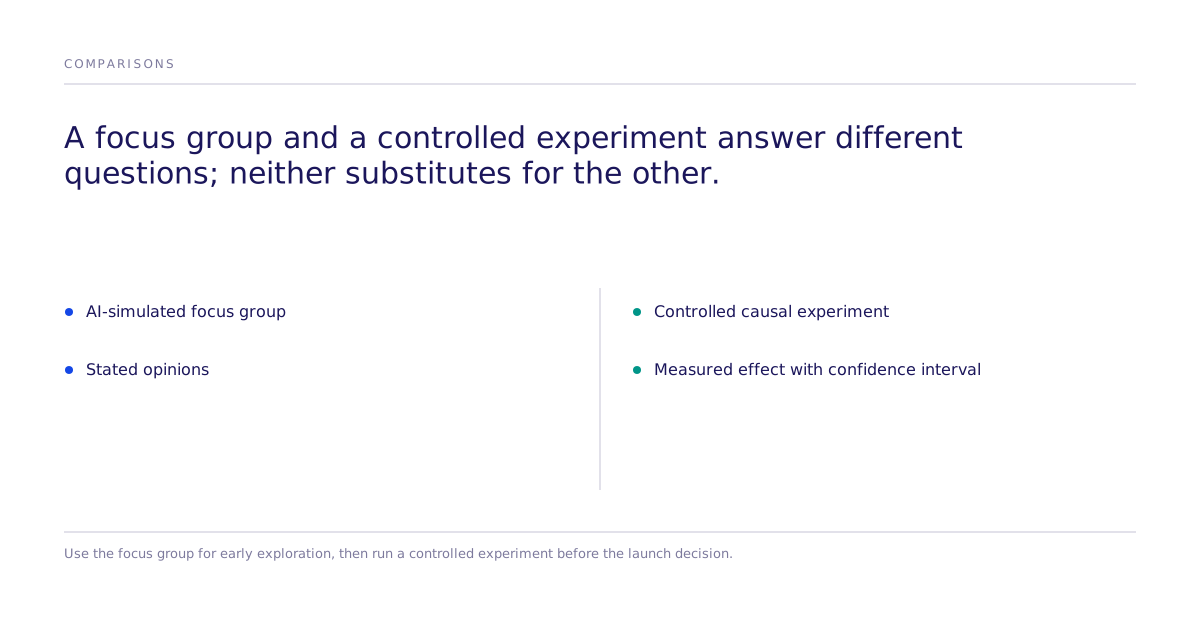
Those are different kinds of evidence, and treating one as a substitute for the other is the actual risk. A synthetic focus group collects stated opinions. It does not, on its own, measure what a market of buyers would do if that concept, price, or message shipped.
What does a synthetic focus-group tool measure?
Tools built around AI-simulated focus groups run structured sessions: an AI moderator guides AI panelists through a discussion of a research topic. OpinioAI is one example of this category, offering self-serve, moderator-led synthetic focus-group sessions aimed at researchers and product teams who already run focus groups and want a faster or lower-cost version of that same format.
That format has a real, bounded use: exploring reactions to a concept, surfacing language a team hadn't considered, and rehearsing how a group discussion might unfold before recruiting real participants. It is a qualitative, exploratory read, not a measurement of causal effect.
Where stated opinion runs out
A focus-group format, human or AI-moderated, collects what participants say about an idea. It does not isolate which specific version of a message, price, or concept changes an outcome, because no session compares outcomes across randomized alternatives. This is the same say-do gap that traditional focus groups have always carried: what a participant says they would do and what a market actually does can diverge.
Shipping a launch, price, or message because it played well in a synthetic panel discussion means acting on stated opinion where the study never tested the causal question: would this specific action outperform the alternative, and by how much.
What does a controlled experiment add?
Subconscious is a causal behavioral platform, not a focus-group tool. It runs randomized controlled experiments against a specific action, such as a message, a price, or a concept, on a simulation of the market, and reports which version changes the outcome with a quantified confidence interval, rather than a transcript of stated reactions.
That distinction matters most at the decision point a focus group can't reach: choosing between two or more concrete alternatives before spending on a launch. A study built this way can also move into real-human validation without changing the underlying causal question, testing the same action against the same design with recruited human participants instead of the simulated panel. A published number needs its limits attached or it becomes marketing. Subconscious's replication accuracy against real human outcomes is measured and published on the leaderboard: our best configuration reaches 87% of the measured human ceiling on one study (0.832 rank correlation against the published human result, where two independent samples of real humans reach 0.959). Across all 43 studies that pass design filters the mean is 0.73. See the causal fidelity paper. It is a validation result, not a guarantee for a new market.
Comparing the two approaches
| AI-simulated focus group | Controlled causal experiment | |
|---|---|---|
| What it collects | Stated opinions from AI panelists in a moderated session | A measured causal effect from a randomized comparison |
| Question answered | What does this group say about the concept? | Which specific action changes the outcome, and by how much? |
| Format | Session-based, following the traditional focus-group structure | Study-based, testing named alternatives against each other |
| Where it fits | Early-stage concept exploration, language discovery | Deciding between specific messages, prices, or concepts before launch |
| Where it falls short | Cannot isolate a causal effect or rule out a say-do gap | Overkill for open-ended, exploratory discussion |
Using both without confusing what each proves
The two are not competing for the same research budget line. A synthetic focus-group session is a reasonable way to explore a concept early and generate language. It is a weaker basis for the decision that follows: which version of that concept, message, or price should actually ship.
For a team already running AI-moderated sessions, the practical addition is not replacing that exploratory step. It's adding a controlled test before the launch decision itself, so the choice rests on a measured effect instead of how a concept played in one simulated discussion. See how Subconscious runs a study or book a walkthrough before committing budget to an untested message, price, or concept. OpinioAI's own pricing is structured around self-serve access to that focus-group format (Pricing | OpinioAI), which fits a team whose evidence need stops at the exploratory stage.
Limitations
The misses belong on the same public leaderboard as the hits. Subconscious does not run AI-moderated group discussions or produce session transcripts; that is a distinct, exploratory research format Subconscious does not claim to replace. Subconscious's person-level audience graph is a simulation infrastructure for controlled experiments, not a recruitable panel of respondents; real-human validation draws from a separate, dedicated participant pool.