Audience-Data Activation vs. Open-Ended AI Exploration: Where Causal Testing Fits
Teams comparing tools for understanding US buyers usually land on two very different categories, and neither one answers the question that actually determines spend: which specific action, a message, a price, a product change, moves the outcome.
Two categories, one missing step
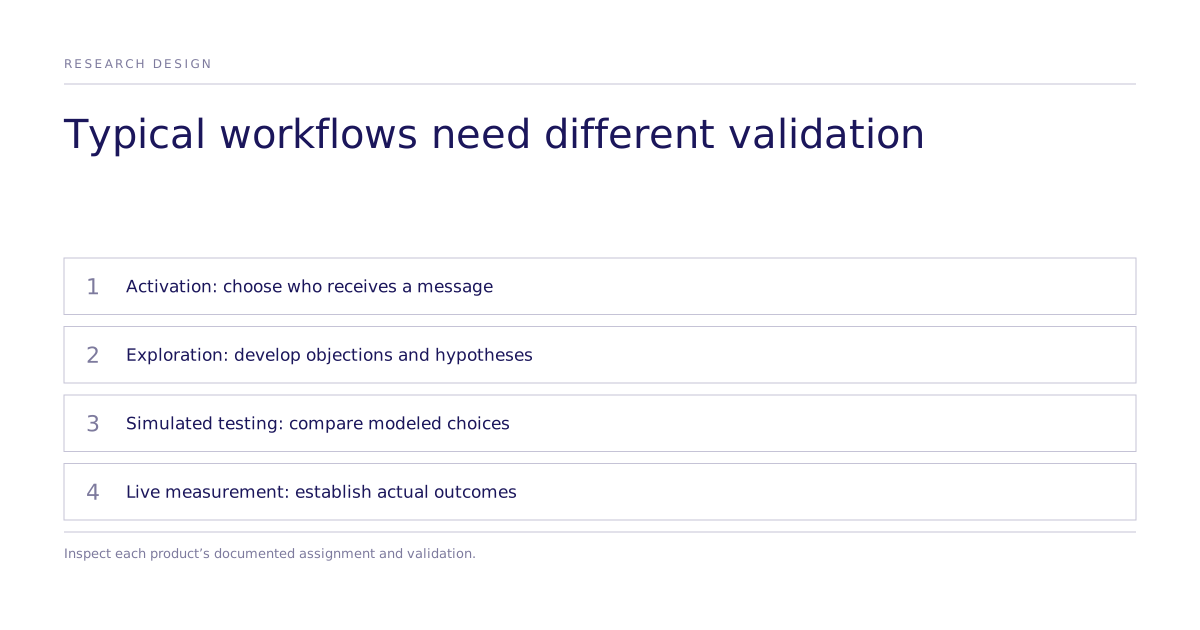
The first category is predictive audience-data infrastructure: platforms built around a large identity graph and per-person attribute data, used to build, enrich, and activate marketing segments at scale. The second is open-ended AI exploration tooling, built for fast, conversational back-and-forth with simulated consumer voices to surface language, objections, and early reactions before a team commits to bigger research or spend.
Both are useful for what they do. These are descriptions of the typical workflow in each category, not claims about every product in it, and some vendors add testing features. Compare the specific workflow you are buying: does it randomly assign alternatives, what outcome does it measure, and how was it validated? In the usual workflow, audience-data platforms tell a team who to target once a message is chosen, and exploration tooling tells a team what a simulated conversation partner says about a concept. Treating either output as proof of what a decision will do is where budget gets wasted. Activating a large segment against an unvalidated message spends media money at scale on something never tested against a holdout. Treating open-ended exploratory chatter as validated direction risks shipping a positioning or product call never checked against a randomized comparison.
What are audience-data activation platforms built for?
This category's strength is scale and reach: a very large identity graph connecting consumer profiles to granular per-person attributes, used to define, enrich, and activate marketing segments across digital channels, plus measurement tooling to track campaign performance afterward. It fits once a team already knows which message or offer it wants to put in front of which audience and needs to find and reach that audience at scale.
Segmentation describes an audience. Activation can deliver a treatment while a decision is still being evaluated, including a documented treatment/holdout comparison. Segmentation or activation without an outcome comparison does not establish which message, price or product change should win. Inspect the actual testing protocol.
What are open-ended AI exploration tools built for?
This category runs fast, conversational sessions with simulated consumer voices, including one-to-one interviews, surveys, or multi-voice group formats, to surface language, objections, and directional reactions before a team commits to larger research. That speed is genuinely useful early: it can shape the questions a later study should ask, or surface an objection a team hadn't considered.
A conversational session on its own does not estimate a causal effect. A simulated conversation can produce plausible-sounding opinion, but that is not the same as an estimate of which action moved an outcome, with uncertainty attached. Recent method work on language-model-based consumer response shows that even a technique built specifically to approximate human purchase intent depends on a specified elicitation method, not on open-ended conversational output alone. Maier and colleagues tested their Semantic Similarity Rating method on 57 personal-care product surveys with 9,300 human participants (LLMs Reproduce Human Purchase Intent via Semantic Similarity Elicitation of Likert Ratings, arXiv, October 2025). The result covers that task and category. Directional exploration and an estimated effect are different claims, and a buyer deciding where to spend needs to know which one they are getting.
"SSR achieves 90% of human test-retest reliability while maintaining realistic response distributions (KS similarity > 0.85)"
Maier and colleagues, arXiv preprint 2510.08338 (source)
Where a controlled causal test fits instead
Subconscious is a causal behavioral platform. It runs randomized experiments on a simulated population and estimates which specific action, a message, a price point, a product change, moves a defined simulated stated-choice outcome, with uncertainty where the design supports it. That sits upstream of audience activation and is a different kind of tool than open-ended exploration: a randomized experiment that produces an estimate a team can examine before acting.
| Question a buyer is answering | Audience-data activation | Open-ended AI exploration | Randomized simulated testing |
|---|---|---|---|
| Which audience should we target with a message we've already chosen? | Typical use | Not the focus | Not the focus |
| What objections or language should we expect before we commit to a study? | Not the focus | Typical use | Not the focus |
| Which message, price, or product version moves the outcome in the modeled population? | Check the specific product for randomized testing | Check the specific product for randomized testing | Typical use |
| How can the answer be checked before a decision ships? | Run a holdout or incrementality test on the activated audience | Follow up with real respondents on the objections found | Matched human survey on the finalists, or a bounded live test |
The one place these categories agree: none of them replace real people
Audience-data activation, exploration tooling, and randomized simulated testing are all inputs to human research or live measurement, not a substitute for it, though each can be checked against people in a different way. An activation team checks a message with a live holdout. An exploration team follows up with real respondents. A simulated study is checked with a matched human survey on the finalists, using the same attributes and levels and a sample like the intended audience, planned before results arrive. A simulated result then supports a claim about stated choice, and a real-outcome claim needs live measurement. That check is not needed for every routine question, but it matters whenever the decision is large or novel enough that the cost of being wrong is high. Who recruits and fields it is scoped per engagement in a decision review.
What does Subconscious not do?
The Subconscious experiment described here compares defined actions on simulated stated choice. It needs a specified audience and endpoint. A claim about an actual campaign needs measured exposure and outcomes, with a defensible comparison. Scope activation, audience enrichment and exploratory work separately, and request documentation for any required integrations.
Before the next dollar goes to activation or exploration
If the question is "who do we target with the message we've already picked," audience-data activation is the right category. If the question is "what objections might come up before we invest in a bigger study," exploration tooling can move fast. If the question is "which message, price, or product version actually moves the outcome we care about," that is a causal test, not a segmentation or conversation problem. See how a randomized study is designed before committing the budget, read the published case studies, or book a decision review and bring one message or price decision.