Audience Research Tools Compared: Query, Conversation, or Causal Experiment
A research, product, or market leader should choose an audience-research tool by the decision it must support. Use a query tool for population-level measurement. Use a conversation tool to explore reasons and objections. Use a controlled causal experiment when the consequential question is which action will change behavior. The wrong instrument can produce a confident answer that does not justify the budget or roadmap choice.
Start with the evidence job
Interface is a poor way to compare research tools. A chart, a chat window, and an experiment can all look persuasive while answering different questions.
Aaru's simulation page, read on 2 October 2026, describes starting from a decision, choosing the populations that can affect it, and writing questions that test each option. It reports results by audience with cross-tabs, and it says Aaru validates against real-world outcomes and not only surveys. It cites a median Spearman correlation of 0.90 against the EY Global Wealth Study of 3,600 affluent investors in 30 or more markets, which is the vendor's stated result for that study. So Aaru is not only a query tool, and a query-style interface does not tell you whether a vendor's design supports an intervention comparison. Compare the study design, the validated task and the uncertainty for the decision you have. Synthetic Users presents its product as a generated user-research platform (Synthetic Users), which is a conversation-style category.
The category this article calls a controlled experiment begins with an action. It compares defined alternatives on the same target population and estimates which alternative moves a specified outcome. Products in the other categories may offer this too, so ask each vendor how alternatives are assigned and what is measured.
Three instruments answer three questions
| Evidence job | Query or predictive tool | Conversation tool | Controlled causal experiment |
|---|---|---|---|
| Primary question | How many, how much, or how does a segment differ? | Why might a buyer hesitate, and what language explains the hesitation? | Which action changes the defined behavioral outcome? |
| Typical output | Aggregated measures, segment splits, and trends | Open-ended reasoning and follow-up responses | A comparison of alternatives, an estimated effect, and uncertainty where the study supports it |
| Best fit | Ongoing measurement and reporting | Early exploration and hypothesis formation | A bounded product, pricing, message, or go-to-market decision |
| Evidence boundary | Association does not identify the intervention that produced a change | A plausible explanation does not prove a future choice | The result applies to the tested population, alternatives, outcome, and assumptions |
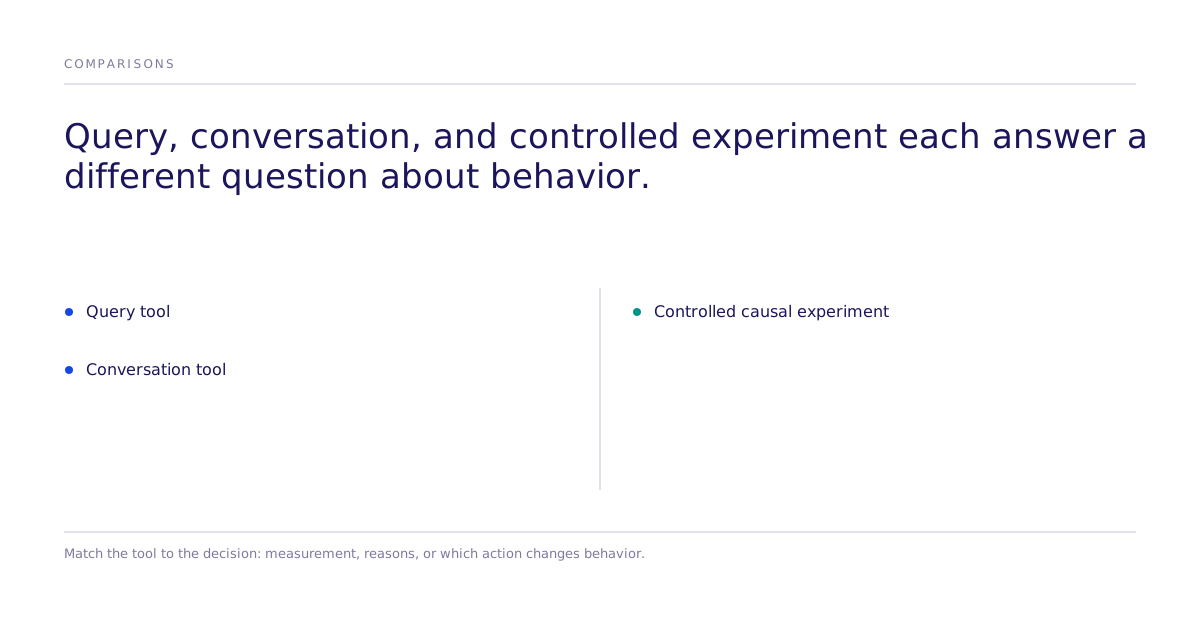
These instruments can complement one another. Conversation can reveal objections worth testing. A query can identify a segment or market pattern. A controlled experiment can then compare the actions a team might take. The methods become dangerous only when one output is used to make a claim that belongs to another.
When description is not enough
Suppose a team must choose between two launch messages. A query tool can measure current preference across segments. A conversation tool can surface possible reasons for hesitation. Both can improve the alternatives.
The investment decision still asks a different question: which message is more likely to change the target behavior for the defined population? Answering it requires holding the relevant conditions constant, changing the message, and comparing the outcome. Without that contrast, a team may mistake correlation, stated preference, or persuasive language for evidence about an intervention.
Subconscious is designed to fit here: a causal behavioral platform that helps teams test product, pricing, messaging, and go-to-market actions before committing capital. Its method centers on controlled experiments over simulated populations rather than open-ended roleplay. The team defines the action, alternatives, population, outcome, and constraints. The experiment estimates the directional difference between alternatives and reports uncertainty where the study design supports it.
Put proof and scope in the same sentence
A fidelity number without its limits reads as marketing. Subconscious's published evidence is a July 2026 working paper, not peer reviewed. It reports a mean Spearman rank correlation of 0.73 on estimated choice parameters across the 43 studies that pass its design filters, and 0.55 across roughly 300 replications. Those are rank correlations of parameters against published human studies. They are not an accuracy rate, and they do not guarantee that a new study will predict market performance. Compare it with other vendors' published validation only on a matched task, metric and design.
Audience definition is a separate property. A study states who the simulated population represents. This article makes no claim about audience-data coverage. Ask any provider for the source, geography, date and permitted use of its audience data.
To check a study for your decision, plan a matched human check: the same attributes and levels in a human survey, a sample like your audience, and a stated measure of agreement. Who recruits and fields it is scoped per engagement. That step does not turn the work into an observed usability session, a clinical trial, or automatic proof of commercial performance.
Apply a procurement test before choosing
Ask each provider the same practical questions:
- What exact decision will this output change?
- Does the method measure a population, explore possible reasoning, or compare actions?
- What is held constant, and what is deliberately changed?
- Which population, alternatives, and outcome bound the result?
- How is uncertainty reported, and what would make the result unreliable?
- Who recruits and fields a matched human check when the stakes require it, and with what instrument and sample?
A query tool is the better choice when the deliverable is a recurring measure or a segment comparison. A conversation tool is the better choice while the team is still discovering language, objections, or hypotheses. A controlled experiment is the better choice when the alternatives are defined and the cost of choosing poorly is material.
Subconscious does not replace open-ended qualitative conversation or ongoing dashboard-style sentiment monitoring. It is built for a bounded action against alternatives. Teams can review the underlying replication leaderboard, examine decision examples in case studies, and see how the workflow is scoped. When the decision, alternatives, population, and outcome are ready, the next step is to book a decision review. A brief such as "which of two launch messages does a defined buyer group choose" is enough to start.