A Causal Diagram Specifies Assumptions; the Response Shape Needs a Model
Two teams can agree on which factor they think drives an outcome and still make opposite decisions, because believing in a cause is not the same as knowing how the effect behaves. A price change, a policy shift, a messaging change: even when the causal link is supported by a good design, the size of the response can depend on direction, magnitude, and conditions. Treating that response as a single flat number is where the highest-stakes decisions go wrong.
The Gap Between "What Causes What" and "How Much, and When"
A causal diagram states which variables an analyst assumes move which other variables, and it guides which comparisons can identify an effect. Drawing an arrow does not confirm the relationship. Confirmation, and an estimate of the response, need a design (an experiment or a credible quasi-experiment) and data. A diagram also says nothing about whether the size of an effect stays constant or changes with direction and severity.
Take the study of how Federal Reserve policy surprises move equity markets. Bernanke and Kuttner analyze how unexpected changes in the federal funds rate relate to stock returns and which expectation channels, such as expected future returns, interest rates and dividends, account for the reaction (2004 Federal Reserve working-paper version; Journal of Finance, 2005). The channels are an analytical decomposition, not a settled mechanism for every period. What a diagram of those channels does not settle is whether a rate increase and a rate cut of the same size produce mirror-image effects. As a hypothetical, suppose tightening surprises moved discount-rate expectations by a different amount than easing surprises moved them the other way. A model that assumes symmetry would average across that difference and misstate both regimes. This is an illustration of the question, not a finding from that paper, which this article does not cite for asymmetry. Whether an asymmetry exists is an empirical question for each setting.
Why Is Identifying the Cause Only the First Step?
Research on factor investing makes a related point: establishing that a factor is causal, rather than merely associated with an outcome, is a necessary step but not a sufficient one (Causal Factor Investing, Cambridge University Press). The economic value sits in describing how the relationship behaves: whether it holds steady, switches between regimes, or flattens out at extremes, and where the evidence cannot say.
That second step is where a linear, one-size-fits-all estimate breaks down: it fails hardest exactly where failure costs most, in large price increases, crisis-level messaging, demand shocks, and other high-magnitude events that live in the tails, not the middle.
Two Ways to Treat the Same Causal Link
| Assume a single, symmetric effect | Test for asymmetry or regime-dependence | |
|---|---|---|
| **What it estimates** | One coefficient applied in both directions and at every magnitude | Separate responses for different directions, magnitudes, or conditions |
| **Where it holds up** | Small, routine changes near the center of past experience | Large or unusual changes, and any decision that hinges on the tails |
| **Where it fails** | Extremes: sharp increases, crisis conditions, rare shocks | Sparse data in the tails, overfitting, misspecified functional form, and extrapolation beyond the observed range; a more complex model is not more reliable by default |
| **Cost of being wrong** | Understated downside risk, overstated upside, in the cases with the most money on the line | Spurious asymmetry found in noise, and wasted effort if the underlying effect turns out to be uniform |
| **What it requires** | A credible causal design | A credible causal design, plus enough data in each direction, magnitude band and condition to estimate each response |
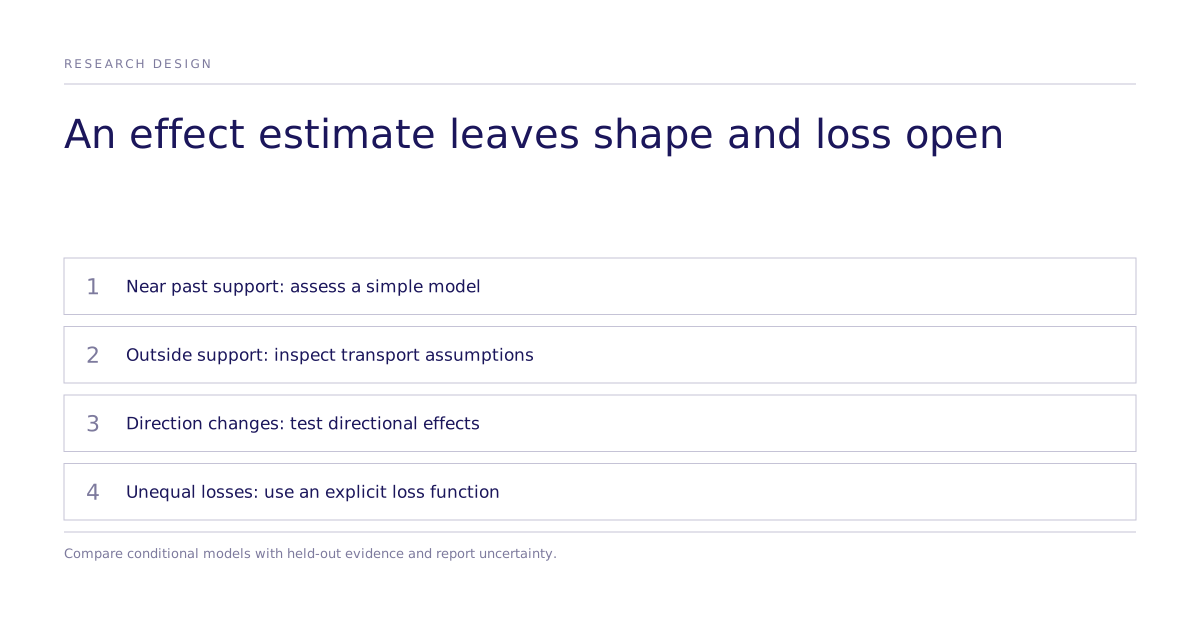
Publishing where a simple estimate holds up is what earns trust in the harder cases. Most decisions sit close to the center of past experience, where a symmetric estimate is a reasonable approximation; this is not a case for always choosing the more complex option. A conditional model should earn its place: compare held-out fit against the simple model, report the uncertainty on each conditional estimate, and say plainly that out-of-support cases, such as a price larger than any you have tested, can stay unresolved. The judgment call is knowing which kind of decision you're facing before you size it.
How to Tell Which Situation You're In
Three questions separate a decision that can use a single estimate from one that needs a conditional one:
- Does the decision involve a magnitude larger than anything already observed? Extrapolating past the range of past data is where regime-dependence tends to surface.
- Does the direction of the change matter? A price increase and a price decrease of the same size, or a positive and negative message, do not have to produce mirror-image effects; if the decision only makes sense in one direction, test that direction specifically.
- Is the cost of underestimating the effect asymmetric with the cost of overestimating it? This is a question about the loss function, not about the effect. If understating downside risk is far more costly than overstating upside, the decision rule should weight the downside more heavily, even when one linear effect model fits the data well. A new, nonlinear effect model is warranted only when the data show that the response itself differs by direction or magnitude.
If either of the first two answers is yes, size the decision using a tested, conditional effect rather than one average number. If only the third is yes, keep the effect estimate and change how you use it: apply a loss function that reflects the asymmetric cost, and show the decision under the lower end of the uncertainty interval.
How Do You Test the Question Before Betting On It?
This is the same discipline behind running a controlled experiment before committing to a decision. Subconscious runs randomized experiments on simulated markets and reports estimated effects with quantified uncertainty rather than a single point estimate, so a team can compare effects across the directions and magnitudes a decision covers within the simulation (see how Subconscious runs a study). Those are modeled stated-choice effects. Where warranted, plan a matched human or live check on the finalists. The simulated test and the human check are two stages of a decision, not a proxy for each other.
The Limit Worth Naming
Confirming that an effect is asymmetric or regime-dependent is a matter of experimental design discipline, not a technique tied to any one tool or workflow. Naming what outside research can't settle is what lets a buyer check the gap before acting on it. Reviewing published research and prior studies on a topic can suggest where asymmetry is likely, but it describes someone else's conditions, not the one a buyer is about to act on, and does not replace testing the specific decision at hand. A tested, conditional estimate still describes an average response across the cases observed; it is not a guarantee about the one case a team is about to bet on. See how this plays out in past studies.
The habit worth keeping: confirming a cause is the starting point of a decision, not the end of one.