Concept Feedback vs. Causal Testing: Choosing How to Validate a Feature Before You Ship
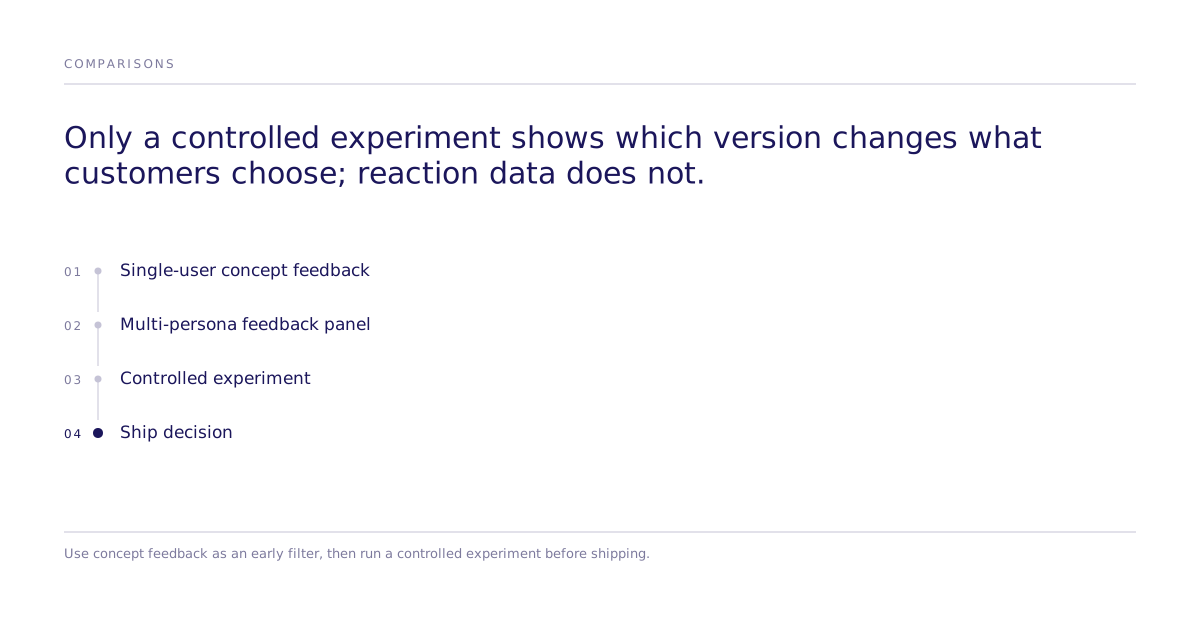
A ship or no-ship decision has more than one kind of evidence available, each answering a different question. Single-user concept feedback tells you whether a simulated person reacts well to an idea. A multi-persona feedback panel tells you whether reactions differ across simulated segments. A controlled experiment tells you which version of a feature actually changes what customers choose. Picking the wrong one can send engineering time toward a feature that never moves a real decision, because the team validated a reaction instead of a cause.
Two ways teams test a concept before real users see it
Tools built for fast concept validation, such as Sanctum, a synthetic-user-testing product built for product teams (Y Combinator launch profile), present a feature or flow to a simulated user and collect structured feedback on it. That workflow sits between ideation and real user testing, answering one question well: does this concept read as confusing, appealing, or off, before a real person sees it.
A related pattern extends that idea to multiple simulated personas, running the same concept past several segments in parallel to compare reactions. That catches a real problem single-user testing misses: a feature that reads well to one persona can confuse another, or land as a dealbreaker for a different segment.
Both patterns tell you how a simulated audience reacts to something you show it, but neither isolates which specific change in the concept caused the reaction to shift, and neither tells you whether the reaction predicts an actual change in what customers do.
What each method actually measures
| Method | Question it answers | What it does not answer |
|---|---|---|
| Single-user concept feedback | Does this concept read as confusing, appealing, or off to one simulated persona? | Whether the reaction changes if you vary the concept, or whether reaction predicts a real behavior change |
| Multi-persona feedback panel | Do reactions to this concept differ across simulated segments? | Which specific attribute of the concept is driving the difference, and whether that difference holds for real customers |
| Controlled experiment | Which version of the feature changes what customers choose, and by how much? | Whether the underlying interface is usable, which is a separate design question |
Reaction data and causal evidence are not interchangeable. A concept can score well in feedback and still fail to move an actual decision, because "people reacted positively" and "this specific change caused people to choose differently" are different claims.
What is the cost of confusing reaction with causation?
Positive concept feedback is not evidence that a feature will change what customers do. Shipping on the strength of reaction data, without testing whether the feature changes a real decision, risks the same outcome as shipping on gut feel: engineering effort spent on something that does not move the metric the business cares about. Concept feedback is not wrong so much as it answers a different question, and a ship decision needs the causal one.
How does a controlled experiment answer the causal question?
Subconscious is a causal behavioral platform built around a different question than concept-reaction testing: not "does a simulated user like this," but "which version of this feature causally changes what customers choose." It runs randomized, controlled experiments on a simulation of the market, estimating which alternative moves the decision-specific outcome.
Where the decision depends on it, a team can move from a simulated experiment to a study with real human participants, without changing the underlying causal question being tested. That step matters when the cost of being wrong is high enough that a simulated result alone is not sufficient confidence for the ship decision. See how the platform works and case evidence.
When is concept feedback still the right call?
A controlled experiment is not a replacement for fast qualitative concept feedback. Early-stage exploratory work, surfacing confusion or gut reactions before a concept is fully formed, is exactly what single-user and panel-style feedback tools are built for. A randomized experiment is the wrong tool for that stage: it needs a defined set of alternatives to compare, and it does not observe someone using an interface the way a usability session does. Real-human validation does not turn a causal test into a usability observation, a clinical trial, or automatic proof of market performance. Treat concept feedback as the early filter and a controlled experiment as the test that precedes a ship decision with real stakes. Teams weighing this trade-off can review the research library or book a walkthrough.