Conversation-Led Exploration vs. Causal Experiments: Which Evidence Can Support a Market Decision?
A fluent conversation can help a team explore an idea. It cannot, by itself, show whether changing a price, message, feature, or launch plan will change customer behavior. A consequential market decision needs a comparison across defined actions, for a defined audience, against a defined outcome.
The buying question is not which conversation feels most human. It is whether the evidence can identify the action most likely to move the outcome that matters.
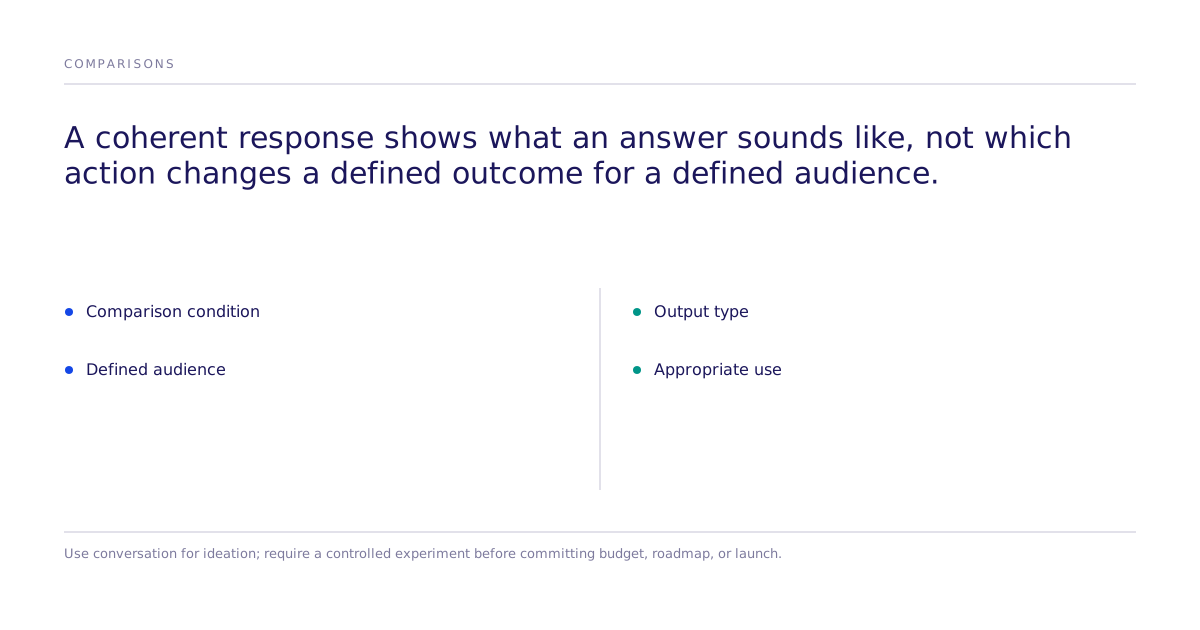
Decide what the evidence must support
Conversation-led exploration and causal research serve different jobs. The first can generate possibilities, expose assumptions, and help a team sharpen its questions. The second is designed to compare actions before budget, roadmap capacity, or sales effort is committed.
That boundary matters: plausible language is not behavioral evidence, even when a response is coherent and useful.
Two methods, two standards of evidence
| Decision criterion | Conversation-led exploration | Controlled causal experiment |
|---|---|---|
| Primary question | What might someone say about this idea? | Which defined action changes a specified outcome? |
| Comparison condition | Usually absent from a single exchange | Alternatives are compared within the experiment design |
| Audience | One constructed point of view or an informal segment description | A defined audience tied to the decision |
| Output | Themes, objections, and possible directions | An estimate of action and outcome, with uncertainty where supported |
| Appropriate use | Early ideation, argument testing, and internal training | Pricing, messaging, product, and launch decisions with material consequences |
The table compares evidence methods, not competing products. One prominent consumer character-chat service describes its own experience around chat, roleplay, and character creation, relevant to entertainment and open-ended interaction, not a substitute for a controlled market test.
The costly error is confusing engagement with causality
A satisfying exchange answers whether the interaction can continue coherently. It does not create the counterfactual a buyer needs: what would have happened if the same audience had encountered action B instead of action A?
Without that comparison, a team can mistake a persuasive response for evidence that a decision will work. That is a familiar say-do gap in a new interface: capital, roadmap capacity, and commercial effort can all follow an action that was never tested against a credible alternative.
How should research be built around the action?
Subconscious runs randomized experiments on a simulated population, built around four explicit elements: the decision, the audience, the alternatives, and the outcome. The respondents are simulated, so the result estimates which action moves the specified outcome in simulated stated choice, with uncertainty stated where the evidence supports it. The published fidelity evidence is on the replication leaderboard.
A team can then replicate the same causal question with real human participants: the same attributes and levels, adapted for a human survey, with a respondent sample that matches the audience. That check evaluates whether the stated-choice result holds among people. A claim about purchases or live performance needs a purchase task, a holdout or a bounded live test. Who recruits and fields the human check is scoped per engagement. This article makes no claim about how large any audience data source is.
Know what the result cannot settle
A controlled experiment is only as useful as its specification. A concrete failure shows how. A team tests two annual-plan discounts on a simulated audience of small-business owners, and the simulation prefers the deeper discount by a wide margin. The audience definition left out the finance managers who actually approve the purchase, and the real approvers weigh cash flow differently. The estimate was precise, and it answered a question about the wrong people. The remedy is to define the audience from who decides, then run a matched human check with that group before acting.
A human check has a clear boundary too. It does not turn a choice experiment into an observed usability session, a clinical trial, or a guarantee of market performance. Qualitative conversation remains valuable when a team needs to generate ideas, explore language, or identify questions worth testing.
What decision rule should you use before choosing a method?
If the cost of being wrong is low and the goal is exploration, a conversation may be enough. If the decision commits money, roadmap capacity, or a market position, require a defined audience, explicit alternatives, a measurable outcome, and a comparison that can distinguish one action from another.
Book a decision review when a pricing, messaging, product, or launch decision needs that standard of evidence.