Customer-Intelligence Dashboards vs. Controlled Experiments Before Launch
A pricing, messaging, or launch decision needs evidence before it ships, not after it. Two different tool categories both get marketed as an "AI customer panel," and they answer that need at opposite ends of the timeline.
Two categories, one shared label
A customer-intelligence tool can draw on several inputs. Native AI's "AI Customer Panel" page, read on 2 October 2026, lists first-party data (panels, interview transcripts, customer feedback), web tracking and third-party internet sources, competitor-customer digital clones, and uploaded data. It also describes replicating shopping scenarios and showing responses to different marketing strategies, with a setting that controls whether digital-twin responses rely only on first-party data or also use third-party information. So this kind of tool is not limited to first-party records. A controlled-experiment platform runs a study against a simulated population built to represent a target segment, whether or not a company has customers in it yet. Which of them can say anything before your own first-party data exists depends on the inputs and the design each one documents.
What a dashboard needs before it is useful
A dashboard is only as good as the data behind it. With first-party signals it surfaces patterns in observed behavior: strong for understanding who a team already has and what they are doing. For a segment or product with no customers yet, its value depends on the third-party or scenario inputs it supports, so ask the vendor what those inputs are and how it checked them for a segment like yours.
What a controlled experiment tests before that data exists
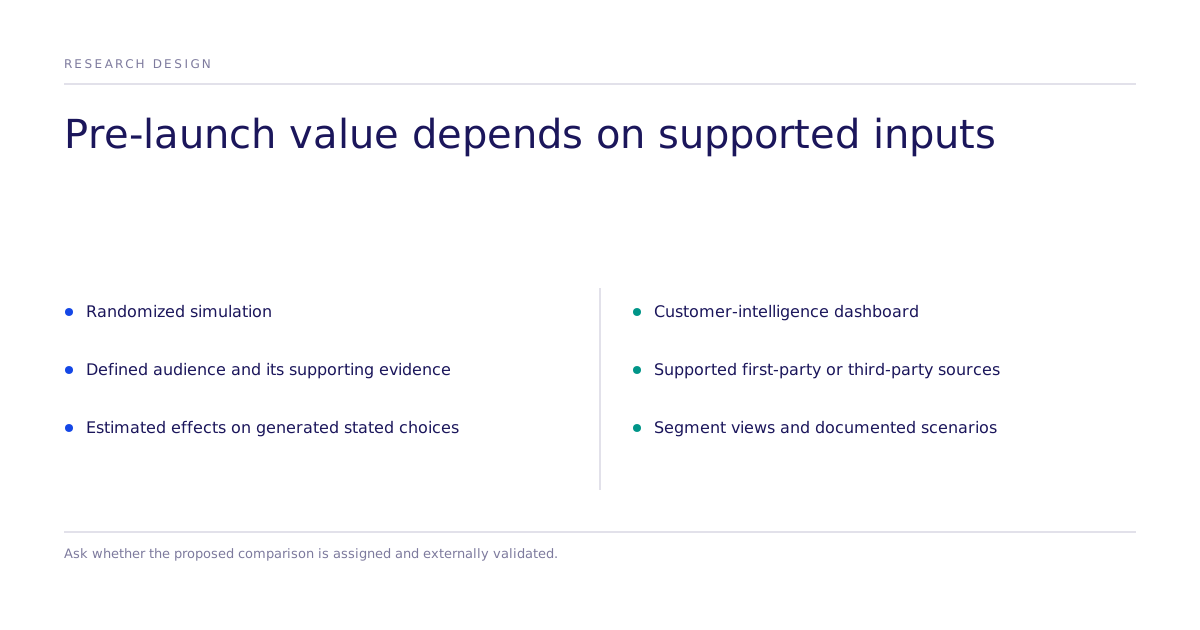
Subconscious runs randomized experiments on simulated populations to estimate which pricing, messaging, or launch action is likely to change a simulated stated choice, before launch, using a defined audience and supporting evidence. Dashboard products may also support third-party or competitor inputs; compare each vendor's documented data requirements. The simulated population has to be defined for the decision: who they are, what they buy, and what the study's evidence for them is. The minimum evidence for an unseen niche audience is a written definition and some external data on that audience, such as survey or purchase benchmarks. A population defined from thin evidence can look precise and still be wrong about a niche, so treat a result for a segment with no customer data as weaker than one calibrated against known customers, and plan a human check on it.
The output is an estimated effect on simulated stated choice, with uncertainty where the design supports it, comparing one alternative against another. It is not a continuous view of an existing base.
Where the two compare directly
| Randomized simulation (Subconscious) | Customer-intelligence dashboard | |
|---|---|---|
| What it needs to start | A defined target segment and the evidence behind its definition | A dataset: first-party, or the third-party inputs the vendor documents |
| Pre-launch value | An estimate before customers exist, weaker for audiences with no outside evidence | Depends on the inputs the vendor supports; confirm for your segment |
| Output | An estimated effect on simulated stated choice, with uncertainty where the design supports it | A segmented, continuously updated behavioral view, plus scenario outputs where offered |
| Best for | Choosing which price, message, or launch action to carry into a human or live test | Understanding a customer base over time |
| Data source | A simulated population; fidelity evidence is published at the corpus level | Customer data, and third-party sources where the vendor uses them |
Where each one breaks down
This individual randomized simulation is a comparison at a specified time, not longitudinal measurement of an existing customer base. Scope the CRM/CDP inputs and monitoring requirements separately, and ask each vendor to document its supported data sources and integrations. A dashboard's scenario features, in turn, need their own check: ask whether the vendor randomizes alternatives and how it validated the outputs.
The two are complementary. A team with an established base and a mandate to track it continuously needs the dashboard. A team deciding what to price, or what to ship next, can run the experiment first, and can still stand up the dashboard once the launch produces customers to track.
From simulated result to human confirmation
When a decision is expensive enough to double-check, repeat the comparison with real human participants: the same attributes and levels, a sample like the intended audience, and a plan for what counts as agreement. Who recruits and fields that check is scoped per engagement in a decision review. The replication leaderboard shows the published fidelity evidence, which is rank agreement on choice parameters across studies.
A practical next step
If the question is which version of a decision is more likely to work before it ships, that is a randomized comparison, not a dashboard. See how a study gets built for a specific decision in past work, or book a decision review and bring the target segment and what you know about it.