Data Twin, Self-Serve Persona, or Causal Test: Which Synthetic-Audience Method Fits the Decision
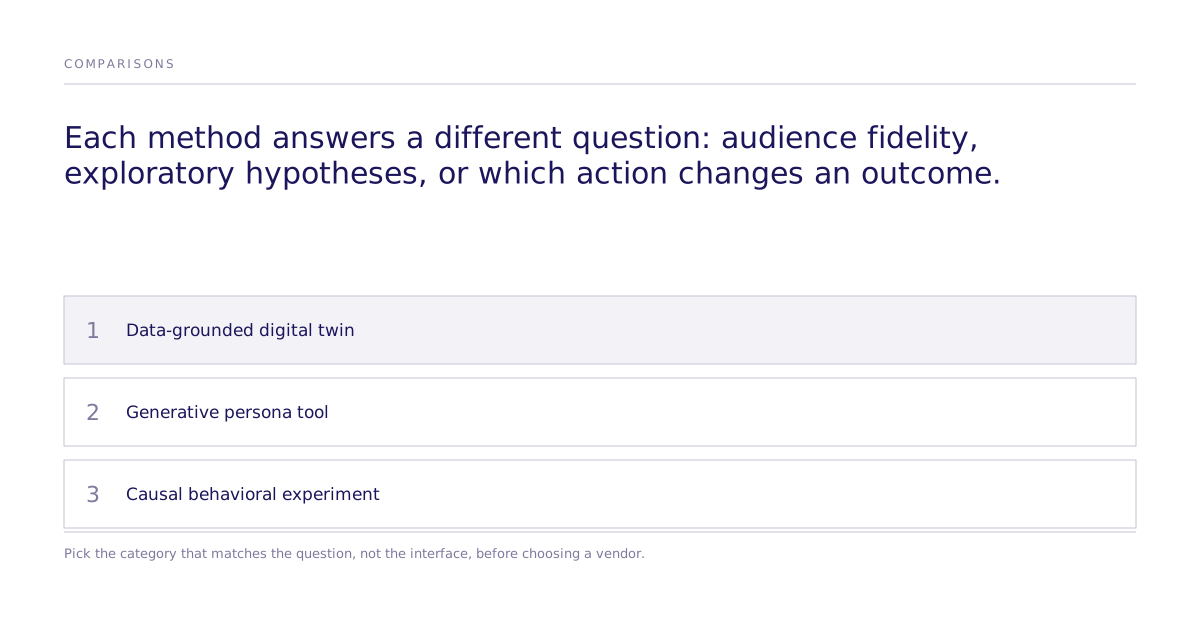
Synthetic-audience methods fall into three categories that answer different questions: a data-grounded digital twin built from an organization's own audience data, a generative persona tool built from descriptions, and a causal behavioral platform that tests which action changes an outcome. For a consequential pricing, messaging, launch, or positioning decision, category fit matters more than feature count. The wrong method can produce a credible-looking answer without resolving the decision.
Start with the decision, not the interface
The useful comparison is not enterprise versus self-serve but known-audience fidelity versus exploratory conversation versus causal evidence. Each has a legitimate job, but proof from one category does not answer the question posed to another.
| Approach | Required inputs | Best-fit question | Evidence to examine | Main limitation |
|---|---|---|---|---|
| Data-grounded digital twin | Deep first-party data about a known audience | What would this specific audience say or do? | Calibration against the source audience and the quality and coverage of input data | Every method in this comparison publishes where it falls short, so a buyer can weigh fit before signing. It cannot represent a known audience well when the required first-party dataset is missing |
| Generative persona tool | Persona descriptions and prompts | What reactions or hypotheses might these described persona types produce? | Prompt sensitivity, variation across runs, and validation against human evidence | Plausible responses are not population-level or causal evidence |
| Causal behavioral experiment (Subconscious) | A decision, target audience, actions to compare, and behavioral outcome; other data inputs depend on the engagement | Which action is most likely to change the defined outcome? | Replication against published human-study outcomes and study-specific validation evidence | Does not provide a packaged workflow for turning first-party subscriber data into a queryable replica |
When do you need known-audience fidelity?
Electric Twin presents its product as synthetic audiences for enterprise research. A data-grounded twin makes an existing audience more queryable: the organization supplies deep first-party subscriber or customer data, and the platform builds and calibrates a replica of that known group.
That category fits a publisher, brand, or research team asking how its own defined audience is likely to react. Its value depends on the quality and coverage of the supplied dataset. Without it, the team pays for onboarding and calibration it cannot complete while the decision window closes.
A queryable replica does not become a controlled action test because its answers are grounded in first-party data. If the decision is between two prices or claims, the buyer should ask whether the method estimates the effect of changing the action, not only whether the replica resembles the known audience.
When a persona conversation is enough
A generative persona begins with a description rather than an ingested audience dataset. For example, a brief might specify a 45-year-old German procurement manager. That detail can focus a conversation and surface objections, language, or hypotheses worth investigating.
The output remains dependent on the description and prompt. It does not establish how a defined population would respond or identify the causal effect of one action over another. For exploratory work, that may be sufficient. For a launch-critical pricing or messaging call, a plausible opinion can look like validation while leaving the commercial decision untested.
Which action actually changes behavior?
Subconscious is a causal behavioral platform. It runs controlled experiments on simulated markets to estimate which price, message, feature, or claim changes a defined outcome. It is built for buyers asking which action is most likely to move behavior, not what the audience looks like or what a persona might say.
Our best configuration reaches 87% of the measured human ceiling on one study: 0.832 rank correlation against the published human result, where two independent samples of real humans reach 0.959. Across all 43 studies that pass design filters the mean is 0.73. It is a validation result, not a guarantee for a new market (the causal fidelity paper).
A number without its limits is marketing. This is the boundary on this one: study design determines what uncertainty, segment variation, and decision outputs can be supported, and those are not identical across every engagement. Subconscious also does not offer a packaged workflow that ingests first-party subscriber data and turns it into a queryable replica of that specific audience. A data-grounded twin remains the better category when fidelity to a known audience is the requirement.
Do not transfer proof across categories
Electric Twin publishes a first-party account of its approach to measuring synthetic-audience accuracy. That proof should be judged against its intended use: reproducing a particular audience from supplied data. Persona plausibility should be judged against the usefulness and stability of the generated hypotheses. Causal replication should be judged against whether a simulated experiment reproduces the direction and outcome of a human study.
Make the procurement call
Name the question before comparing contracts or interfaces:
- Choose a data-grounded digital twin when the organization has deep first-party data and needs a queryable model of that specific audience.
- Choose a generative persona tool when the team needs exploratory conversations and hypotheses from described persona types.
- Choose a causal behavioral experiment when the team must compare defined actions for a defined market outcome.
For a consequential pricing, messaging, launch, or positioning choice, review the public replication results, see how a causal study is structured, or bring the decision to a demo.