How to Compare AI Focus Group Software
A traditional focus group requires a scoped participant sample, recruitment, moderation and analysis. Obtain an itemized quote that identifies incentives, transcription, deliverables and the work required for each segment.
An AI focus group changes the mechanics, but product claims about fielding time, platform spend, segment limits or automatic cross-tabs need proof from the specific tool and study. Compare methods by the decision they support, not the loudest speed claim.
Three properties to inspect
A defined panel
The audience definition should be explicit. "Ask a model to imagine eight customers" is not enough. Record the segment, context, decision, and assumptions used to construct the simulated participants.
Structured moderation
The workflow should support consistent questions, follow-ups, and probes. A collection of one-off answers is closer to a survey than a moderated group.
A reusable artifact
The study should preserve the prompts, audience definition, stimulus, transcript, and outcome. Reuse matters only when the team can see what stayed constant and what changed.
Compare method types before vendors
Synthetic panels generate responses from simulated audiences. They help with early concept, message, and objection screening, but need calibration and human validation.
Real-human research with AI moderation recruits people and uses software to guide or analyze the session. Outset describes AI-moderated interviews with real participants alongside its other research offerings. Confirm the participant source for the particular study you are buying.
Video-first qualitative tools emphasize recorded interviews, observation, and synthesis. They fit questions where voice, expression, or the interview itself matters.
Population-scale simulation targets larger modeled populations rather than a panel-of-twelve format. Ask what data grounds the population, how it is validated, and whether the output matches the decision.
Asynchronous interviews let real participants respond on their own schedule while software asks follow-ups. They trade live group dynamics for easier scheduling.
The vendor list can change. The method distinction is more durable.
Which product mechanism is being offered?
A product sold as an AI focus group may generate respondents, moderate real participants, analyze recorded interviews, or combine these jobs. Require a demonstration of the mechanism for your proposed study.
Ask the supplier to identify which outputs come from people and which are generated. Then inspect its participant source, moderation process, validation record and data terms. A broad vendor list cannot substitute for that check.
Compare the demonstrated study workflow with the table below. Record the retrieval date of any capability or commercial terms used in procurement.
A buyer's comparison table
Score each candidate against the same criteria:
| Criterion | Question |
|---|---|
| Audience construction | Can you inspect and revise the audience assumptions? |
| Experiment design | Can you compare alternatives under the same conditions? |
| Validation | What human baseline supports the intended use? |
| Moderation | Are follow-ups consistent and reviewable? |
| Evidence | Are transcripts, prompts, and settings retained? |
| Segment comparison | Can you distinguish aggregate patterns from segment differences? |
| Human oversight | Can a researcher review and correct the analysis? |
| Procurement | What are the real limits, services, and data terms? |
Do not treat a stated 80 to 95 percent accuracy range, ~90 percent correlation, a 100+ participant capacity, or 6-7 figure contract size as comparable measures without definitions. Those numbers can refer to different tasks, populations, and validation designs.
Where do simulated focus groups help?
Simulated groups shorten the path from a question to a testable hypothesis. A team can compare three segments under the same prompt, revise a stimulus, or run a planning session on a Sunday at 2 a.m.
Compare measured design, execution, analysis and validation effort for the same decision and deliverables. Include any human follow-up required before the result supports the intended commitment.
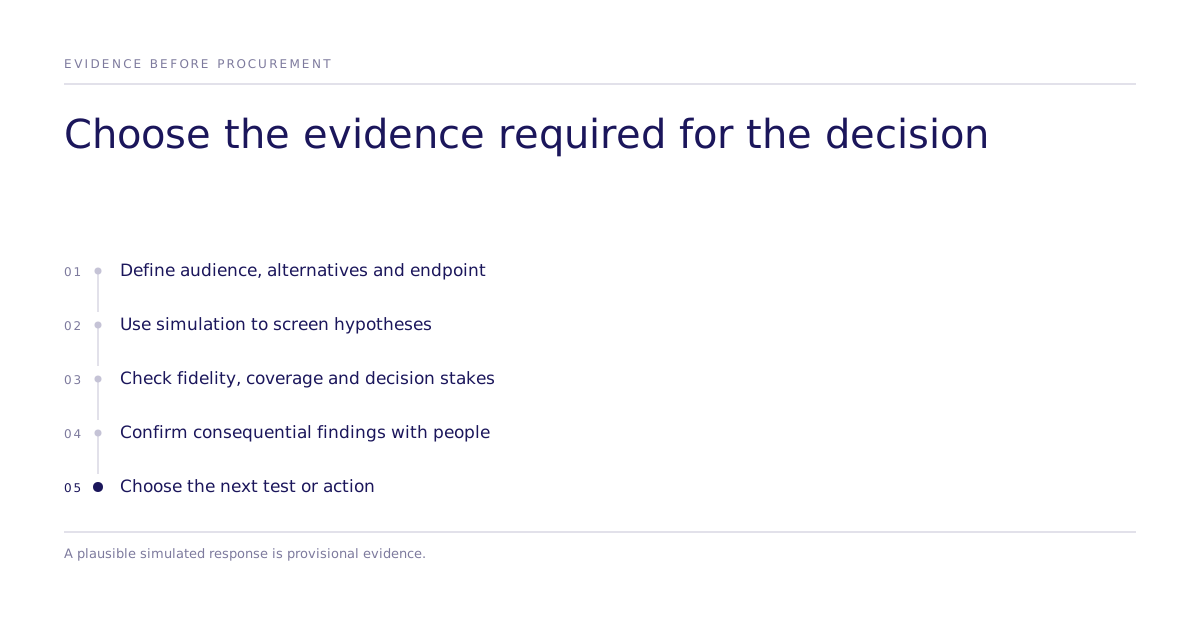
The strongest use is hypothesis triage: deciding which questions deserve real-human follow-up.
Where are real focus groups still necessary?
Use people when the decision depends on food, smell, touch, fit, ergonomics, physical behavior, or body language. Use audited human evidence for regulatory or legal substantiation. Use human research when a category has no useful precedent or when the investment is too consequential for directional evidence alone.
The practical 2026 pattern is sequencing: simulated work for early triage, then human research for final validation when the decision warrants it.
Model the operating economics honestly
A planning scenario might assume five to twenty simulated groups per month, followed by two or three human-research questions per quarter. The right cadence depends on decision volume, validation risk, and the cost of mistakes.
Do not promise 100x throughput or a 70 percent budget reduction from the method alone. Measure the actual cycle time, research spend, discarded concepts, and decision quality in your own workflow.
Subconscious's research methodology describes decision-specific randomized comparisons on a market simulation. A comparison estimates a defined simulated response; it does not establish a human effect without matched evidence. Review case studies, or book a decision review with the alternatives, audience and human validation your decision requires.