How to Evaluate a Synthetic Respondent Platform Before You Trust Its Output
Before signing with any synthetic-respondent or AI-research vendor, require one thing: proof that its simulated studies reproduce real human study outcomes, not just a claim that they do. A platform whose output looks plausible but has never been checked against real human behavior is a bad foundation for a pricing, messaging, or launch decision.
What "synthetic respondent" covers
The category spans three shapes of product. Conversational panels build AI personas and let a team question them directly. Behavioral simulations run larger population-level models and report distributions rather than individual answers. Survey-shaped tools route the same synthetic personas through a structured questionnaire so the output slots into existing survey-reporting workflows. The shape a vendor sells determines what kind of evidence you can reasonably ask it to produce: a conversational panel should be able to show you a transcript; a behavioral simulation should be able to show you the comparison it ran.
The evaluation checklist before you sign
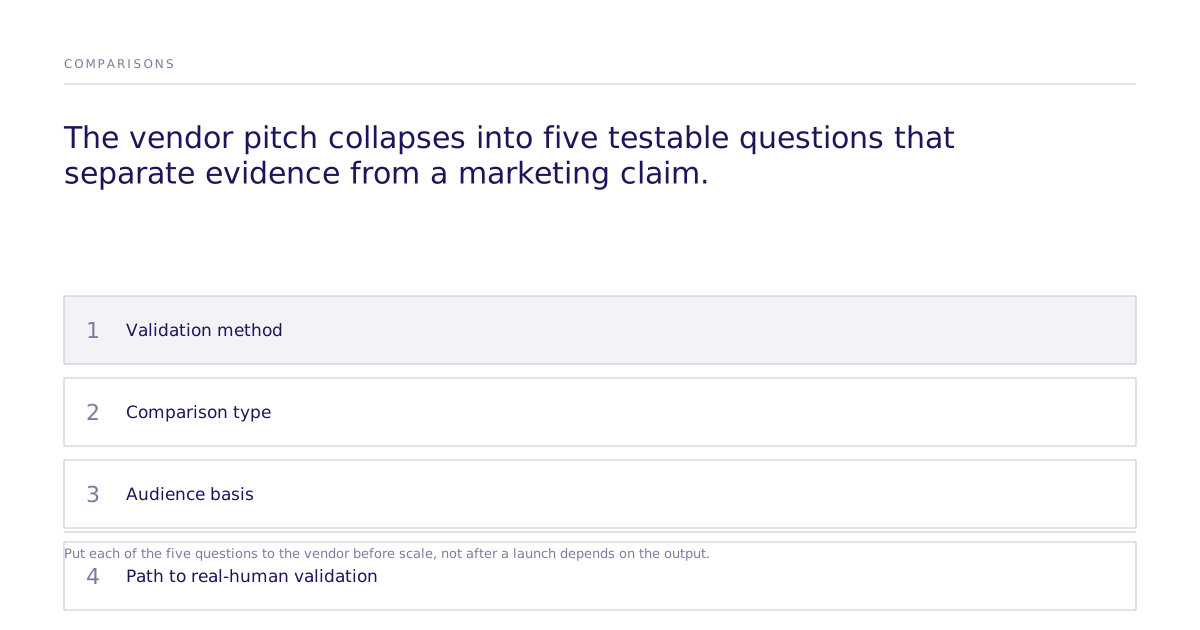
Every vendor pitch collapses into a small set of testable questions: use them before scale, not after a launch depends on the output.
| Evaluation criterion | Question to ask the vendor | Why it matters |
|---|---|---|
| Validation method | Does it publish how often a simulated study reproduces a real human study's result, or only a self-reported accuracy percentage? | A self-reported number with no comparison study behind it is a marketing claim, not evidence. |
| Comparison type | Is the test a controlled comparison between two actions, or a general statement of accuracy? | A causal comparison ("which message performed better and why") answers a different question than a correlation score against a historical panel. |
| Audience basis | Is the audience a modeled simulation, a recruited human panel, or both, and does the vendor say which for a given study? | These are different evidence types. A vendor that blends them without disclosure makes its output impossible to weigh correctly. |
| Path to real-human validation | Can the study move from simulated exploration to real human testing without changing the underlying question? | Regulated decisions and high-stakes launches need this path. If the method changes when real respondents are added, the two results are not comparable. |
| Disclosed limitations | Does the vendor publish where its method fails, not only where it works? | A published record of mid-range and failing results is harder to fake than a single flattering headline number. |
Is correlation the same as causal evidence?
An accuracy percentage against a historical panel tells you how often a vendor's synthetic answers matched what people already said. It does not tell you which of two actions, such as two prices or two messages, would cause a better outcome going forward. A number without its limits is just marketing. Independent researchers who have reviewed published experiments with synthetic-user studies have found the results inconsistent across studies and question types (A Review of Experiments with Synthetic Users, MeasuringU), which is one reason a single accuracy number should not be the deciding factor. Replication against an academic benchmark, checked study by study, is a sturdier bar than a marketing-page percentage (Testing Synthetic Data Against Academic Benchmarks: A Replication Study, Greenbook).
Subconscious runs the checklist above against its own product. Its randomized experiments compare specific actions rather than reporting a single accuracy score, and every published result on its leaderboard is a study, not a headline percentage. Subconscious can also test or validate studies with real human participants, so a team can move from a simulated experiment to real-human testing without changing the causal question it started with. Publishing what a method is not is what lets a buyer check it against the claim. Its simulated audience is a person-level graph covering 800 million real people, which is a modeling scale, not a recruitable panel, and the two should never be presented as interchangeable.
Where does simulation alone stop being enough?
Simulated exploration fits early-stage work well: concept testing, message testing, and segmentation, where a same-day answer matters more than recruiting real respondents for every iteration. The failure modes belong on the record next to the successes. It fits poorly, on its own, with regulated decisions, deeply sensory product tests, or any situation where a stakeholder will demand real human signal before approving the outcome. For those cases, pair the simulated study with a smaller real-human validation step rather than treating the simulation as the final answer.
Put the checklist to work
Run the five questions above against any vendor before signing a contract. To see how Subconscious's own controlled experiments and validation evidence hold up against it, start with how the platform works or book a walkthrough.