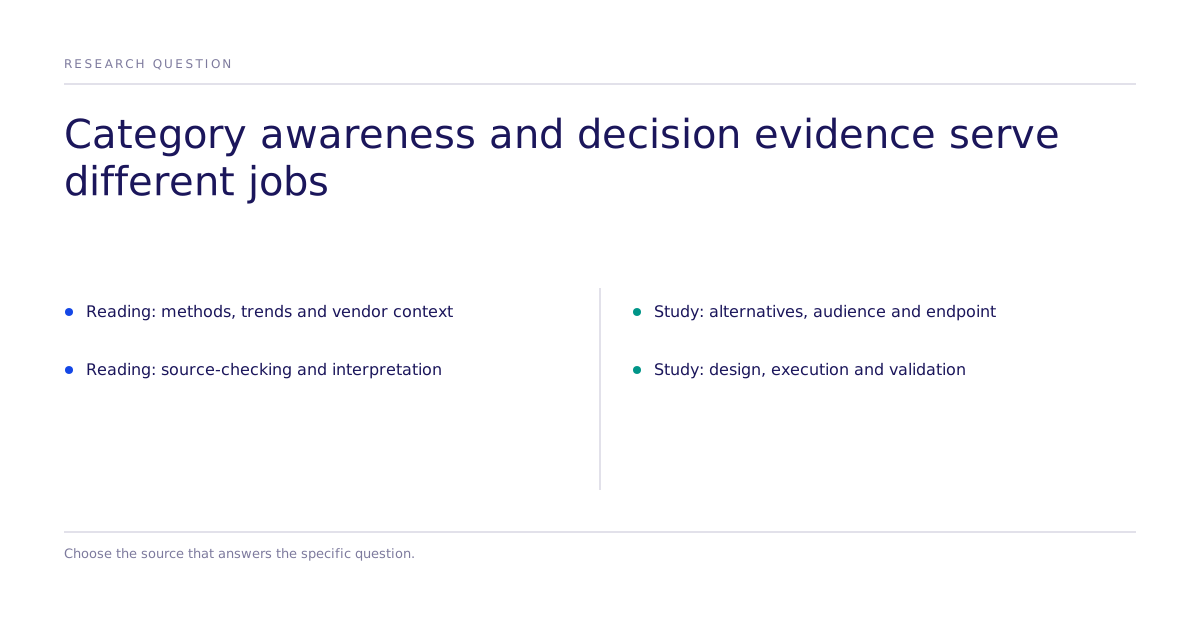
Industry Awareness vs. a Decision-Specific Test: What Each One Actually Answers
A research or insights lead who reads trade coverage and attends industry events stays current on how the category is moving. That is different from testing whether a specific positioning line, price point, or launch message will work with the audience it targets. Confusing the two is where teams get burned: trend awareness shows what the field is doing in general, not what your buyers will do when they see your specific offer.
The Question Behind the Question
Before a positioning, pricing, or launch decision ships, the real question is not "have we kept up with the category" but "have we tested this specific choice against the audience it affects." General industry reading answers the first question, not the second: it was never built to isolate one variable for one audience.
The cost of getting this wrong shows up after the decision is live: a positioning statement ships on general sentiment rather than evidence tied to the actual buyers who see it, and the gap surfaces only once it is too late to cheaply reverse.
What Does Trend-Watching Actually Give You?
Trade publications, conferences, and supplier directories serve a real function: they surface what peers are trying, which methods are gaining adoption, and which vendors are worth a closer look. For a team building internal literacy or scoping a vendor shortlist, that coverage is the right tool.
Trend coverage does not answer a question specific to your product, your audience, and your choice. General coverage describes the category, not the decision in front of you.
Where the Two Diverge: Iteration Cost
The two approaches diverge most clearly on what a follow-up question costs.
| Staying current on the category | Testing your specific decision | |
|---|---|---|
| Answers | What the industry is doing | How the tested audience responds to defined alternatives |
| Best use | Scoping vendors, building internal literacy, tracking trends | Positioning, pricing, messaging, and launch calls that need evidence before budget commits |
| Cost of a follow-up question | Analyst reading and source-checking time | A new study needs design, execution and validation; an existing audience definition can reduce setup work |
| What it cannot replace | The specific test your decision needs | The judgment of when general awareness is not enough |
Neither column is strictly better; the table makes the tradeoff explicit, not a winner.
How Does Subconscious Fit the Gap?
Subconscious is a causal behavioral platform built for the second column: running a controlled experiment on the specific action a team is considering, rather than reading about what the category is doing in general. It complements industry awareness reading rather than replacing it.
Research by Sfeir and colleagues evaluates LLM assistance with specifying and estimating multinomial-logit models. Its results depend on the model, prompting and available data. The paper concerns analyst assistance, rather than validation of generated buyer responses.
For a simulated decision test, inspect the alternatives, response endpoint and matched human evidence separately from any claim about faster model development.
When a decision genuinely depends on validation beyond a simulated experiment, a team can move the same causal question to recruited human participants without changing what is being tested. That step matters when the stakes of the specific choice, not general category awareness, are what the team cannot afford to get wrong.
A Practical Loop: Read, Test, Confirm
Teams that use both well run something like this: read the trade coverage to know what is worth testing, run a controlled experiment on the specific choice in front of them, and reserve recruited-participant validation for the calls where the cost of being wrong is highest. Reading generates candidate questions. Testing narrows them to the one decision that matters this quarter.
When Is General Awareness Still the Right Call?
Not every question needs a dedicated test. Scoping vendors, building shared vocabulary, or staying current ahead of budget season are cases where general reading is the right tool and a formal experiment would be overkill. The judgment call is knowing which side of that line a decision sits on.
What This Doesn't Replace
The scope of a method belongs next to its results. A buyer checking the method needs to see exactly what it does not cover. A controlled experiment answers a specific causal question about a specific audience. It does not replace staying current on industry practice, nor does it replace the judgment of when a decision is big enough to warrant its own test rather than general reading. See how this plays out in practice in case studies built from real decisions, or read more on how the method works.
Next Step
If a decision is sitting on general industry sentiment rather than evidence tied to the specific audience it affects, that is the signal to stop reading and start testing. Book a walkthrough to see what a controlled test on your specific decision looks like before it ships.