Ipsos Synthesio vs. a Pre-Launch Causal Test: Two Different Questions
A brand team that already runs Ipsos Synthesio for always-on monitoring is not choosing whether to replace it. The real question: does listening to what people already said tell a team whether a message, claim, or positioning choice that has not gone live yet will work? It does not, because listening only reports on conversation that already happened. A message that backfires is only visible after it is published, spending, and shaping how the market reads the brand.
What Ipsos Synthesio answers
Ipsos Synthesio aggregates social, search, news, and forum data into dashboards and reports for consumer-intelligence and market-research teams. It tracks sentiment, share of voice, and emerging conversation across a category, and it plugs into the marketing and analytics stack that enterprise research functions already run.
What it cannot do is tell a team how an audience will respond to a message, claim, or positioning line that has not shipped. Listening data is observational; there is no experiment behind it, because nobody has been shown the thing that has not been said yet.
Where does the gap show up before a launch?
Treating a monitoring read as a substitute for a pre-launch test is how a message ships on evidence that was never designed to answer the question being asked.
Testing the message before it goes live
Subconscious uses randomized comparisons on a configured market simulation. A team defines candidate messages and a response endpoint, then compares the simulated results before committing media spend. Audience provenance and segment coverage still need to support that study; a modeled audience is separate from recruited human participants.
When a decision calls for it, scope a matched human study separately. Agree the recruitment, sample and response endpoint with the simulated comparison before fielding, because a human check is only comparable when it answers the same question.
Comparing what each method answers
| Method | Question it answers | Evidence source | Best for |
|---|---|---|---|
| Social listening | What is my audience already saying? | Real social, search, and news conversation | Brand-health tracking, sentiment shifts, category monitoring |
| Pre-launch simulated comparison | Which candidate changes the specified simulated response? | Randomized comparison within a configured model | Narrowing message options before matched confirmation |
| Real-human validation | Does the simulated result hold with recruited participants? | Direct human response, same causal question | Confirming a result before a high-stakes commitment |
How do listening and causal testing work together?
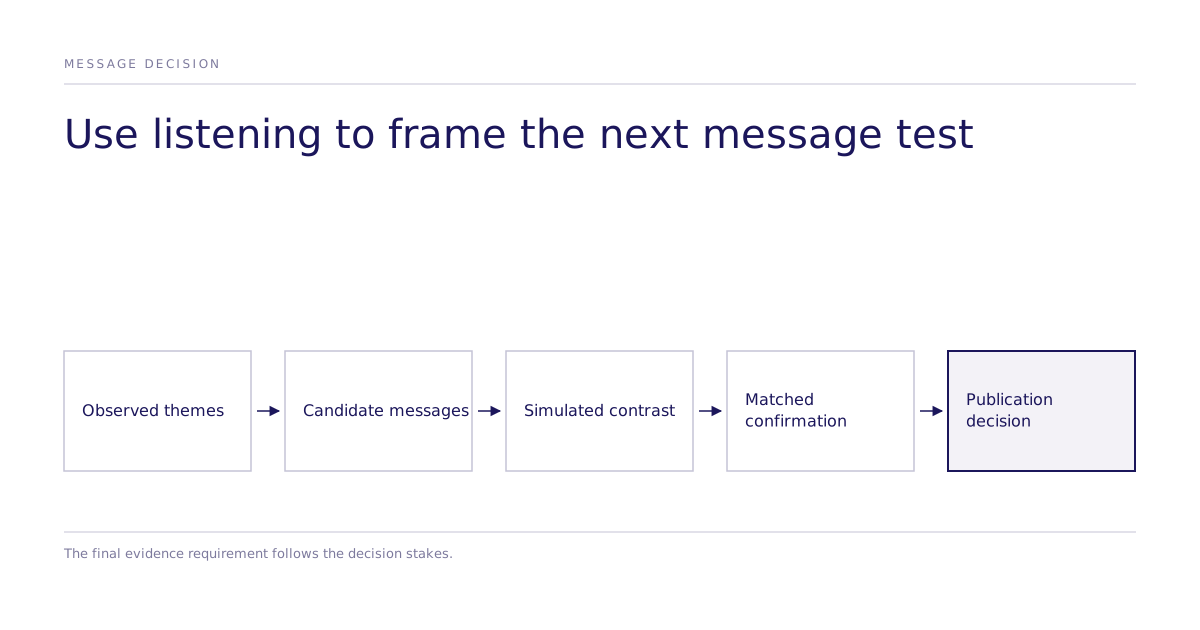
The two categories are complementary, not competing. Listening surfaces what is already happening in a category: which themes are rising, where sentiment is turning, what a competitor's claim triggered. Those signals are useful raw material for shaping which candidate messages are worth testing next.
A pre-launch causal test then evaluates those specific candidates before they ship. For a brand team running both, the sequence is: listen to know what to test, then test before committing budget to what you publish.
What the simulated comparison does not settle
The study described here compares the candidate messages a team specifies on one defined simulated response. It does not read live conversation, so keep a listening platform in the workflow for ongoing brand-health monitoring, sentiment shifts and crisis detection. Audience-graph reach is not the same as a recruited panel. Confidence intervals and other quantitative outputs depend on the specific study design, and they describe the model and assignment, not a guarantee about real audiences. Treat a simulated result as a first pass when the decision is high enough stakes to warrant recruiting real participants.
To scope a specific message comparison, book a decision review with the candidate statements, target audience and intended outcome, or read how Subconscious runs a study.