Kano or MaxDiff: Which is better for feature selection?
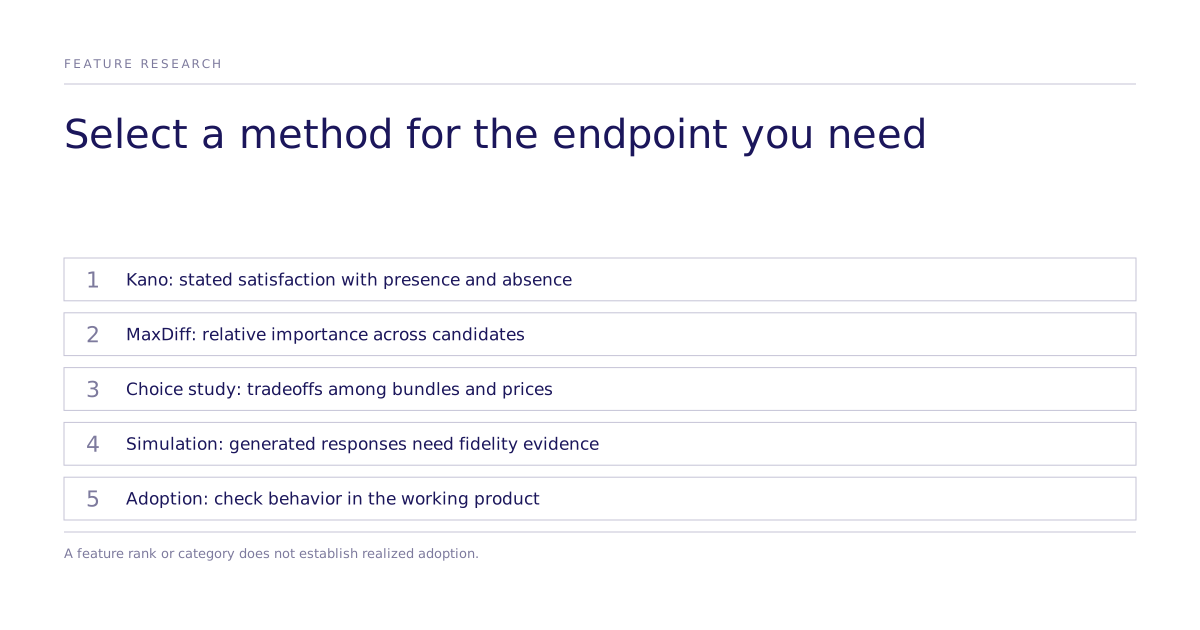
Use Kano when the question is how a feature's presence or absence changes stated satisfaction. Use MaxDiff when a long feature list needs a relative importance ranking. Neither output alone establishes the effect of shipping a feature on adoption, retention or revenue.
The short version:
- Kano classifies stated satisfaction using paired presence/absence questions. MaxDiff asks repeated best–worst choices to estimate relative importance.
- Choose the method from the immediate research question. A team may use Kano for satisfaction categories and MaxDiff for prioritization, then validate the consequential product decision separately.
- Stated satisfaction, importance and purchase behavior are different endpoints. Ask whether the selected method has been checked against the actual outcome for your product and audience; the sources below do not supply that comparison.
- A randomized discrete-choice study can test feature and price tradeoffs on a specified choice endpoint. A simulated version still requires evidence that its contrasts transfer to the intended human audience.
- Before locking the roadmap, combine the screening result with implementation cost, observed usage and a study of the remaining decision uncertainty.
What does Kano actually measure?
Kano measures how a feature affects stated satisfaction, not whether it drives adoption. Noriaki Kano's 1984 method asks a paired functional/dysfunctional question for each feature ("how would you feel if this were present" and "how would you feel if this were absent") and sorts the answers into must-be, performance, and delighter categories. Quantilope's comparison frames this correctly as a satisfaction-impact taxonomy, distinct from a ranking task. The dysfunctional question is genuinely useful for one thing: mmrresearch's 2025 analysis argues it's still the only reliable way to detect true must-be features, because it separates "I wouldn't notice this" from "I'd be furious without it." That's a real strength. It's still a respondent guessing at a hypothetical feeling, not a person facing a real tradeoff.
What does MaxDiff actually measure?
MaxDiff measures relative importance among stated preferences, with no satisfaction label attached. Best-worst scaling, developed by Jordan Louviere and commercialized by Sawtooth Software, presents respondents with subsets of features and asks them to pick the best and worst of each set, repeatedly. The output is a clean rank order across a long list, without the scale-use bias that plagues simple rating questions. Qualtrics, Displayr, QuestionPro, and quantilope all ship MaxDiff modules, with Sawtooth still treated as the reference implementation. What MaxDiff can't do is explain why a feature ranks where it does: mmrresearch notes it struggles to distinguish a must-be feature (furious without it, indifferent with it) from an excitement feature (thrilled with it, indifferent without it), because both can produce similar mid-pack importance scores.
Kano vs. MaxDiff at a glance
| Dimension | Kano | MaxDiff |
|---|---|---|
| Question format | Paired functional/dysfunctional questions per feature | Repeated best/worst choices across feature subsets |
| Output | Satisfaction category: must-be, performance, delighter | Rank order of relative importance |
| Strongest at | Detecting true must-be features via the dysfunctional question ([mmrresearch](https://www.mmrresearch.com/post/is-kano-modeling-interchangeable-with-maximum-differentiation)) | Fine-grained ranking across long lists without scale bias ([quantilope](https://www.quantilope.com/resources/kano-va-maxdiff)) |
| Weakest at | No rank order across a full feature set | Struggles to separate must-be from excitement-type features |
| Matched adoption validation in the sources below | Not reported | Not reported |
| Best for | A short candidate list needing a satisfaction taxonomy before deeper testing | A long backlog you need to force-rank, with no causal claim attached |
Kano or MaxDiff: which is better for feature selection?
Kano is the closer fit for satisfaction categories; MaxDiff is the closer fit for relative importance across many candidates. A roadmap also needs implementation costs, dependencies and evidence on the outcome the feature is meant to change. A randomized choice study adds a structured tradeoff, but its elicited choices remain distinct from adoption in the working product.
Why doesn't switching from Kano to MaxDiff close the say-do gap?
Switching survey format does not automatically close the say–do gap. Both Kano and ordinary MaxDiff elicit responses to described features. A choice experiment can include competing bundles and prices, but it still needs a matched behavioral comparison before its result is treated as adoption evidence. The reviewed vendor comparisons do not report that validation.
Is "Tandem MaxDiff" a real fix?
Tandem MaxDiff does not by itself close the adoption gap. KSR's 2025 argument for "Tandem MaxDiff" proposes running MaxDiff instead of, or alongside, Kano to get both satisfaction-style signal and rank order from a single instrument. Combining the questions can place both outputs in one instrument; compare quoted fieldwork and analysis costs for the proposed study. Satisfaction inference and best–worst ranking remain elicited responses. The linked argument does not report a matched purchase, signup or churn check. Causal interpretation depends on assignment and study design, while transfer to adoption requires evidence measuring that behavior.
What would a causal test of feature value actually look like?
A randomized discrete-choice study varies feature bundles and prices by design. Mixed Logit and ICLV are analysis models; the experimental assignment identifies the tested contrasts. Subconscious applies choice modeling to a market simulation. Its July 2026 working paper, not peer reviewed, reports mean Spearman rank correlation on estimated choice parameters of 0.73 across 43 design-filtered studies, and 0.55 across roughly 300 replications. These figures do not measure feature adoption or effect-size agreement. Published benchmarks can overlap model training data; check contamination controls and matched human evidence for a new roadmap study. An interval fitted to simulated choices covers model uncertainty in that study, rather than all error in transferring to real customers.
How does this compare against a real human baseline, in practice?
Review the aggregate replication evidence and the paper's reported methods and limitations. The public paper does not release per-study replication data, so it cannot supply an inspectable result for every feature-selection design. For adjacent decisions, the comparisons hub and methods and validation hub cover feature and pricing research.
If you're choosing between Kano and MaxDiff this week, run the one that fits your immediate need: Kano for a short list needing satisfaction categories, MaxDiff for a long backlog needing a rank order. Treat that result as a screening pass, not a roadmap-ending answer. Before you commit budget against it, price a randomized discrete choice pilot on your top 5 to 8 features and see whether the effect estimate and its confidence interval change your priority order. If you want a second opinion on the design, meet with the team.