Live moderated video research or causal simulation: choose by the evidence required
Choose live moderated video research when watching a real respondent is part of the evidence. Choose a causal simulation when the decision is which of several defined actions produces the higher generated response on a specified endpoint, such as simulated choice share. A simulated result cannot supply body language, tone, or an observed reaction, and it does not establish a change in purchases or other real behavior. A matched human stated-choice study checks elicited choices; a claim about actual behavior requires a study measuring that behavioral endpoint. A moderated conversation, for its part, does not by itself isolate the effect of one action against another.
Start with the evidence the decision needs
A live moderated research platform offers structured, moderated conversations with real participants (platform overview). This method is the stronger fit when a researcher must see how someone handles a prototype, hear hesitation, follow an unexpected answer, or interpret a reaction in context.
A simulated panel produces directional reasoning from a defined audience model. It can help a team form hypotheses or compare lines of inquiry, but it does not show what a recruited respondent did in a live session.
| Research question | Evidence required | Appropriate method |
|---|---|---|
| How does a respondent react while using this experience? | Direct observation, follow-up questions, tone, and body language | Live moderated video research |
| What themes or objections should the team investigate? | Directional reasoning from a defined audience model | Simulated panel |
| Which proposed action produces a higher simulated choice or response than an alternative? | A randomized comparison on a specified simulated endpoint | Subconscious causal experiment |
| Does the simulated contrast hold with recruited people or in live conditions? | A matched human study with the same alternatives and endpoint, scoped separately | Recruited human study |
The wrong method leaves a specific gap
Using moderated sessions for a causal choice can produce rich explanations without showing which action caused the outcome.
Simulation leaves a gap when direct observation is required. The team receives generated responses but never sees a person hesitate, navigate, misunderstand, or respond on camera. For usability, ethnography, and other observation-dependent work, that missing evidence is decisive.
The buyer should name the action, outcome, and required evidence before committing fieldwork budget or calendar time. The cost of choosing poorly is not just the research expense. It is reaching the decision point with an answer to a different question.
Causal experiments answer the action question
Subconscious is the causal-experiment layer in this research system. It compares which action produces the higher generated response on a defined endpoint in a simulation of the market.
The practical advantage is decision alignment. A team can compare the actions it might take on the generated endpoint it chose, then use the result to decide what deserves human or live confirmation. How the method works explains the experiment design, while /research covers the validation approach.
A matched human study can check the same comparison. Scope its recruitment, sample and response endpoint separately, because the simulated study does not guarantee a human confirmation. The simulated study is not a moderated video session.
Build the research sequence around the unresolved risk
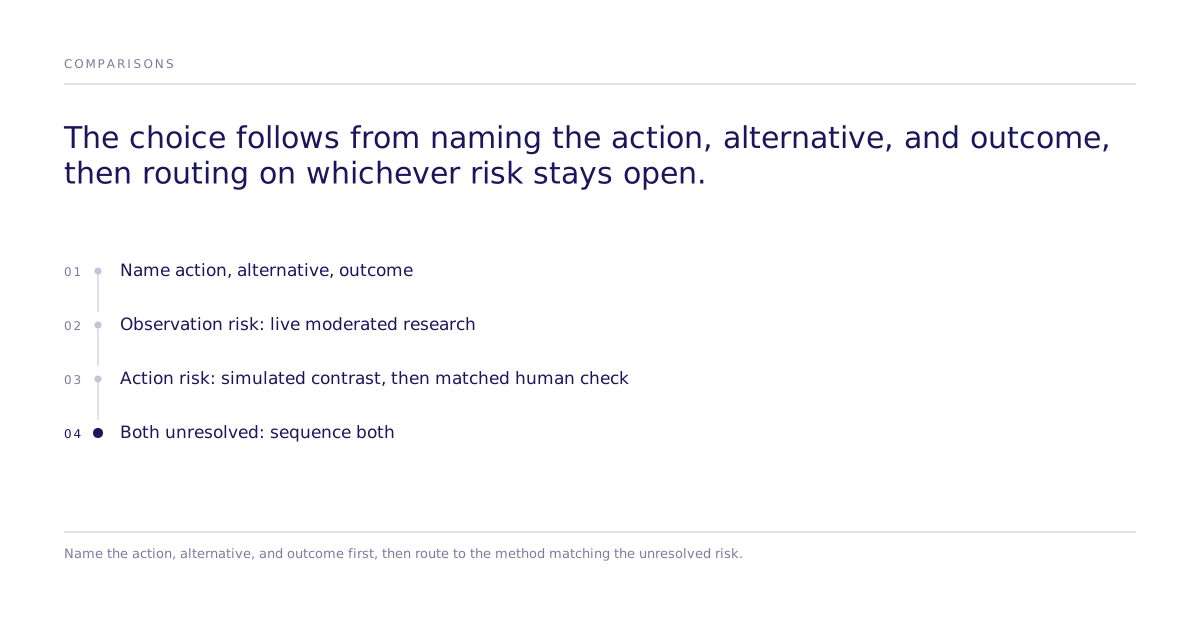
Begin with the decision itself: the action under consideration, the alternative, and the behavior that should change. Then choose the next method based on the risk that remains.
- If the unresolved risk is which action performs better, compare the actions on a specified simulated endpoint. A matched human study can check elicited choices; measure actual behavior before claiming a purchase or other behavioral change.
- If the unresolved risk is how a real person behaves or reacts, recruit and observe real respondents.
- If both matter, keep the methods separate and sequence them deliberately. Use the simulated comparison for the action question, then use live moderated research for the observation question.
For a decision centered on which action to compare, bring the action, alternative, and target outcome to a working session. For a decision centered on direct observation, choose live moderated research.