Looking for a Simile Alternative? Ask What Proves the Simulation First
Teams searching for a Simile alternative need to compare how each platform answers a pricing, messaging, or launch question. The useful comparison starts with the decision, the measured behavior, and the evidence needed before committing budget.
Simile positions itself as an AI simulation platform for testing human behavior. Its published examples include models of action distributions trained on interviews and transaction data. Ask Simile and any alternative for current access terms, the proposed study scope, and a delivery estimate for your question.
The real question isn't speed, it's proof
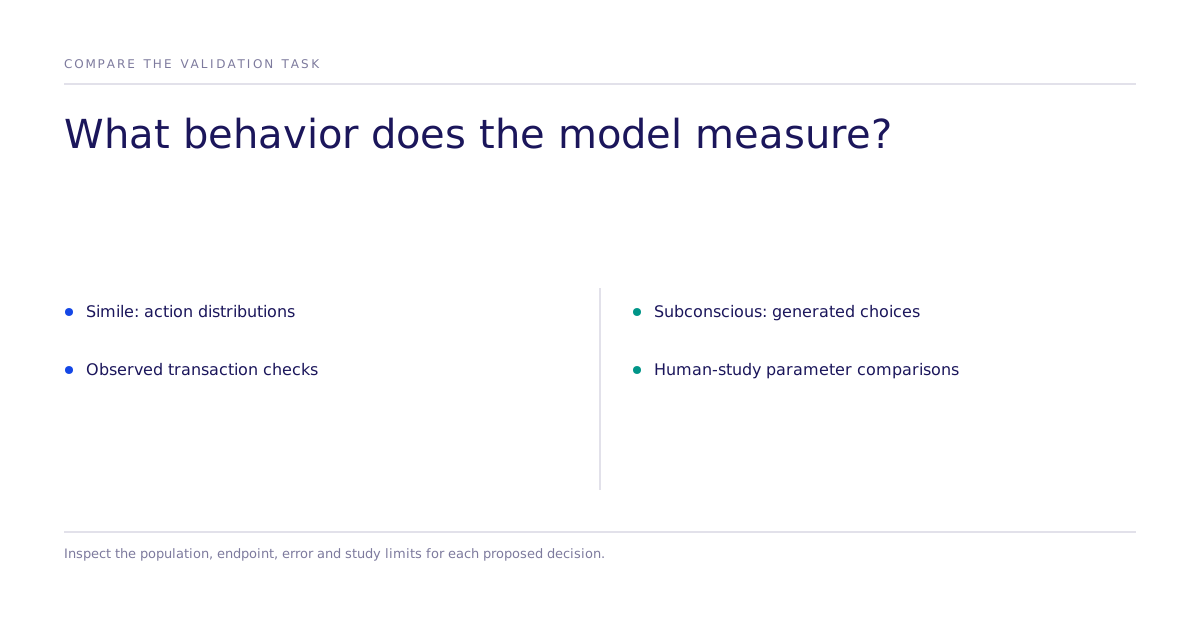
Some vendors publish behavioral validation, including Simile's confidence methodology. Simile describes comparisons with observed transaction distributions and held-out evaluation of an error prediction model. Those disclosures help a buyer inspect a method; they do not establish performance for every new decision.
The question worth asking is not "how quickly can I get a persona running," but "what happens when I check this simulation's answer against a real human study, and does the method hold up when it's wrong."
Where does a causal behavioral platform fit?
Subconscious runs controlled discrete-choice experiments against a simulated population. Randomized attributes support estimates of what changes generated choices within that study. A simulated choice effect needs additional validation before it can support a claim about real customer behavior or sales.
A team can plan a real-human study around the same causal question and alternatives. Comparing the simulated and human results makes disagreement visible. Keep the population, instrument, outcome, and analysis aligned, and document any differences; agreement in one study does not remove uncertainty in a new market.
What does a causal behavioral platform not solve?
Interview-grounded population simulation can fit questions about heterogeneous audiences, while a structured choice study can fit explicit trade-offs among named alternatives. These are study-design choices that may overlap within a product. Ask each vendor which method it proposes for your decision.
Request a scoped delivery estimate, access terms and validation evidence for the proposed study. Check that each benchmark names its population, measured outcome and limitations. Any number attached to a decision like this should come from a page you can check yourself, not from a vendor's back-of-comparison table.
A framework, not a leaderboard
| Question to ask | Simile's published examples | Subconscious's structured choice studies |
|---|---|---|
| What does it output? | Distributions of actions, with estimated confidence | Estimated effects on generated choices, with uncertainty where supported |
| How is fidelity checked? | Observed transaction comparisons and held-out error-model evaluation | Aggregate choice-parameter rank agreement with human replications; the public paper does not release per-study replication data |
| What's the access model? | Confirm current scope, terms, and onboarding directly | Confirm current scope, terms, and onboarding directly |
| When does it fit? | When the proposed behavior model and validation match your decision | When named alternatives can be tested through a structured choice design |
Start with the decision, not the vendor
Before evaluating any synthetic-research tool, including Simile, write down the action considered, the cost of getting it wrong, and what would count as evidence either way. Ask each vendor, including Subconscious, to show how its proposed study has been checked against relevant human behavior. Compare populations, endpoints, errors, and independent verification before relying on a result.
Related reading: research, leaderboard, case studies, or book time to walk through a specific decision.