Managed Research Communities vs. Self-Serve AI Panels vs. Causal Experiments
Choosing a research operating model means matching the work to the decision: an ongoing relationship with a managed community, exploratory conversations with generated personas, or a controlled comparison of specific alternatives. One product may offer several methods. Compare the proposed study and its evidence before comparing delivery estimates.
What a managed insights community answers
A managed community or panel platform maintains relationships with participants so a team can field repeated studies. Fuel Insights describes B2B research programs and insight delivery on its site. Ask how the proposed program recruits participants, defines the sample and instrument, and handles analysis. A managed program's rigor depends on those choices; its timeline depends on recruitment and fieldwork.
What does a self-serve AI panel tool answer?
A self-serve AI panel tool may let a team build synthetic personas and hold structured or open-ended conversations with them. A conversational workflow can help generate hypotheses and identify language to test. The conversation alone is not a randomized comparison of actions. If the product also offers experiments, evaluate that study design separately from the chat interface.
Where does a causal experimentation platform fit?
Subconscious runs randomized comparisons of product, pricing, or messaging alternatives using generated responses from a modeled population. The estimated effects describe choices inside the simulated study. A real-human validation study can check the same causal question before a consequential commitment. Document how the modeled population was constructed separately from how real participants are recruited: synthetic responses do not establish access to a pre-recruited human panel.
A three-way comparison
| Operating model | Primary output | Delivery dependencies | Best fit |
|---|---|---|---|
| Managed research community | Structured findings from a defined sample and instrument | Recruitment and fieldwork | Deep, statistically framed programs run by a dedicated research team |
| Self-serve AI panel tool | Exploratory persona conversations and directional themes | Persona setup and conversation scope | Early hypothesis generation and messaging exploration, not causal proof |
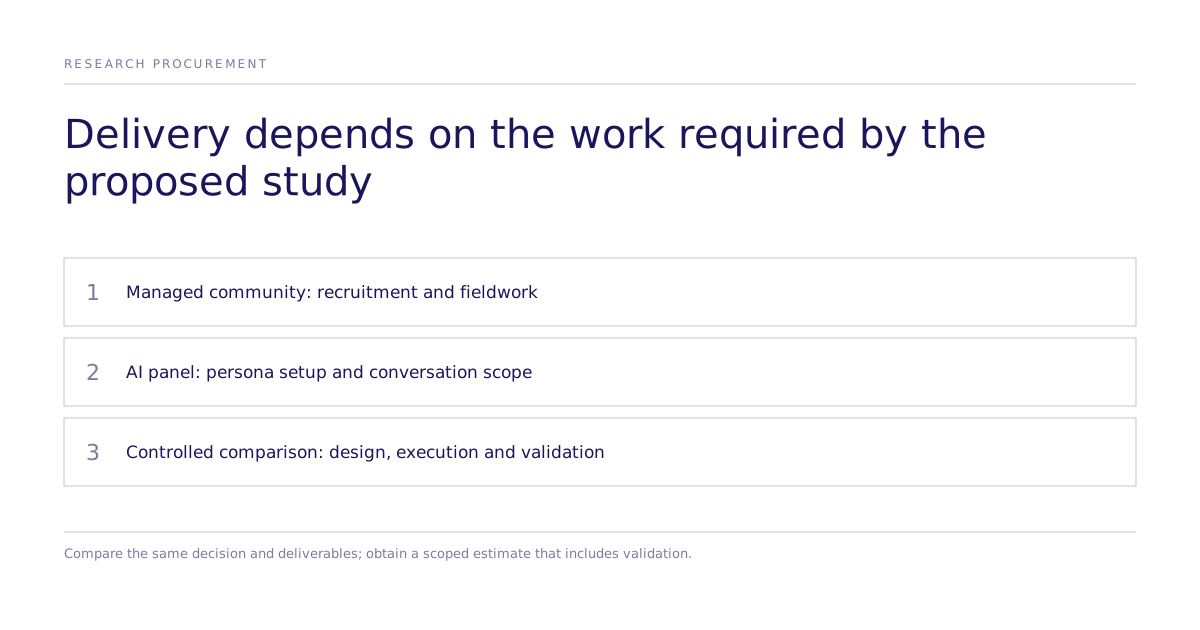
| Causal experimentation platform | Estimated effects of randomized alternatives on the study's measured outcome, with uncertainty where supported | Experimental design, execution and validation | Decision-specific comparisons, with human validation matched to the risk |
Request a delivery estimate for the same decision, audience and deliverables. Include the validation required before using the result.
Using more than one model without confusing them
These three models are not interchangeable, and they are not always sequential. A team might run a self-serve panel conversation to sharpen a hypothesis, then design a randomized causal experiment to test the resulting alternatives, and reserve a managed community study for the long-running relationship work a single experiment isn't built for. What breaks is treating any one model's output as another model's proof: a persona's stated preference is not a causal estimate, and a causal estimate from a simulation is not a claim about a specific recruited sample unless validated against real human behavior.
Limitations
A causal experimentation platform does not replace a managed research community for long-running relationship-based programs. Exploratory persona conversations are useful for early hypothesis generation; they are not a source of causal proof, and no accuracy percentage from any vendor should be read as settling that question. Pricing scenario testing, confidence intervals, and automated recommendation outputs are not standing claims here; treat them as decision-specific outputs that depend on how a given study is designed.
A useful next step
Start with the decision, not the tool. Name the action under consideration, the audience, and the outcome that matters, then match the model to what the decision requires: a managed community for a deep relationship program, a self-serve panel conversation to sharpen a hypothesis, or a randomized experiment when the team needs to know which action moves the outcome before committing budget. Or talk through a specific decision.