Network Simulation, Persona Chat, or a Causal Test: Picking the Right Tool Before a Launch Decision
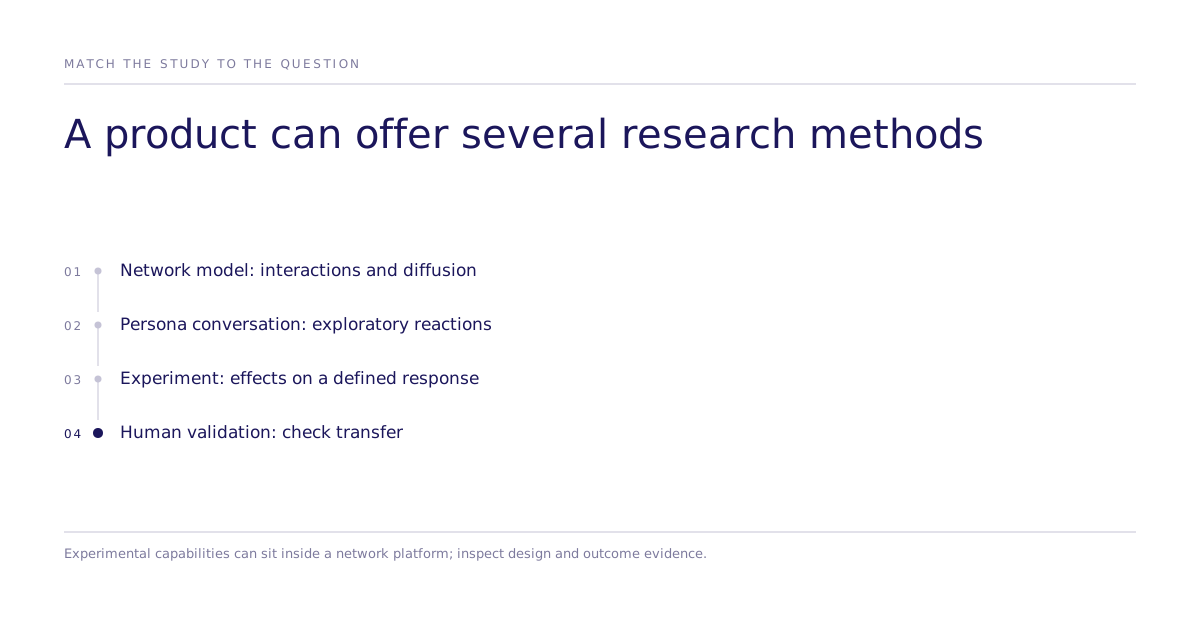
Before a launch decision, a team may need to understand how a message spreads, explore how a customer describes a problem, or compare specific alternatives. Network models, persona conversations, and controlled experiments can serve these different questions. A product may combine them, so inspect the actual study design rather than infer its evidence from the interface.
How do network models and persona conversations differ?
A network model connects simulated agents to examine interactions and how opinions spread. Artificial Societies describes interconnected personas and several research methods, including scenario cascades, multiverse experiments, and conjoint analysis. A diffusion model can make propagation assumptions visible; its correspondence with a real audience still needs validation.
A persona conversation lets a researcher ask questions of an individual simulated profile and follow up on the answers. The output resembles interview notes. It can suggest hypotheses and reveal how the model frames a problem, but a transcript alone does not estimate the effect of choosing one launch alternative over another.
Network platforms can also compare alternatives. Artificial Societies describes experiments across copies of participants and conjoint trade-offs. Ask how the proposed comparison assigns conditions, measures an outcome, reports uncertainty, and checks those simulated effects against human evidence.
What does the interface leave unresolved?
The launch question is usually narrower than a general audience description: which message, price, or offer should ship? Diffusion traces and interview responses alone do not identify that contrast. An experimental workflow can compare alternatives, including within a network model, but the resulting simulated effect still needs evidence of relevance to the real decision.
How do you test the alternatives directly?
Subconscious uses controlled choice experiments to compare concrete alternatives in a simulated study. Randomized attributes support estimates of their effects on generated choices. The July 2026 causal-fidelity working paper, not peer reviewed evaluates agreement between estimated choice parameters and corresponding human studies. That endpoint is different from propagation accuracy, observed purchases, or guaranteed launch performance; compare like tasks before using a fidelity result.
| Approach | Core question it answers | What it produces |
|---|---|---|
| Network-propagation simulation | How might a message spread through an interconnected audience? | A model of diffusion and influence across a simulated population |
| Individual persona conversation | What does this specific customer type say when asked? | A set of per-profile reactions, closer to interview notes |
| Controlled choice experiment | Which randomized attribute changes generated choices within the study? | Estimated choice effects and their uncertainty where the design supports it |
Where does a causal test stop?
A choice experiment requires defined alternatives and a measured response. If propagation is central to the decision, ask whether the study explicitly models network exposure and interactions. If the question requires real participants, a simulated choice comparison does not replace recruitment; it can help specify the question for a human study.
How do you move from a simulated comparison to real people?
A real-human study can test the same question and alternatives. Align the target population, instrument, measured outcome, and analysis, and record changes made for fielding. Compare the resulting estimates and uncertainty before treating the simulation as evidence for that population.
For teams comparing network platforms and persona tools, start with the needed output: diffusion under stated assumptions, exploratory reactions, or a comparison of specific options. Review aggregate validation evidence, then use how the process runs or a walkthrough to define the decision-specific evidence required.