Panel Marketplace, Persona Chat, or Causal Experiment: Choose by the Decision
A panel marketplace, a synthetic persona chat, and a controlled causal experiment answer different research questions. Choose a panel marketplace when the study requires recruited respondents. Use persona chat to develop hypotheses. Use a controlled choice experiment when the business must compare how defined alternatives change a stated choice response before committing budget.
The costly error is asking exploratory output to carry a pricing, messaging, or positioning decision. If the method never compared actions under controlled conditions, it cannot isolate what caused the result.
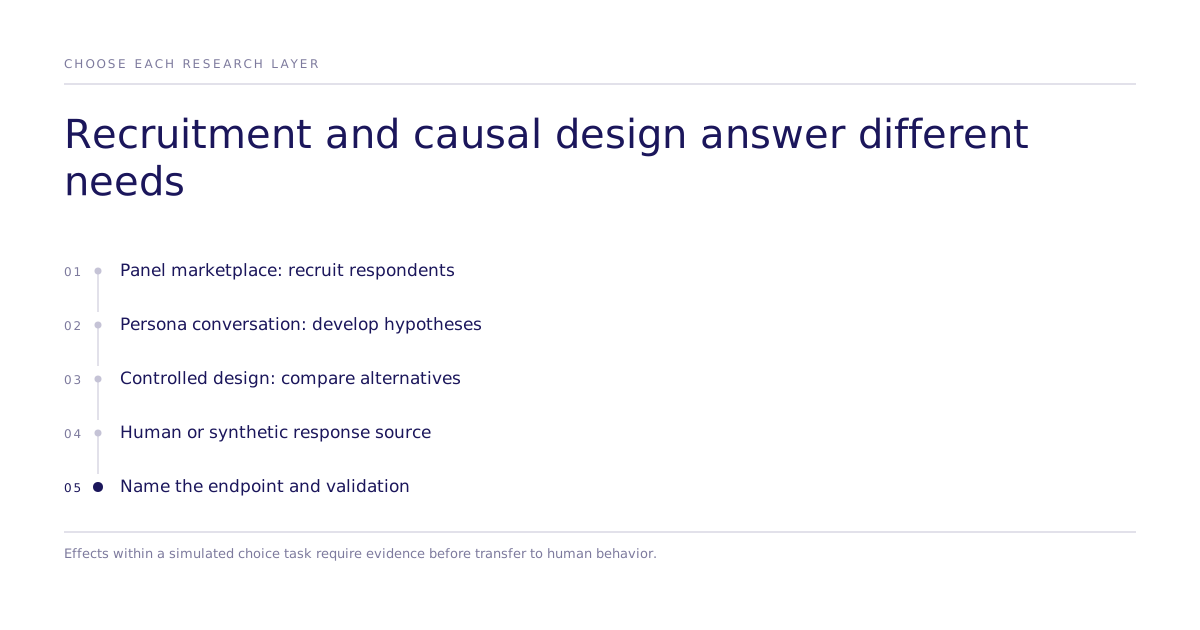
Match the tool to the evidence required
A panel marketplace supplies recruited respondents to research applications through an API, as described in its respondent-sourcing documentation. That is a fieldwork capability. It does not turn a survey into a causal experiment.
| Research layer | Question it can answer | Appropriate use | What it cannot establish alone |
|---|---|---|---|
| Panel marketplace | What do recruited respondents report? | Tracking studies, syndicated research, or workflows that require a respondent-supply API | Which action caused a difference in buyer behavior |
| Synthetic persona chat | What hypotheses or reactions should the team examine? | Early exploration and question development | Whether one action changes an outcome relative to another |
| Controlled choice experiment | Which product, price, message, or position changes the measured choice response? | Decisions that require a randomized comparison of alternatives before budget or roadmap commitment | Observed behavior of recruited people without a matched human study |
What is the substitution risk?
Persona chat can surface language, reactions, and hypotheses worth testing. The boundary appears when a team treats those outputs as evidence that one proposed action will outperform another. A conversation is not a designed comparison, and a directional response is not an estimate of causal effect.
The same boundary applies to ordinary fieldwork. Recruiting real people improves the relevance of the respondent source, but respondent identity does not determine study design. A survey can involve real people and still fail to isolate the effect of a price, claim, or launch message.
When the evidence does not match the decision, the contradiction arrives after spend is committed. The larger cost is not the research spend but acting on a signal that was never designed to answer the business question.
How do you build one causal question through the stack?
Start with the action the business can take. For example: choose price A or price B, lead with claim A or claim B, or launch position A or position B. Then define the buyer choice that would distinguish the alternatives.
Subconscious runs controlled discrete-choice experiments with generated responses to estimate how randomized alternatives change choices inside the simulated study. Inspect the modeled population's provenance and limits separately from any real-human recruitment plan.
When the stakes warrant human evidence, design a real-human study of the same alternatives and decision logic. Align the population, instrument, endpoint, and analysis, and document differences. That study can test transfer; it does not guarantee market performance or replace research judgment.
Keep fieldwork in the design when it belongs there
A research stack still needs a panel marketplace when:
- A tracking study or syndicated research product depends on repeated fielding with recruited respondents.
- An existing research application needs a respondent-supply API, following a workflow such as the provider's documented demand integration.
- The methodology or stakeholder requirement calls for recruited human fieldwork.
A controlled choice study is a different layer from respondent supply. It compares alternatives on generated responses and does not stand in for fieldwork. Obtain fieldwork scope, terms and pricing separately from the respondent-supply provider or research agency, and keep human research operations wherever the methodology requires them.
How do you route the study by its decision?
Need recruited respondent supply: choose the fieldwork layer. Need candidate hypotheses: use exploration. Need effects on a defined choice response: design a controlled comparison with the appropriate respondent source and a validation plan.
Review the research approach to assess the method. When the decision and alternatives are defined, scope the study.