Persona Chat, Product Simulation, or Causal Experiment: Choosing How to Validate a Roadmap Call
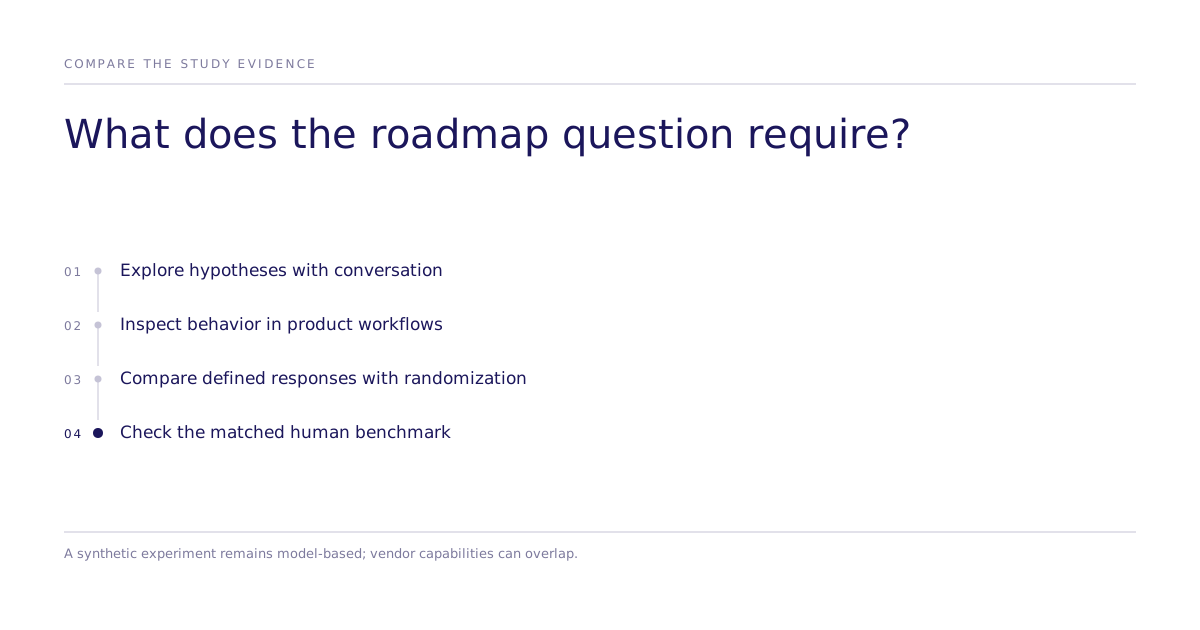
A product leader considering a feature, pricing change, or roadmap priority may need exploratory conversations, simulated product workflows, or a randomized comparison of alternatives. These capabilities can overlap. The useful distinction is what the study measures and how that response has been checked against real customers.
The question each method actually answers
Open-ended persona conversation answers "how does our customer reason about this, and what am I not anticipating?" It is exploratory by design: a team talks to a simulated customer type and follows the conversation wherever it goes, often surfacing objections nobody wrote into the brief.
Seldon describes simulated user workflows for examining concepts, adoption, friction, and product changes. Its site attributes persona construction to user analytics and ethnographic research. Ask for the proposed task, behavioral benchmark, assignment protocol, and uncertainty rather than infer the study design from the simulator label.
A controlled choice experiment asks how randomized attributes change the measured choice response. Subconscious uses discrete-choice studies with generated responses to estimate those effects, with uncertainty where supported. This remains a model-based simulation; randomization within the study does not alone establish an effect on real customers.
What backs the number?
A workflow simulation and a choice study may both produce quantitative results. Compare the actual task, alternatives, assignment, response generator, estimator, and human validation.
Randomized assignment supports an effect estimate for the outcome and population represented in a study. A simulator can include that design, too. Seldon's public homepage describes workflow tests and behavioral fidelity, but does not provide enough assignment and analysis detail to classify every proposed study as experimental or nonexperimental.
Neither approach replaces exploratory persona conversation. Discovering an objection nobody anticipated is a different job from measuring the size of an effect once the team already knows what it's testing.
Comparing the three approaches
| Persona conversation | Product-outcome simulation | Controlled causal experiment | |
|---|---|---|---|
| Primary question | What hypotheses might this profile suggest? | How might users act in the proposed workflow? | How do randomized attributes change a defined response? |
| Output | Exploratory reactions and objections | Simulated behavior, with details dependent on the proposed study | Estimated effects within the study, with uncertainty where supported |
| Best used for | Discovery and question development | Evaluating specified product workflows | Comparing specified choice alternatives |
| Evidence to check | Prompt and profile assumptions | Matched behavioral benchmark and study design | Assignment, estimator and transfer to human choices |
What does Subconscious add to this stack?
Subconscious uses generated responses in controlled choice studies. Inspect population construction and its limits. A consequential decision may call for a real-human study using the same alternatives and causal question, with differences in population, instrument, and fielding recorded.
An effect estimate and its interval describe the study's response model. Human fidelity and market relevance are separate questions that need corresponding evidence.
What are the limitations of a causal experiment?
A causal experiment only answers the question it was designed to test. If the roadmap decision itself is still unclear, and the team doesn't yet know which options belong in the decision space, an experiment run too early is answering a question nobody asked yet.
A human validation study can check the question tested in simulation. It does not automatically turn a choice task into an observed usability session or establish market performance. Examine whether the recruited population and measured response match the intended decision.
Next step
Teams evaluating how to validate a specific decision can see the mechanics of a controlled study in how Subconscious runs an experiment or review completed studies to see what a measured effect and its confidence interval look like in practice.