Persona Chat or a Structured Choice Experiment: Which Evidence Should Back a Market Decision?
Use a one-on-one persona chat to explore language and rehearse an argument. Do not use one simulated character's reaction to greenlight a pricing change, message, or launch. A structured choice experiment across generated respondents can compare defined alternatives on a stated choice endpoint. A consequential commitment also needs human or live confirmation of the same contrast, and a statement of the uncertainty that remains.
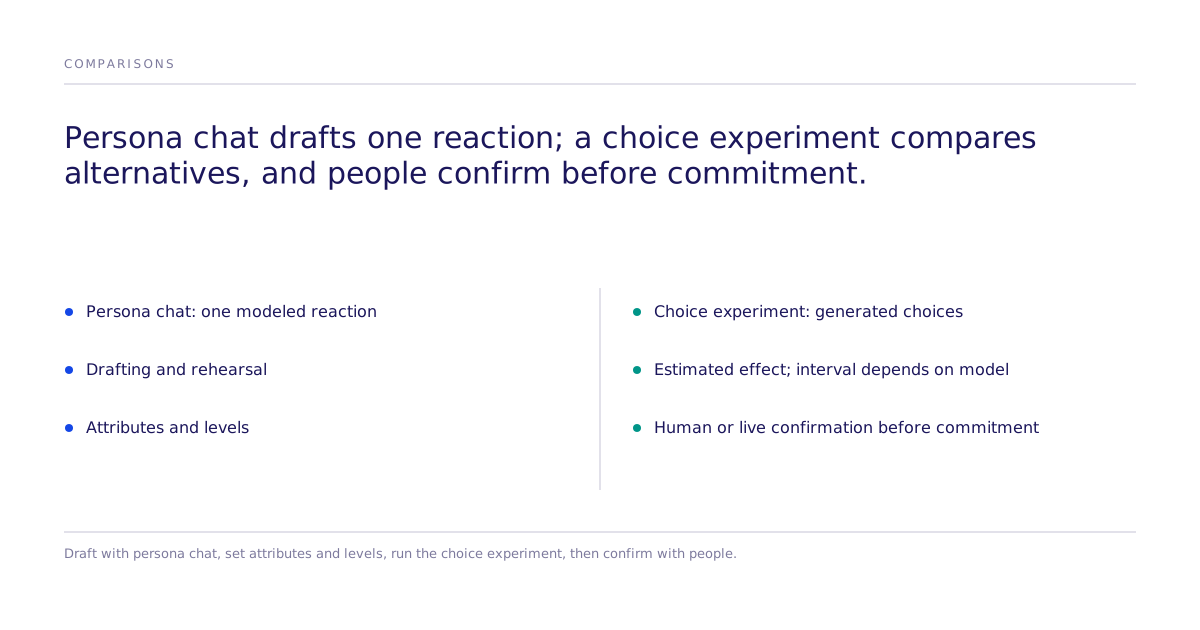
Match the evidence to the decision
The useful distinction is not which interface feels more conversational. It is whether the decision needs qualitative exploration or quantified evidence.
A persona chat can help a team rehearse a sales pitch, challenge a message draft, or review a landing page from one simulated point of view. A published product demonstration presents persona-based website feedback as candid qualitative critique (product demonstration). That is appropriate while the team is still shaping the question.
A pricing, positioning, or launch commitment asks a different question: how does changing an attribute affect choice across a defined audience? A single conversation cannot estimate that population effect or its uncertainty.
How does a structured choice experiment work?
Subconscious.ai runs randomized discrete choice experiments on panels of synthetic respondents. The design randomly varies the attributes under consideration, such as price, message, or feature bundle, and each generated respondent chooses among the alternatives shown. The response is a generated choice, not an observed purchase.
Estimation is a separate step from design. An analyst fits a discrete choice model, such as Mixed Logit, to the generated choices and reports the estimated effect of each attribute with an interval. That interval depends on the model, the random assignment and the measurement. It does not show how recruited people will respond.
That evidence is appropriate when a team must compare concrete alternatives before deciding what to confirm with people. The method and its limits are described in the July 2026 causal fidelity working paper, which is not peer reviewed. Its aggregate results concern rank agreement of estimated choice parameters with human studies, not agreement on effect size or realized market outcomes. See case studies for applied examples.
The practical split
| Decision dimension | One-on-one persona chat | Structured choice experiment |
|---|---|---|
| Evidence produced | One simulated character's qualitative reaction | Estimated effects of defined alternatives on generated choices, with uncertainty that depends on the model and design |
| Question it answers | How might this argument land with one modeled buyer? | How does changing an attribute affect generated choice in a defined audience? |
| Best decision stage | Drafting, roleplay, and initial message review | Comparing alternatives before human or live confirmation of a pricing, positioning, or launch commitment |
| Core limitation | Cannot estimate a population effect | Generated choices are not observed behavior; transfer to recruited people needs matched human evidence |
When should you use persona chat versus a choice experiment?
Start with persona conversation when the work is exploratory. Turn the strongest alternatives into explicit attributes and levels once the team can state the choice it needs to make. Then run the structured choice experiment to rank the alternatives. For a consequential commitment, confirm the leading contrasts before relying on them.
When the commitment warrants it, plan a matched human study of the same alternatives, population and response endpoint, scoped and recruited separately. The simulated study does not guarantee it. Review the research approach before relying on any comparison. Keep the simulated and human populations distinct in the write-up.
What can the result tell you and what can't it?
A persona conversation remains qualitative input, not measured buyer preference. A synthetic panel estimates effects on generated choices within its defined audience and experimental design; it does not automatically prove market performance or replace recruited-human evidence.
The right workflow preserves those boundaries. Use conversation to form the alternatives, structured choice evidence to compare them, and human validation when the risk requires it. Review the full research workflow or scope a decision experiment.