Persona Chat, Survey Research, or Causal Experiment?
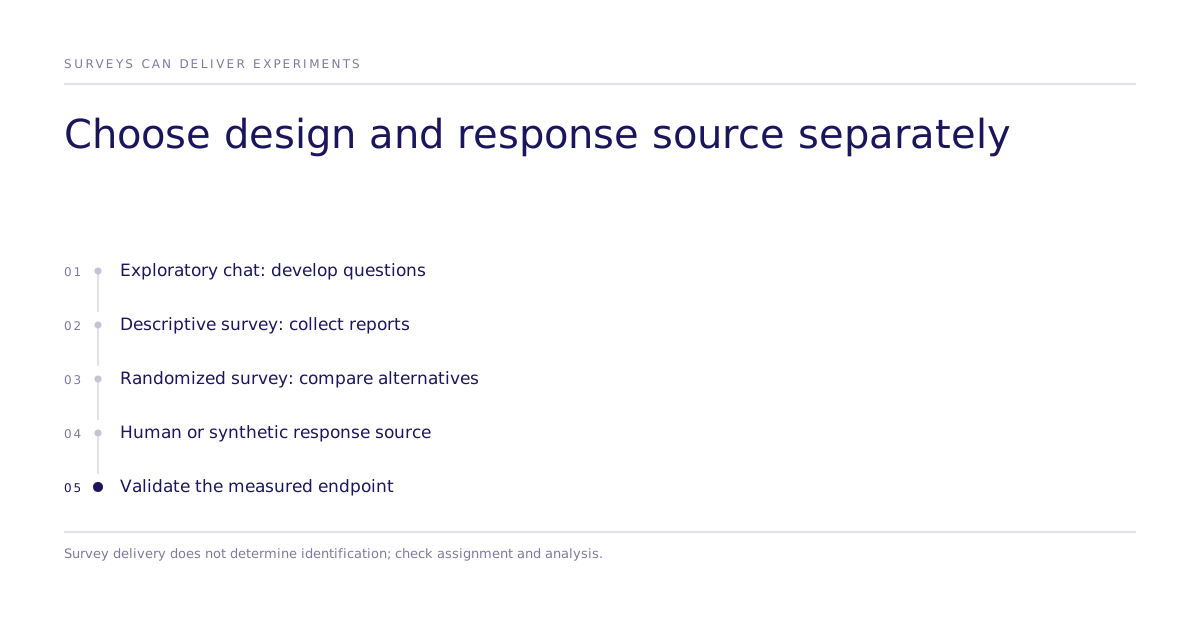
Persona chat can develop research questions. A survey can collect descriptive responses or deliver a randomized experiment. For a pricing, messaging, positioning, or launch decision, choose the design by the evidence needed, then choose the appropriate human or synthetic respondent source.
What is at risk if you choose the wrong research method?
The cost of choosing poorly is not an imperfect research artifact. It is the budget, positioning, or product decision made from evidence that cannot answer the underlying question.
An open-ended persona conversation can surface hypotheses, objections, and language worth investigating. A nonexperimental survey describes what respondents report, without by itself identifying an action's effect. A randomized survey or choice experiment can compare specified alternatives and estimate their effects on the measured response.
Match the method to the buyer's question
Questionnaire delivery, respondent source, and identification are separate choices. The table distinguishes workflows that can share the same platform.
| Buyer question | Persona chat | Survey research | Causal experiment |
|---|---|---|---|
| What should we investigate? | Explores themes and possible objections through open-ended conversation | Tests a structured set of questions | Requires defined alternatives rather than an open-ended prompt |
| What does the target population report? | Produces simulated conversational responses | Collects responses under a questionnaire | Measures choices among specified alternatives |
| Which option changes the outcome? | A conversation alone does not estimate the effect | Can estimate effects when it contains a suitable randomized design | Estimates effects on the specified response, with uncertainty where supported |
| What must the team define? | Persona and prompt | Sample, questionnaire, and analysis plan | Population, alternatives, outcome, and experimental design |
A discrete-choice experiment presents defined alternatives and analyzes observed choices to estimate how changes in their attributes affect preference. Statistical guidance treats experimental design, model selection, and interpretation as connected parts of that analysis. ISPOR's good research practices for discrete-choice experiments describes those method choices.
Keep the causal question intact
Subconscious runs controlled discrete-choice studies with generated responses. Randomized attributes support estimates of effects on choices within the simulation. A real-human validation study can check whether the same contrast holds in the target population.
The practical advantage is decision alignment. A team testing a price does not receive an unstructured conversation about price; it receives evidence about the alternatives in the decision. The same applies to a message, positioning choice, or launch option.
For a consequential call, scope a human study separately, with the same alternatives, population and response endpoint as the simulated contrast. Recruitment and the human result are not guaranteed by the simulated study. The simulated result and the human result remain distinct evidence, and case studies show how that evidence is applied.
What does the choice study require?
The study described here requires a defined decision, alternatives that can be compared, and a measured response endpoint. If the team needs open-ended conversation or an ongoing survey program instead, request that workflow separately and judge it on its own evidence.
Real-human validation does not turn a choice study into an observed usability session, a clinical trial, or automatic proof of market performance. High-stakes decisions still require judgment about the population, study design, uncertainty, and external evidence. The validation leaderboard gives context for evaluating simulated research against human behavior.
Use the procurement conversation to expose the difference
Ask each provider to state what its output can support:
- Can it name the population against which the result applies?
- Does it compare the actual alternatives under consideration?
- Does it return an effect estimate and confidence interval?
- Can the causal question remain unchanged during real-human validation?
- Which decisions fall outside the method?
If the team cannot define the action or alternatives, begin with exploratory research. If it needs reported responses, specify a survey. If it needs effects of alternatives, build a controlled design, which may be delivered through that survey. The experiment process shows what must be specified before testing.