Persona Chat vs. Controlled Discrete-Choice Experiments: Choosing the Right Research Method
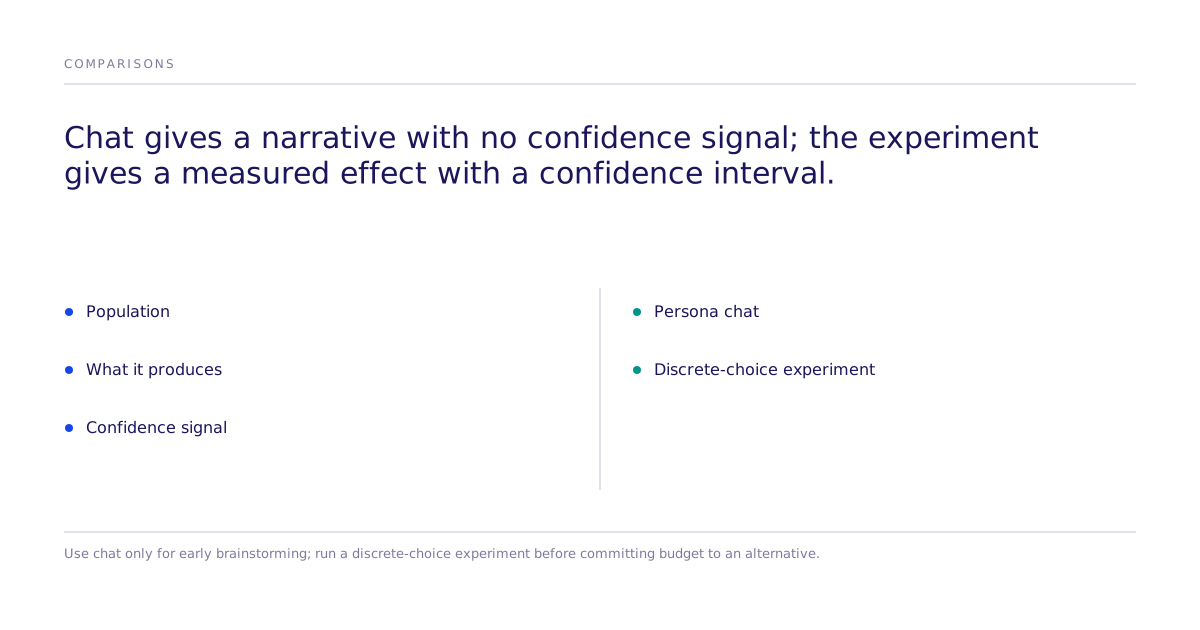
Two things get lumped together as "AI market research" that measure completely different things: an open-ended conversation with a chatbot persona, and a controlled discrete-choice experiment run against a defined population. The chat gives you a plausible-sounding impression. The experiment gives you a measured effect with a confidence interval. Confusing the two is the actual risk, not which vendor you pick.
The decision this comparison is actually about
A research, product, or marketing leader has been running ad hoc persona conversations in a general-purpose chatbot to get a read on a customer segment before a positioning, messaging, or product decision. The question is not "which chatbot persona is better." It is which category of tool the decision needs: an open-ended interview that produces one plausible narrative, or a controlled experiment that measures which alternative changes stated choice for a defined population, with a confidence number attached to the read.
Getting the category wrong is the expensive mistake. Treating a single persona conversation, or a vendor's self-reported accuracy figure, as a measured result can send budget toward a message, price, or feature direction that a rigorous test would have shown does not move the target population.
What an open-ended persona chat produces
Prompting a general-purpose chatbot to "act as" a customer segment produces a conversational impression. It is fast and useful for early brainstorming, not a measurement:
- The persona is a prompt, not a population. Two people writing the same brief into the same chatbot will get two different personas, because the persona's behavior depends on how the prompt was written, not on a defined sampling frame.
- The output is a narrative, not a comparison. A chat produces an opinion in response to a question. It does not compare two or more concrete alternatives (a price, a message, a feature) and report which one changed the audience's stated choice, or by how much.
- There is no confidence interval. A chat response reads as confident regardless of how reliable it actually is. Nothing in the output tells you whether the "reaction" would hold up against a second independent sample.
Chat-based exploration is a reasonable way to think out loud before the decision is defined. It is a poor substitute for evidence once real budget is on the line.
What a controlled discrete-choice experiment measures
A discrete-choice experiment starts from a different premise: define the population, define the alternatives, and measure which alternative changes what people say they would choose. Subconscious runs these as structured causal experiments (McFadden discrete choice and mixed logit models) over synthetic populations, and returns the measured effect of each alternative together with a confidence interval, not a single narrative reaction.
- A defined population, not an improvised persona. The population a test targets is specified up front and held constant across the alternatives being compared.
- A controlled comparison, not an open-ended conversation. The experiment tests two or more concrete alternatives against each other and reports which one wins and by how much.
- A measured effect with a confidence interval, not a plausible-sounding answer. The result states how much a given alternative changes the outcome, and how much uncertainty surrounds that number.
Comparing the three ways teams actually make this call
| Method | Population | What it produces | Confidence signal |
|---|---|---|---|
| Internal debate or gut call | Whoever is in the room | An opinion, informally weighted by seniority | None |
| Open-ended chatbot persona chat | An improvised prompt, not a sampling frame | A narrative reaction to one framing at a time | None |
| Controlled discrete-choice experiment | A defined population, held constant across alternatives | A measured effect for each alternative, compared directly | Confidence interval on the measured effect |
The first two methods are useful for exploration. Only the third produces a number a team can defend when the decision is expensive to get wrong.
Where each method actually fits
Open-ended persona chat is the right tool when a team is thinking out loud, drafting early messaging options, or exploring a segment before the decision itself has been defined. Its maker positions it that way, for broad, ambitious knowledge work rather than as a research-measurement tool (OpenAI, "ChatGPT is now a partner for your most ambitious work"). That framing fits drafting and brainstorming, not measuring which alternative changes stated choice.
A controlled discrete-choice experiment is the right tool once the team has narrowed to concrete alternatives (two or more prices, messages, or feature framings) and needs to know which one actually changes the target population's stated choice, with enough confidence to commit budget behind the answer. Research and the leaderboard show how these experiments are structured and validated across studies.
From a simulated experiment to real-human confirmation
Naming the next verification step is part of publishing a result honestly. A team can move from a synthetic discrete-choice experiment to a recruited real-human study on the same causal question without changing what is being tested; only the respondent source changes. That step matters when a decision is large enough to justify a second, independent check before commitment.
Limitations
A controlled discrete-choice experiment on a synthetic population is a decision-support signal, not a substitute for direct human research ahead of a high-stakes launch or a major repositioning call. It narrows which alternatives are worth testing further and quantifies the uncertainty in that narrowing; it does not replace judgment, and it is not a clinical trial or a usability study.
Frequently asked questions
Is a chatbot persona conversation ever good enough?
For early exploration and brainstorming, yes. Once the decision comes down to two or more concrete alternatives and the cost of choosing wrong is real, a narrative reaction from one improvised persona is not enough evidence to act on.
What makes a discrete-choice experiment different from a persona chat?
A discrete-choice experiment defines the population and the alternatives up front, then measures which alternative changes stated choice and by how much, with a confidence interval attached. A persona chat produces one narrative reaction to one prompt, with no defined population and no confidence signal.
Do teams need to choose only one method?
No. Open-ended exploration is often how a team narrows down which alternatives are worth testing. The controlled experiment comes after that narrowing, once the decision is concrete enough to measure. See how we work for the method, or book time to scope a specific comparison.