Persona Chat vs. Designed Panel Study: Which One Answers Your Next Decision
A marketing or product research lead facing a go/no-go call has two very different tools available: a persona built from the analytics and CRM data a company already has, or a designed panel study that varies one thing at a time and measures the effect on stated behavior. Picking the wrong one doesn't just waste a research budget. It can put a pricing or positioning decision on an answer that was never built to carry that weight.
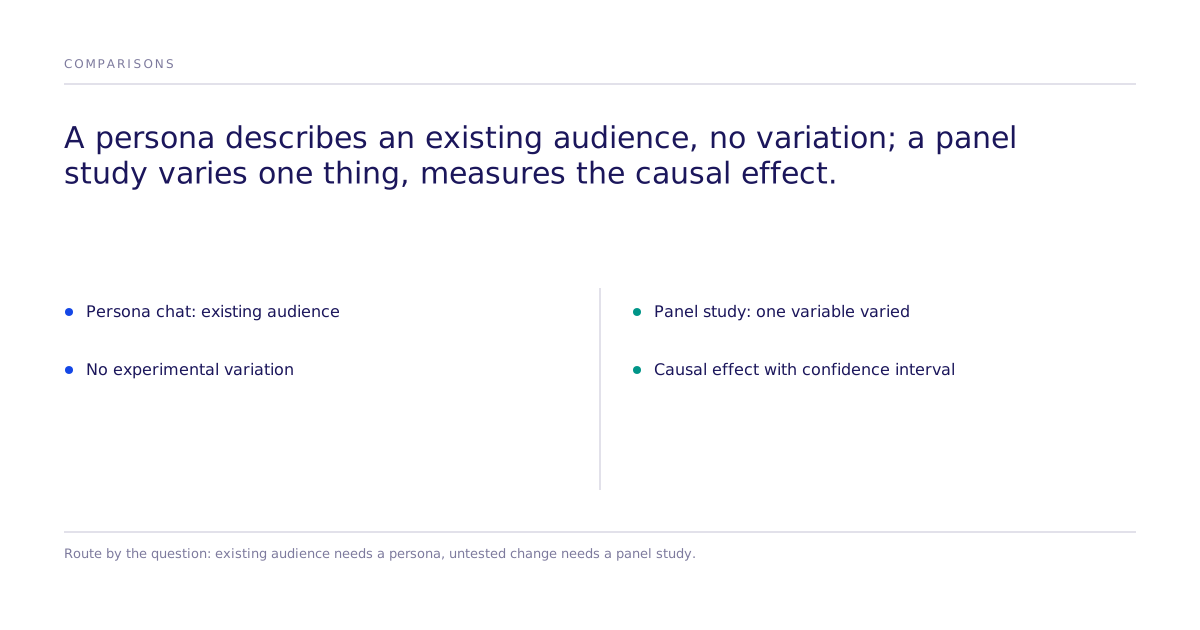
What an analytics-grounded persona can and can't tell you
Several vendors build chat-style personas directly from a company's existing analytics and CRM data, letting a team query an audience segment in natural language (product overview). The persona reflects the audience a company has already reached: real segments, real behavior patterns.
A number published without its limits is marketing. That grounding is also the boundary. It cannot tell a team how a market it hasn't reached yet, or a price, message, or feature it hasn't shipped, will move behavior, because there is no experimental variation behind the answer and no confidence interval attached to it. Ask the persona what a price increase does to renewal and it will produce a fluent, confident-sounding answer. Nothing in the underlying data tested that price.
What does a designed panel study measure?
A designed panel study starts from the opposite end. It holds everything constant except one variable under debate (price, message, feature, packaging) and measures how a defined population's choices shift. That is the same logic behind a randomized controlled experiment, applied to a market question instead of a lab question.
Subconscious runs this kind of study as a controlled discrete choice experiment (McFadden DCE, Mixed Logit, ICLV) against a defined synthetic population, and reports the causal effect of the change along with a confidence interval. That is not a description of who is in an existing segment; it is an estimate of what a specific change does to behavior.
Where each tool actually fits
| Analytics-grounded persona | Designed panel study | |
|---|---|---|
| Best question it answers | Who is already in my data, and what do they say when asked? | What happens to behavior if I change this one thing? |
| Data it is built from | Connected analytics and CRM history | A population defined for the specific decision |
| What varies | Nothing. It describes an existing audience | One variable, held against a controlled alternative |
| What comes back | A conversational description of an observed segment | A causal effect estimate with a confidence interval |
| Where it breaks | A market or change that has not yet been observed | Questions with no experimental design behind them |
The table is a routing tool, not a scorecard.
The failure mode this causes in practice
Naming a failure mode here lets a buyer check for it before a decision ships on it. The costly mistake is not picking the wrong tool in the abstract. It is treating a persona chat's fluent answer as if it were a causal forecast. A team that asks a data-grounded persona how customers will react to a new price, and ships against that answer, has skipped the step where anyone varied the price and measured the response. The persona was designed to describe people the team already knows, not to test that change.
The tell is in the question itself. "What does my audience look like" and "what does this specific change do to behavior" are different questions, and only one of them requires an experiment.
Where does Subconscious fit, and where doesn't it?
Subconscious is the right tool once the question is which specific change in price, message, or feature is likely to move behavior, not what an existing audience looks like. It isn't a substitute for a persona tool when the job is querying an audience already built from a company's own data.
Our best configuration reaches 87% of the measured human ceiling on one study: 0.832 rank correlation against the published human result, where two independent samples of real humans reach 0.959. Across all 43 studies that pass design filters the mean is 0.73. It is a validation result, not a guarantee for a new market. See the causal fidelity paper. A team can also move a study from simulation to a recruited real-human validation on the same causal question, without redesigning the comparison. That is useful when the decision is large enough to warrant a second, independent check.
Limitations
The misses sit on the page next to the hits so a buyer can weigh both before trusting a result. A designed panel study still depends on someone specifying the right alternatives and the right population; a badly designed experiment produces a confident-looking effect estimate for the wrong question. A controlled study also only answers the specific comparison it was built for. It does not retroactively describe an existing customer base the way an analytics-grounded persona does.
Next step
An audience already reached calls for an analytics-connected persona tool. A specific price, message, or feature change calls for a designed experiment with a measured effect and a confidence interval. Review current replication results and how a study gets built, or talk to the team about the decision on the table.