A Persona Document Names the Buyer. It Doesn't Test the Decision.
A buyer persona document is not enough evidence to greenlight a campaign, message, or pricing decision. It organizes what a team believes about its buyer, not which action will change that decision.
Use the document to align the team on whom it wants to reach, and a decision-specific experiment for evidence on what to do next.
The two artifacts solve different jobs
HubSpot presents its free offering as a buyer-persona template generator. Its output is an alignment artifact: a shareable profile that captures the target buyer's role, goals, challenges, and motivations.
A randomized choice experiment compares defined actions for a defined buyer population and estimates which action changes the specified response in the study.
| Buyer question | Persona document | Randomized choice experiment |
|---|---|---|
| What does it establish? | Who the team intends to reach | Which defined action changes the measured response in the study |
| What goes in? | Existing knowledge, assumptions, goals, and challenges | A buyer population, actions to compare, an outcome, and constraints |
| What comes out? | A static, shareable one-page profile | A comparative estimate with uncertainty where the study design supports it |
| When is it useful? | Workshops, briefs, pitches, and internal alignment | Campaign, message, product, or pricing decisions with a meaningful cost of being wrong |
| What does it not prove? | How the market will respond | The exact future market outcome |
The costly category error
A persona can say that a buyer values simplicity. It does not show that a simplicity claim will change preference, adoption, or purchase choice relative to another claim.
The category error happens when a team treats the description as validation, selecting a campaign or price because it sounds consistent with the profile, then committing budget without testing the action. If the assumption is wrong, the team learns only after the market has seen the decision.
Subconscious runs randomized comparisons of product, pricing, messaging, and go-to-market alternatives on a market simulation. The study estimates effects on a defined generated response before a team commits capital.
How do you turn a persona into a testable decision?
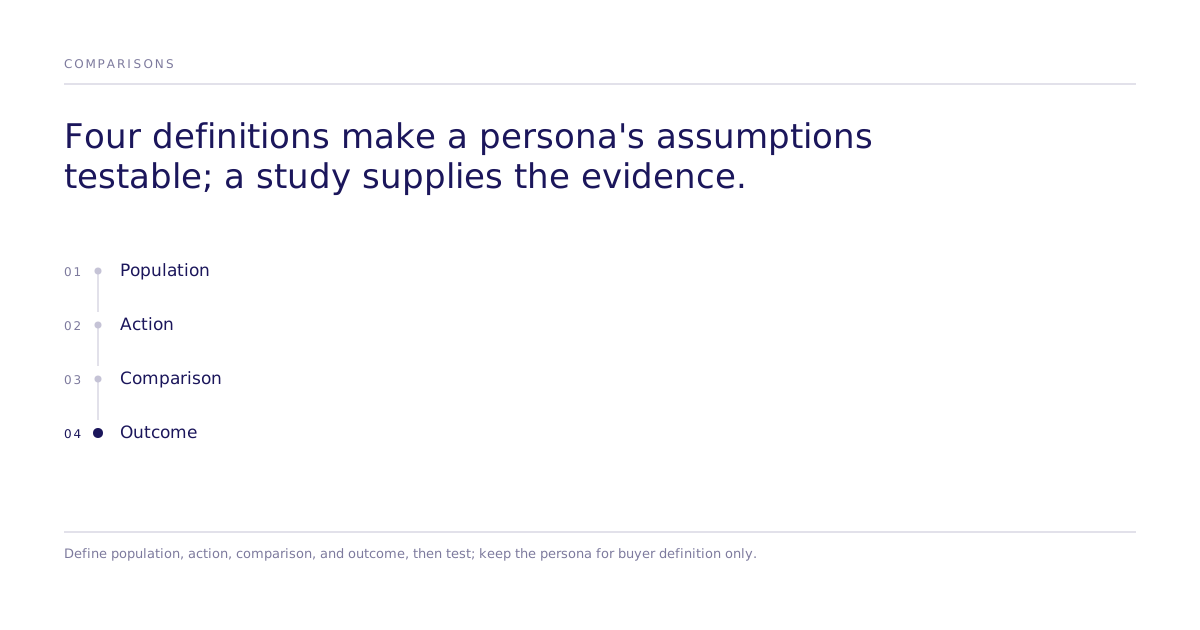
A persona can frame an experiment if the team converts its assumptions into four choices:
- Population: Which buyers does the decision concern?
- Action: Which message, price, or product choice is under consideration?
- Comparison: What credible alternative will the team test against it?
- Outcome: Which choice or behavior would change the decision?
The four definitions turn a persona assumption into a testable question. The study, with its response source and limits, supplies the evidence. The persona stays in its proper role: defining the buyer population and generating hypotheses, not evidence for an action's effect.
Demand proof in proportion to the decision
A simulated experiment remains evidence under a model, study design, and set of assumptions, not automatic proof of market performance. Teams should inspect whether the experiment was replicated or validated, where it failed, and how uncertainty was estimated. Confidence intervals belong in the result only when the current study design supports them.
For decisions that need another layer of evidence, scope a human study separately, with the same alternatives, population and response endpoint as the simulated contrast. The recruited participants and the simulated population remain distinct evidence sources, and the simulated study does not guarantee that a human confirmation will follow. Neither study turns the comparison into a usability session, clinical trial, or guarantee of the launch result.
How do you choose based on the decision at hand?
Choose a persona generator when the deliverable is a document for a workshop, pitch, or internal brief. A persona document answers who the team intends to reach. The randomized choice study answers a different question: which defined action changes the measured response.
Add a causal experiment when choosing among actions and the cost of choosing poorly is material. Keep the buyer definition from the persona. Test the campaign, message, feature, or pricing scenario as a controlled comparison. Escalate to real-human validation when the evidence's stakes and limits warrant it.
If you have a defined buyer, competing actions, and an outcome that matters, bring the decision to Subconscious.