Persona Document, Simulated Reaction, or Causal Test: Choosing the Right Instrument
Use an Xtensio persona folio to share and update the buyer brief. Use simulated conversations to explore reactions. Use a controlled choice study to estimate how specified alternatives change the measured response, then check human relevance before a consequential commitment.
Why do people confuse these three tools?
All three tools talk about "personas." That surface similarity hides a real difference in what each one delivers.
Xtensio's persona generator creates editable, collaborative folios from a product and audience description. Teams can add research, update the content, and share a live link or export. Those document capabilities support alignment; they do not by themselves supply a validated experimental effect.
An interactive persona tool lets a team query modeled profiles or discuss several concepts. That can generate comparative feedback and hypotheses. Without a controlled assignment and analysis plan, however, the reactions do not estimate a population-level effect of changing the concept.
A controlled choice study varies specified attributes for a defined response population and estimates their effects on choices within that design. The response source may be human or synthetic and needs to be disclosed.
What each instrument produces
| Instrument | Output | Interactivity | What it tells you |
|---|---|---|---|
| Persona document (Xtensio) | Editable, shareable folio | Collaborate, update, and share | A buyer brief for alignment |
| Interactive AI-persona tool | A generated reaction to a prompt | Query and converse | What a modeled buyer might plausibly say |
| Controlled choice study (Subconscious) | Estimated choice effects with uncertainty where supported | Configured as a study | How randomized attributes change generated choices in that study |
A document organizes assumptions. Conversation can compare ideas informally. A randomized choice study supplies a defined contrast and an effect estimate; human fidelity remains a separate check.
When is a document the right call?
If the job stops at documentation, a document is the correct tool. Agencies producing client-facing deliverables, marketing teams running a workshop, or founders aligning advisors on who the customer is need something visual, polished, and easy to circulate. A persona document does that job well, and a controlled experiment does not replace it. A choice experiment addresses a different research question from a workshop persona folio: which of the specified alternatives changes the measured response.
When a simulated reaction is not enough
The risk appears when exploratory feedback is treated as evidence that a concept will improve a business outcome. A fluent reaction, even one comparing several options, does not supply the assignment protocol, estimator, or human benchmark needed to support that inference.
When does a controlled test change the answer?
Once the brief and candidate alternatives are clear, Subconscious can run a controlled choice study with generated responses. The result estimates effects inside that simulated task. Inspect population provenance and plan appropriate human confirmation before transferring the conclusion to a market decision.
A real-human study can test the same question and alternatives. Align the population, instrument, endpoint, and analysis, and record fielding differences so disagreements can be interpreted.
What a controlled test still doesn't replace
Use direct human research when the question requires observing real behavior firsthand: watching someone use a product, hearing an unscripted objection, or discovering a failure nobody thought to test. A generated choice comparison supplies a different endpoint.
Using more than one instrument on the same project
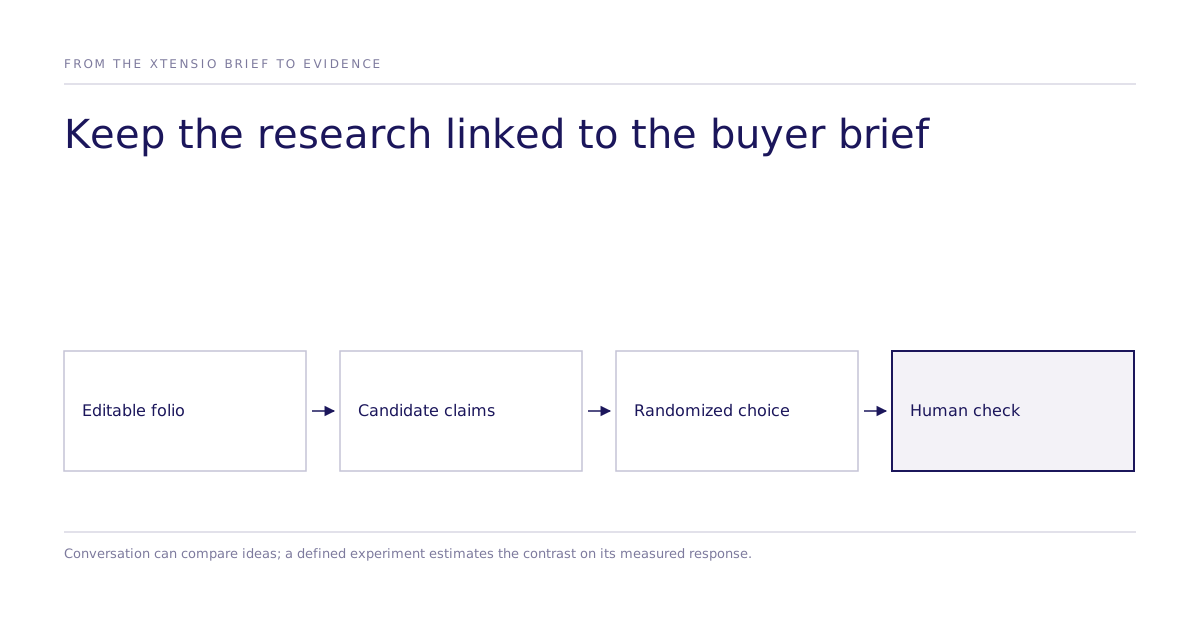
For example, an Xtensio folio might record the hypothesis that procurement leads value implementation effort. Keep the supporting interviews and assumptions in the folio. Draft two claims about onboarding, hold the offer fixed, and specify a choice endpoint among relevant buyers. A randomized study can estimate the claim contrast, including a no-clear-difference result. If the study uses generated responses, check the contrast with recruited buyers before a costly rollout. Keep the resulting evidence linked to the brief. See study design, methodology, or decision examples.
If the decision on the table is worth real spend, talk to the team about what a controlled test of that decision would look like.