Persona Documents, Persona Chat Tools, and Causal Buyer Tests
A persona document organizes buyer knowledge, and persona chat can suggest reactions worth investigating. A pricing or messaging decision needs evidence about the proposed contrast. For example, test a lower monthly price against the current price for the same offer, rather than infer its effect from the persona's story.
The static persona document
A persona document may combine roles, motivations, pain points, and research notes in a shared profile. The time needed to create or refresh it depends on the underlying research and how the team maintains it. Record which inputs are observed, inferred, or assumed, and update them when new evidence changes the buyer brief.
The document earns its keep as a shared shorthand: it gives a cross-functional team one name and one story to organize around. It was never designed to answer "how would this specific segment react to this headline," and using it that way asks it to do a job it cannot do.
What is a persona chat tool?
A conversational persona produces responses conditioned on its profile, prompt, and model. Teams can use those reactions to refine questions or candidate messages. Check the specific product's inputs, update workflow, and validation rather than assume common capabilities across vendors.
Academic work on this kind of language-model-simulated sampling has found that model-generated response distributions can track human survey and experimental responses on some stated-preference and economic-decision tasks, though the fit varies by task and population and is not universal (Argyle et al., 2023; Horton, 2023). That is evidence about how closely a language model's simulated answers can track a human sample on certain questions. It is not evidence that any specific chat persona has been validated for the launch, pricing, or messaging decision a team is about to make with it.
What neither approach proves
A persona document can be grounded in customer research and checked for relevance. A conversational model can also be compared with people on a specific questionnaire. Neither validation format alone establishes that a new price or message changes behavior; the study must compare the actual alternatives and measure a relevant response.
| Question a buyer needs answered | Static persona document | Persona chat tool | Controlled choice test |
|---|---|---|---|
| Who is the segment? | Yes, as a fixed description | Yes, as a configurable profile | Assumes a segment is already defined |
| Does it estimate the effect of changing price, message, or feature? | No | Not directly; answers are extrapolated from a conversation | Yes, that is the object being measured |
| Is uncertainty reported? | No | Not standardly | Yes, when the study design supports it |
| Can it be checked against real people on the same question? | The underlying assumptions can be checked | Yes; request matched task and population evidence | Yes; compare the experimental contrast and uncertainty |
The cost of treating either one as evidence
When a team greenlights a headline, a price change, or a feature bet because a persona document "would agree" or a persona chat tool "said" a certain thing, it is extrapolating from a description to a decision the description was never built to answer. If the guess is wrong, that shows up after the campaign has run, the launch has shipped, or the roadmap quarter is already spent, and the budget along with it.
Testing the actual decision
Subconscious runs randomized choice experiments with generated responses to estimate how specified attributes affect choices within a simulated study. That identifies a study-level contrast. Human fidelity and market transfer require corresponding evidence.
When a decision needs a stronger form of evidence, scope a human study separately, with the same alternatives, population and response endpoint as the simulated contrast. The simulated study does not guarantee that a human confirmation will follow.
When is a persona description still the right call?
A persona document or conversation can fit a kickoff brief and stakeholder alignment. Compare the actual work and procurement requirements before choosing a tool. A designed study becomes useful when the team needs evidence about alternatives it plans to act on.
When is a controlled test the right call?
The controlled test becomes worth the switch once a team is making a repeated, specific, budget-bearing decision against a defined segment, not orienting around one. A launch, a pricing change, or a message rewrite carries a real cost if the team is wrong. Consensus in a workshop, or a plausible answer from a persona chat tool, is not the same evidence as a designed experiment against that segment.
Limits of a causal experiment here
A controlled experiment does not replace the work of defining the segment. It answers the specific question it was designed to test, not every open-ended question a persona description might be asked. Real-human validation strengthens a specific causal estimate; it does not turn the study into an observed usability session, a clinical trial, or a guarantee of market performance.
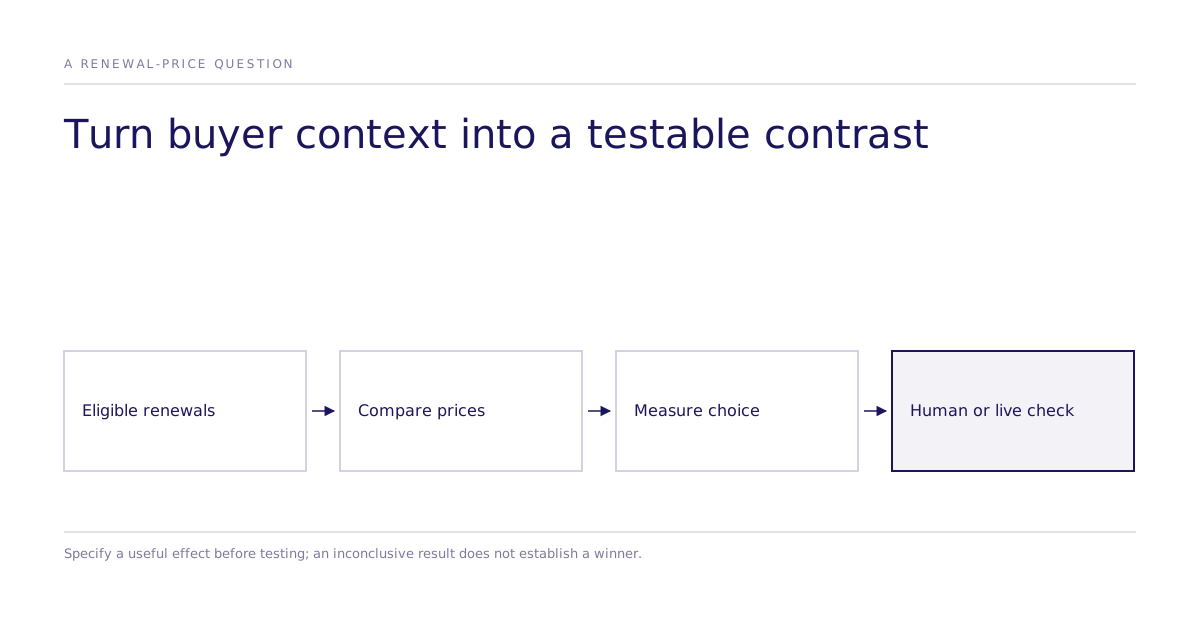
Consider a subscription team testing a price change. Define eligible renewal customers, keep the feature bundle fixed, compare the proposed monthly price with the current price, and measure renewal choice in the study. Specify a minimum useful change before seeing the estimates. An inconclusive result should remain inconclusive. If responses are synthetic, use a matched human study or appropriately designed live test to check transfer before a consequential rollout. Keep the persona brief as context, not the effect estimate. Review study design, worked examples, or scope the comparison.