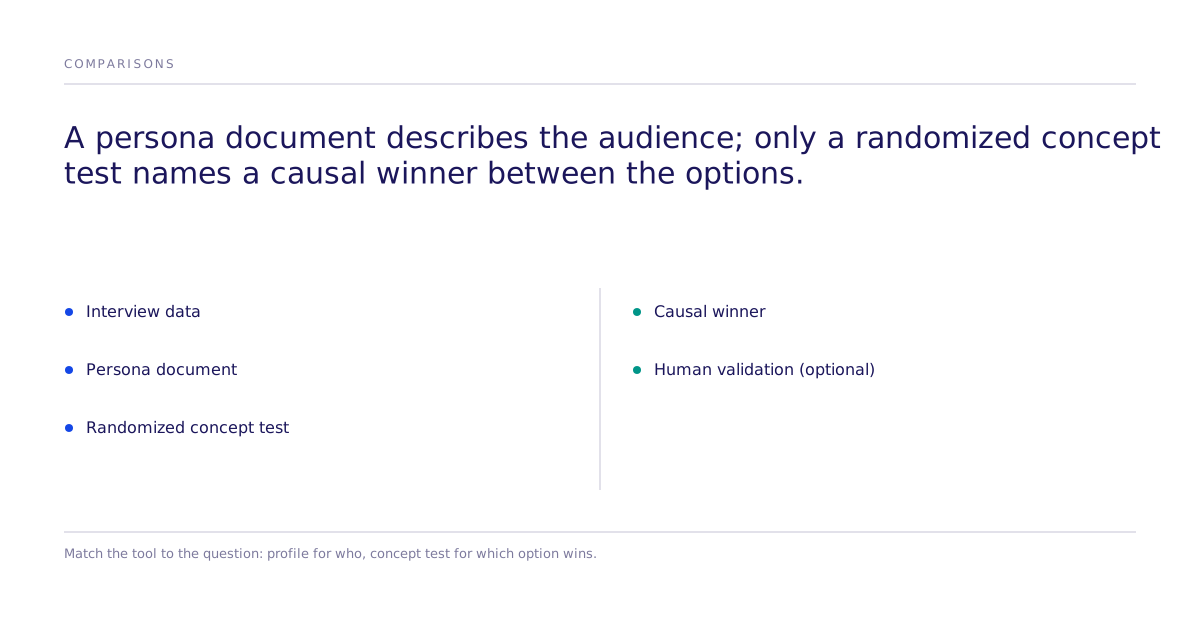
Persona Documents vs. a Randomized Concept Test: Which One Answers Your Question
A persona document tells a marketing or insights team who the audience is. It does not tell the team what happens when message A runs against message B, or which price a buyer actually picks over another. Those are two different jobs, and choosing the wrong tool for the job is how a campaign ships on an assumption that was never tested against an alternative.
Two starting points for understanding an audience
Research tools that build interview-derived persona documents start from a corpus of past interviews or transcripts. They organize what a team already learned into a structured profile: a name, a set of quoted motivations, a summary of pain points. One tool built around this workflow describes itself as turning existing customer-interview datasets into shareable persona profiles.
Tools built for randomized concept testing start from the decision, not the archive. A team defines two or more concrete options, a message, a price, a feature set, a positioning line, and runs a controlled comparison against a simulation of the market to see which option performs better and why. The persona document answers "who is this person." The controlled test answers "which version wins."
What can't a persona document tell you?
A persona document is a description, not an experiment. It can summarize what interviewees said they wanted last quarter. It cannot show a team what a specific new headline does against a specific alternative headline, because no comparison ran. A team that treats a persona's stated preferences as a stand-in for that missing comparison is making a causal claim, "this message will work because this persona would like it," without ever having tested causality.
Comparing the two approaches
| Interview-derived persona document | Randomized concept test | |
|---|---|---|
| Starting material | Past interview or transcript data | Two or more concrete options to compare |
| Primary output | A structured profile of a customer type | A causal result: which option performed better, and why |
| Answers "who is this person" | Yes | Indirectly, as context |
| Answers "which option wins" | No | Yes |
| Requires existing interview data | Yes | No, though interview data can inform the setup |
| Path to real-human confirmation | Not built in | Available as a separate validation step |
How does Subconscious run a controlled comparison against a simulated market?
Subconscious runs randomized experiments that compare concrete options, messages, prices, features, against a simulation of the market and returns which option wins and why, with confidence intervals attached to the result. It is closer to "if we ran this as an A/B test, which version would come out ahead, and how confident should we be." Teams evaluating how the underlying method works can see how a randomized comparison is built before any spend goes into a campaign.
Subconscious can also test or validate studies with real human participants. Publishing the point where simulation hands off to real people is what a buyer checks before betting budget on the result. A team can start with a simulated comparison, then confirm the winning result against a recruited human sample, without changing the underlying causal question, when the decision is consequential enough to warrant that extra step.
When is an interview-derived persona document still the right call?
Choose a persona document when the job really is systematizing a corpus of interviews a team already has, organizing scattered qualitative notes into something shareable across the organization. Stating where a method reaches its edge is what lets a buyer size the decision correctly. A controlled comparison is not a substitute for having talked to customers in the first place.
Making the choice
If the open question is "who are we building for," a persona document built from real interviews answers it directly. If the open question is "which message, price, or concept should we ship," that requires a comparison with an actual winner, not a description of a type of person. Teams that need to see how this fits into a broader research and testing process can review the workflow, or look at documented outcomes from past comparisons before deciding which approach fits the decision in front of them. A team ready to run a controlled comparison against its own concepts can start with a working session.