Persona Panels vs. AI-Led Interviews: What Evidence Supports a GTM Decision?
Persona panels and AI-led interviews can help a team form hypotheses. They do not, by themselves, establish whether a price, message, or launch action caused a behavioral outcome. When budget depends on the answer, require a controlled test of the action. Add real-human validation when the stakes justify it.
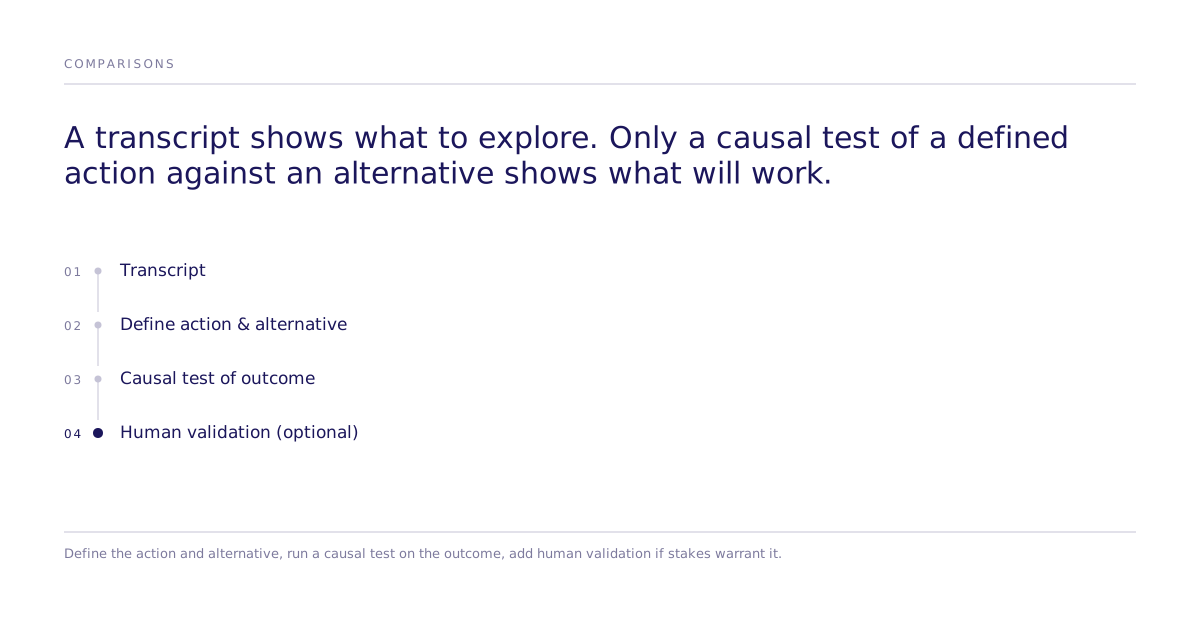
What each research surface can tell you
A simulated panel places several personas in one conversation. Its output is group commentary that a team can inspect, share, or use to generate questions.
An AI-led interview focuses on a 1:1 conversation. The output is a transcript intended to surface stated motivations, language, and decision drivers. One current interview platform describes personas built from deep interviews and a conversational research workflow on its persona simulation page.
Both surfaces can support exploration. Neither isolates the effect of changing one action while holding the rest of the decision constant.
Why Is Fluent Output Mistaken for Proof?
A detailed transcript can feel decisive because the reasoning is coherent. That fluency is not evidence that the modeled population will behave the same way in market.
Before using simulated conversations to approve a pricing, positioning, or launch decision, check for three risks:
- Variance collapse. Are responses converging so tightly that real disagreement may be missing?
- Demographic flattening. Are group differences represented as labels rather than differences in behavior?
- Over-rationality. Are respondents explaining choices more consistently than people tend to act?
These checks define the limit of qualitative exploration, not its worth. A transcript cannot show that the proposed intervention will change behavior.
The decision needs an intervention, an alternative, and an outcome
Subconscious.ai is a causal behavioral platform. It runs controlled experiments on simulated populations to estimate which action moves which outcome. Its live method includes causal experimentation and discrete-choice-style modeling rather than free-form simulated roleplay.
A useful study starts with a specific decision:
- Intervention: the price, message, offer, or launch action under consideration.
- Alternative: the action it must beat.
- Population: the buyers whose behavior matters.
- Outcome: the choice, adoption, trust, or preference the team needs to change.
The research program is organized around that causal question. Subconscious can also test or validate a study with real human participants without changing the causal question.
Choose the evidence that matches the decision
| Decision criterion | Persona panel or AI-led interview | Causal behavioral experiment |
|---|---|---|
| Primary question | What might these simulated characters say or discuss? | Which defined action changes a defined outcome? |
| Output | Group commentary or a 1:1 transcript | A directional comparison across controlled actions |
| Best use | Exploration, language discovery, and hypothesis formation | Pricing, messaging, or launch choices with budget at risk |
| Main limitation | Fluent answers can be mistaken for behavioral evidence | The team must specify the action, alternative, population, and outcome |
| Stronger next proof | Use the transcript to define a testable hypothesis | Validate the same causal question with real human participants |
When Is Open-Ended Conversation the Right Tool?
Choose an interview-style workflow when the job is open-ended qualitative exploration of a simulated character. It can help a team collect motivations, vocabulary, objections, and hypotheses.
Subconscious is not built for that job. It is also not a fully automated pricing optimizer, and it does not replace a defined experiment with an automatic recommendation. Human research remains necessary for discovery, emotional depth, regulated contexts, and real-world confirmation.
Turn the GTM question into a test
Use the transcript to decide what to test, not what to ship. Write the proposed action and its alternative. Name the buyer population and the outcome that would change the decision. Then review how a causal study is built or scope the decision before committing the launch or pricing budget.