Persona Simulation vs. Causal Action Testing: Choosing a Research Method for a Product Decision
A product or research leader comparing synthetic user simulation vendors is really deciding on a method, not a brand. Two claims recur across this category: a stated speed advantage measured in hours rather than months, and a stated accuracy or behavioral-match percentage. Neither claim tells a buyer whether the tool proves what changes behavior or only predicts what people might say. That distinction is the decision this article answers.
What Do Product-Focused Persona Simulation Tools Do?
One common vendor pattern, illustrated by Vectorial, builds synthetic user simulations aimed at product development: which features to build, how to prioritize a roadmap, and how to validate a concept before committing engineering time. A team presents options, the tool simulates user responses, and the output feeds prioritization.
Vendors in this category typically describe their synthetic personas as trained on behavioral data and market a turnaround measured in hours rather than months, alongside a stated accuracy percentage. A vendor benchmark number needs its scope stated to mean anything. Those figures describe how closely a simulated response distribution tracked a prior human sample in the vendor's own test, not a guarantee about the specific product or pricing decision a buyer is about to make.
What Question Do These Tools Not Answer?
A persona simulation can report how a modeled user is likely to respond to a described feature. It does not, by itself, isolate which single change caused a shift in that response, versus everything else that varied in the setup. A model can track how people describe their preferences and still stay silent on what happens when one variable, and only one variable, changes.
For a buyer choosing a research method ahead of a launch, pricing change, or message test, that gap has a real cost. Committing budget to a tool that predicts engagement, then discovering after launch that the modeled response did not hold under real market conditions, is a more expensive failure than a slower research cycle.
Where a randomized experiment changes the answer
Subconscious runs controlled discrete choice experiments, using McFadden discrete choice modeling, Mixed Logit, and ICLV, on a simulation of a target market. The method is built to isolate the causal effect of one action, such as a specific feature, price point, or message, rather than to produce a general-purpose persona a team can converse with. Subconscious can test or validate studies with real human participants, so a team that starts with a simulated experiment can move to real-human validation without changing the underlying causal question.
A speed or cost claim only holds up once its limits are attached. This does not claim Subconscious is faster or cheaper than any specific competitor. It makes Subconscious the fit when the decision on the table needs a causal effect with a confidence interval behind one specific action, not a persona to interview or a stated behavioral-match percentage.
Comparing the two approaches
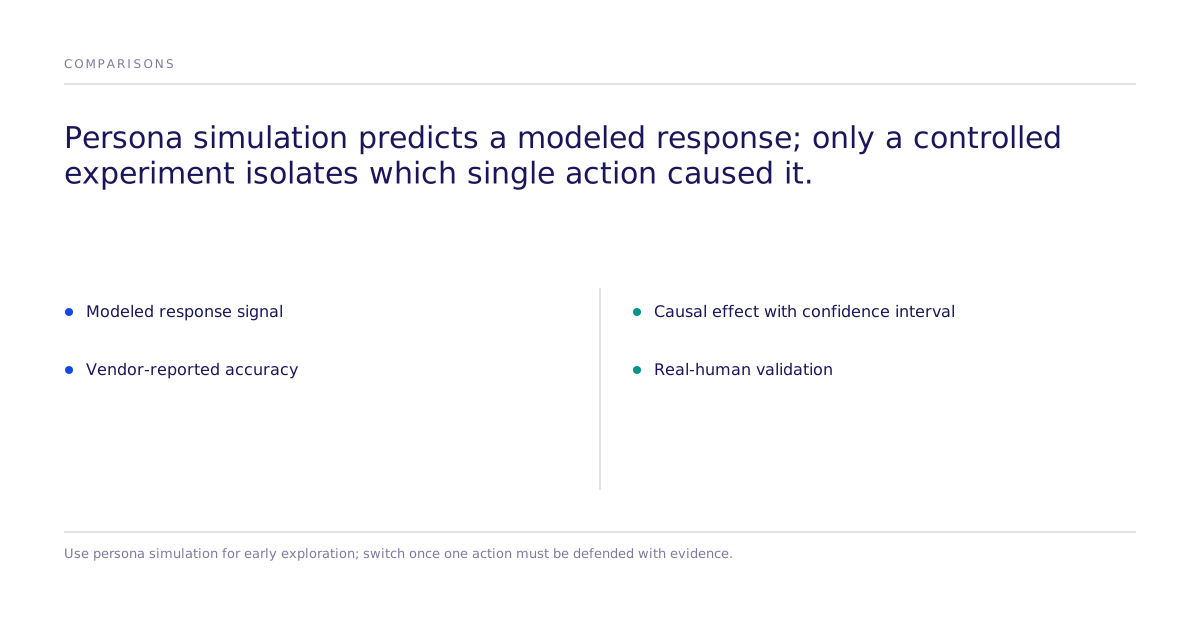
| Persona simulation for product decisions | Subconscious causal action testing | |
|---|---|---|
| Primary question answered | How would a modeled user respond to this option? | Which specific action caused the change in response? |
| Typical output | Simulated response or preference signal | Causal effect estimate with a confidence interval |
| Validation path | Vendor-reported accuracy percentage against a prior sample | Real-human validation of the same causal question |
| Best fit | Early concept and roadmap exploration | A launch, pricing, or message decision where isolating one variable matters |
When Is Persona Simulation the Right First Step?
Exploratory concept work and early roadmap ideation do not always require isolating a single causal variable. If a team needs a fast read on general reaction to a set of options before anything is locked in, a persona-based tool answering how an option would land can be a reasonable starting point. Causal action testing becomes the better fit once a specific decision, such as which price or which feature to ship, needs to be defended with evidence rather than a general impression.
Limitations and failure conditions
Naming where a method stops working is what lets a buyer match it to the right stage. Causal action testing is not a substitute for exploratory qualitative research or open-ended persona interviews, which serve an earlier stage of product thinking. It requires a study designed around one clear action to compare, not an open conversation about a product area. No comparison in this article ranks one commercial vendor as superior to another: the vendor capabilities described above come only from that vendor's own public product pages, and any accuracy or coverage figure a vendor publishes describes their own benchmark.
Practical next step
A team already leaning on persona simulation for early exploration does not need to abandon it. The decision point is the moment a specific action, a price, a feature, a message, needs to ship and the cost of being wrong is real. At that point, review Subconscious's published replication results and get a demo scoped to the exact action under consideration, rather than a general platform walkthrough.