Prototype Feedback or Market Proof: Choosing the Right AI Persona Tool
A product or growth leader picking an AI-persona tool is really asking one question: is this decision about a screen, or is it about the market? Those are different questions, and no single AI-persona tool answers both well.
Two questions get bundled into one buying decision
"Will people get stuck on this screen" and "will people actually buy, switch, or respond to this message" sound related; both get answered with AI personas talking through a scenario. They are not the same decision, and the cost of using the wrong evidence for each is different.
A confusing checkout flow costs conversion and support tickets. A launch, pricing, or positioning bet built on a persona that sounds plausible but was never checked against real human choices can burn a budget cycle, a sales team's time, and credibility with a board that asked for proof, not a transcript.
What tools fit prototype-walkthrough feedback?
Tools built around dropping in a Figma file or a live URL and watching an AI persona click through it answer the first question directly. Uxia is built for exactly that loop: upload a prototype, define a task, and get a walkthrough that reports where the flow breaks, from inside a design workflow. If the research question is "is this UI confusing," a tool shaped around screen-level friction answers it faster than a broader research platform will.
Publishing where a tool stops is what lets a buyer check it against their actual question. What a prototype walkthrough does not do is tell a team whether a market will choose the product, respond to a message, or pay a given price.
What tool fits a causal behavioral test?
Subconscious is the causal AI company. Randomized experiments on a simulation of a market, validated against real human behavior, tell a team why people choose and which action drives the outcome. Instead of asking whether a screen is confusing, it compares alternatives, such as a price, a message, an audience, or a launch claim, and estimates which one moves the outcome.
Subconscious is not a prototype usability tool. It does not do Figma or URL walkthroughs, click-path friction detection, or screen-level UX heatmaps. What it answers instead sits upstream of the screen: which product, pricing, messaging, or launch action is more likely to change buyer behavior before a team commits budget or roadmap capacity.
Why isn't a plausible persona the same as a validated one?
Recent research on using large language models for choice-style tasks found that model outputs can recover plausible attribute signs and rough tradeoffs, but remain sensitive to prompting strategy and struggle with segmentation and individual-level heterogeneity (Can large language models assist choice modelling? Insights into prompting strategies and current models capabilities, arXiv, checked 2026-07-27). That matters for a buying decision: a persona that answers fluently has not necessarily been checked against how people actually choose.
"Our findings reveal that proprietary LLMs can generate valid and behaviourally sound utility specifications, particularly when guided by structured prompts (CoT)."
Sfeir and colleagues, Journal of Choice Modelling (source)
A short decision framework
| Question in front of you | Right kind of evidence | Tool shape that answers it |
|---|---|---|
| Will people get stuck on this screen? | Task-based usability feedback | Prototype walkthrough, screen by screen |
| Will this price, message, or launch claim change buyer behavior? | A controlled comparison of alternatives, checked against human behavior | A causal experiment run on a simulated population |
| Is a plausible-sounding persona answer enough to ship on? | Validation against real outcomes, not just fluent output | Human-baseline replication or real-participant validation |
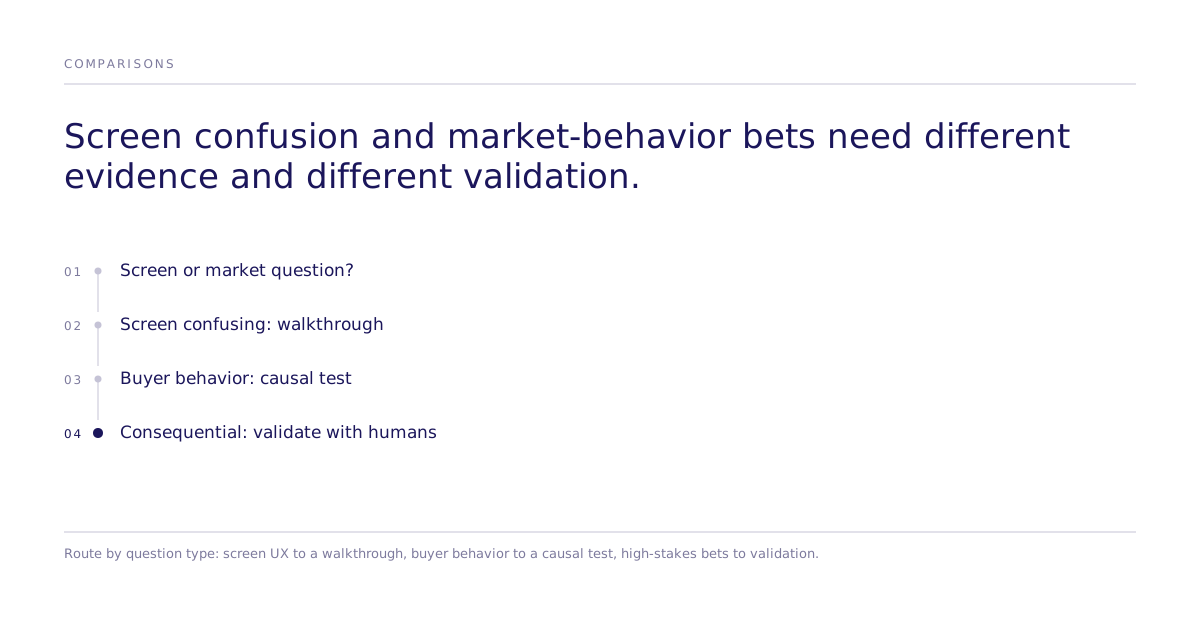
Use this table to route the decision, not to rank the tools. A team often needs both: designers running prototype walkthroughs before a screen ships, and a growth or insights team running a causal test before a price, message, or launch claim ships.
Moving from a simulated read to a validated one
When a decision is consequential enough, the test should not stop at a simulated read. Subconscious can validate studies with real human participants, moving a team from a simulated experiment to real-human validation without changing the underlying causal question. That step matters most for decisions with real budget or reputational exposure, such as a pricing change, a launch claim, or a positioning shift. It matters less for a quick internal read on whether a screen is confusing, where a prototype walkthrough already gives a fast, sufficient answer.
Limitations and where this comparison stops
This is a framework for routing a decision to the right kind of evidence, not a head-to-head product scorecard. A number without its limits reads as marketing. Vendor pricing, published accuracy benchmarks, and compliance claims change quickly and cannot be independently verified here, so none are repeated in this comparison. Subconscious's own methodology centers on controlled experiments and validation against human behavior, not a published accuracy number against any single competitor.
Naming where a tool is the wrong fit is what lets a buyer match it to the right question. Neither tool category replaces the other. A prototype walkthrough tool answers "is this screen confusing" and does not answer "will the market respond." A causal behavioral test answers the market question and is the wrong tool if the only open question is a click-path problem inside a design file.
Where to go next
A team weighing this decision can see the underlying research behind causal behavioral testing, review case evidence from decisions tested this way, or read how the platform works. Teams comparing methods can also check the leaderboard for how simulated results are tracked against real outcomes.