Real-Human Panels vs. Controlled Synthetic Experiments: Choosing a Pre-Launch Validation Method
Before a pricing, concept, or message decision ships, a research or product leader has to pick a validation method: recruit real humans, run a controlled experiment on a simulated population, or do both in sequence. The right choice depends on the decision's stakes and timeline, not on which method is newer.
The cost of picking wrong
Recruiting real humans for every iteration burns weeks and budget on decisions that do not need regulatory-grade evidence. Running simulation alone for a high-stakes, board-facing, or regulator-facing call risks shipping on evidence that was never checked against real human behavior.
What is real-human research built for?
Remesh is one example of this category: a recruited-human research platform, where a live group of real people is convened, and as they answer in their own words, AI clusters those answers into live themes and distills them into one representative voice, replacing manual synthesis a moderator used to do by hand (Remesh: Research Moderation & Data Collection). Recruited human research, whether a traditional facilitated focus group or a larger AI-moderated live discussion, produces qualitative texture and reactive discourse dynamics: people responding to each other in real time, revising positions, surfacing objections nobody anticipated. That dynamic is not something a controlled experiment is designed to reproduce. It is the right tool when a decision is regulator-facing, board-facing, or part of a longitudinal cohort study where the record needs real-respondent provenance.
What is a controlled synthetic experiment built for?
A controlled experiment run on a simulated population is a different instrument, not a faster version of the same one. Instead of asking a group of people what they think of an idea, it exposes a modeled population to controlled alternatives, such as a price, a claim, or a concept, and estimates which alternative moves the target behavior, for which segment, with uncertainty reported where supported. Subconscious runs this kind of study as a causal behavioral platform, answering which action changes an outcome rather than what a sample of respondents says it prefers.
Comparing the two approaches
| Dimension | Recruited real-human panel (e.g. Remesh) | Controlled synthetic experiment (Subconscious) |
|---|---|---|
| Respondents | Real, recruited people | Simulated population |
| What it produces | Qualitative discussion and themes, traceable to real respondents | A causal estimate of which action moves an outcome |
| Regulatory or board-grade evidence | Yes, when properly documented | Not on its own; pair with real-human validation for that record |
| Iteration cost | New recruitment and scheduling each round | Re-run the same causal question without re-recruiting |
| Path to real-human validation | Already real-human | Can escalate to real-human participants on the same causal question |
When is real-human evidence the right call?
Real-human research, live or traditional, is the right choice when the output will be cited to a regulator, a board, or the public and needs real-respondent provenance; when the study is part of longitudinal cohort tracking; and when the decision is a high-stakes brand or strategy pivot where the cost of being wrong justifies the cost and time of recruitment.
Sequencing simulation and real-human validation
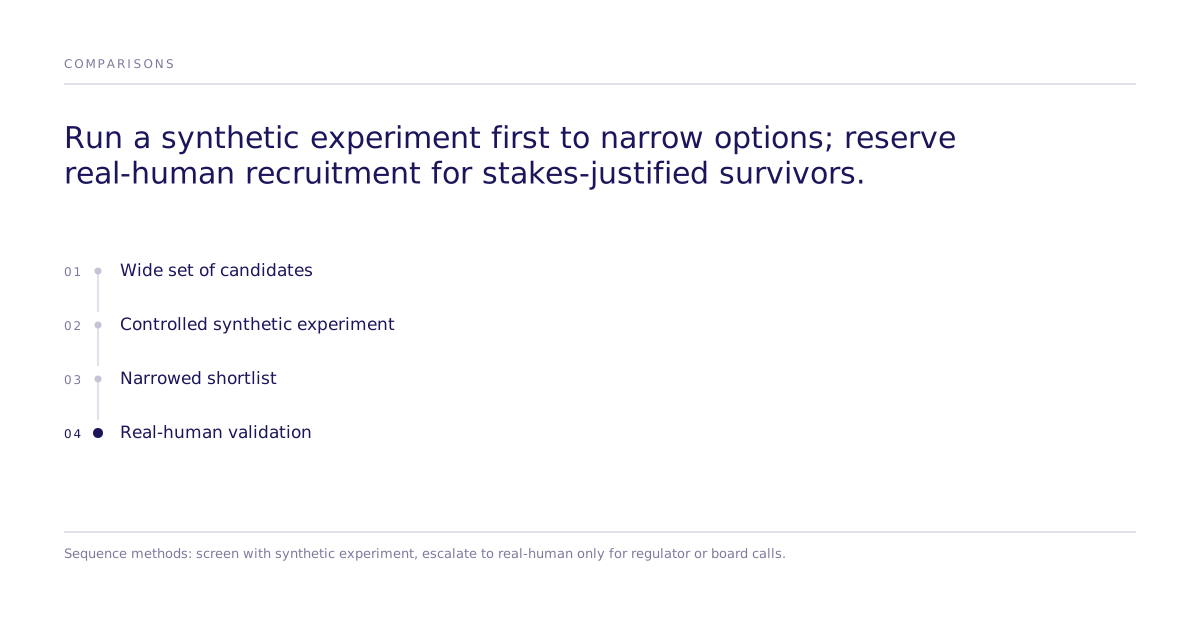
Sophisticated research teams do not treat this as a one-time choice between methods. A common pattern: run a controlled experiment on a simulated population first, to screen concepts, prices, or messages and narrow a wide set of options down to the strongest candidates. Reserve real-human recruitment for the survivors, once a decision's stakes are big enough to earn that cost and speed tradeoff.
This works because Subconscious can test or validate studies with real human participants on the same causal question a simulated experiment already ran, without redesigning the study. Subconscious can also run controlled studies against a person-level audience graph covering 800 million real people, a modeling resource for defining and targeting a population, kept distinct from a recruitable panel of real respondents.
Limits on both sides
A controlled synthetic experiment is only as good as its causal design. Recruited-human panels carry the opposite limit: bounded by how many people can be recruited and scheduled, which makes them a costly way to test many candidate variants before a decision has been narrowed.
Where to start
For most pre-launch pricing, concept, and message decisions, running a controlled synthetic experiment first is the faster path to a defensible shortlist. Escalate to real-human research when the decision's stakes, audience, or regulatory context call for real-respondent provenance. See how Subconscious runs these studies, review case studies, or book time to scope a specific decision.